

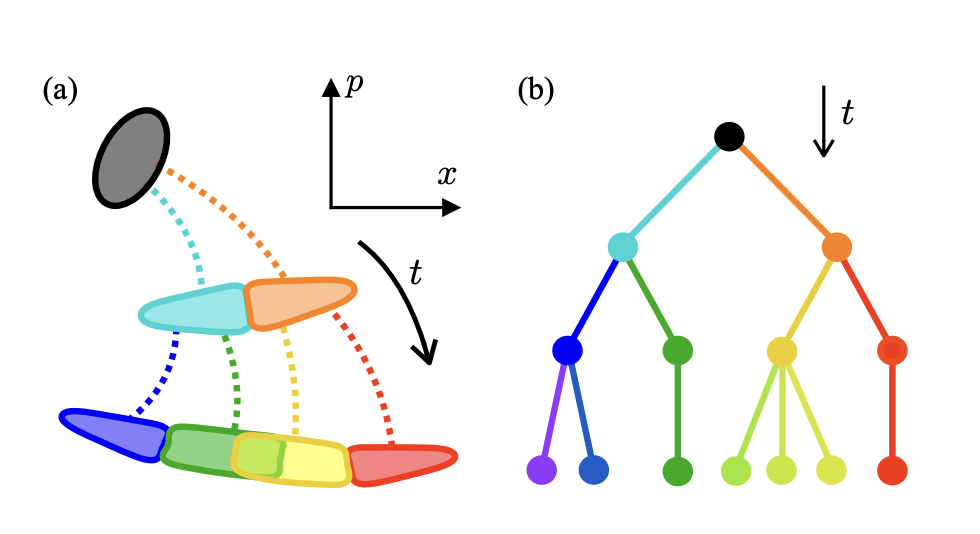
The interpretation of quantum mechanics continues to challenge physicists, particularly concerning the transition from quantum superposition to the definite states observed in macroscopic reality. A central concept in addressing this issue is the notion of ‘wavefunction branches’, theoretical subdivisions of a quantum state that evolve over time and potentially offer a pathway beyond traditional interpretations reliant on measurement and observation.
Recent work seeks to rigorously define these branches, moving beyond the established framework of decoherence, which describes the loss of quantum coherence due to interaction with the environment. C. Jess Riedel, from Physics & Informatics Laboratories at NTT Research, Inc., explores these definitions in a new article entitled ‘Wavefunction branches demand a definition!’, comparing approaches proposed by Taylor & McCulloch and Weingarten, and assessing their strengths and weaknesses in formally characterising these evolving quantum states. Riedel’s analysis focuses on the role of complexity in identifying and maintaining these branches, with implications for both fundamental quantum theory and the potential for efficient classical simulation of quantum systems.
Quantum complexity fundamentally connects wavefunction branching with emergent spacetime geometry, establishing a compelling link between these concepts and redefining our understanding of reality. Investigations into consistent histories and decoherence demonstrate quantum measurements do not necessitate wavefunction collapse, but instead induce branching into multiple possibilities, each representing a distinct outcome. Quantum complexity serves as a quantifiable measure of this branching, with more complex systems exhibiting a greater proliferation of branches and offering a pathway from quantum uncertainty to classical definiteness. Decoherence, a process where quantum systems lose coherence due to interaction with the environment, is thus reinterpreted not as collapse, but as a selection amongst these branches.
This emerging framework challenges traditional decoherence theories by
This emerging framework challenges traditional decoherence theories by moving beyond the system-environment paradigm and proposing a potentially observer-independent definition of measurement. Researchers centre arguments on the idea that complexity within quantum states directly correlates with the stability and persistence of these branches, effectively creating a pathway from quantum uncertainty to classical definiteness. The core proposition revolves around defining wavefunction branches – time-dependent decompositions of quantum states – by their inherent complexity, exhibiting a tree-like structure evolving forward in time and approximating eigenstate behaviour concerning macroscopic observables. Eigenstates represent stable states of a quantum system, and their approximation suggests a move towards classical predictability.
The persistence of these branches over time appears guaranteed by the inherent complexity within quantum states, directly correlating with their stability. Identifying and sampling these branches, when characterised by bounded entanglement – a specific type of quantum correlation – promises efficient classical simulation of quantum systems, offering a significant advancement in computational capabilities. Classical simulation aims to replicate the behaviour of quantum systems using conventional computers, a task typically limited by the exponential growth of computational requirements with system size.
Researchers actively explore the potential of holographic duality, specifically the Anti-de Sitter/Conformal Field Theory (AdS/CFT) correspondence and the Ryu-Takayanagi formula, as a framework for understanding how spacetime itself emerges from quantum information. This exploration suggests a deep connection between the geometry of spacetime and the complexity of the underlying quantum states, potentially revolutionising our understanding of gravity and cosmology. The AdS/CFT correspondence posits a duality between a theory with gravity in a higher-dimensional space (AdS) and a quantum field theory without gravity in a lower-dimensional space (CFT). The Ryu-Takayanagi formula provides a way to calculate the entanglement entropy in the CFT, which is related to the area of a surface in the AdS space.
Researchers propose a framework where spacetime itself may
Researchers propose a framework where spacetime itself may not be fundamental, but rather an emergent property arising from the underlying structure of quantum complexity. Evidence supports the idea that the geometry of spacetime is intrinsically linked to the complexity of the quantum states describing it, potentially offering a novel perspective on gravity and cosmology. This perspective draws heavily on concepts from quantum gravity and string theory, suggesting a deep connection between quantum information and the fundamental structure of the universe. The ability to effectively identify and sample these branches, particularly when exhibiting bounded entanglement, holds the promise of enabling asymptotically efficient classical simulations of complex quantum systems.
Researchers actively investigate the relationship between quantum complexity and the emergence of spacetime, establishing a compelling link between these concepts and redefining our understanding of reality. This approach proposes a new perspective on the quantum-to-classical transition, emphasising the role of complexity, information, and the structure of quantum states. Researchers move beyond traditional decoherence by offering a potentially observer-independent framework for understanding how classical reality arises from the quantum realm, challenging long-held assumptions about the nature of measurement.
Researchers highlight the importance of identifying and characterising wavefunction branches, defined by significant differences in unitary complexity required for interference versus distinction. Unitary complexity refers to the computational resources needed to prepare or manipulate a quantum state, and the distinction between interference and distinction highlights the role of complexity in determining the behaviour of quantum systems.
🗞 Wavefunction branches demand a definition!
🧠 DOI: https://doi.org/10.48550/arXiv.2506.15663


