Understanding the dynamics of quantum systems as they transition between different states remains a central challenge in physics, and recent work by Jia Li and Yajiang Hao from the University of Science and Technology Beijing, along with their colleagues, sheds new light on this process. The team investigates the spatial and temporal scales governing dynamical quantum phase transitions within the Bose-Hubbard model, a key system for understanding interacting quantum particles. Their research demonstrates that sufficiently large subsystems exhibit behaviour mirroring that of the entire system during these transitions, revealing a critical exponent of zero and establishing the necessary parameters for detecting these transitions experimentally. This work provides a crucial foundation for future investigations, bridging theoretical understanding with the potential for real-world observation of these subtle quantum phenomena.
Their research investigates the spatial and temporal scales governing dynamical quantum phase transitions within the Bose-Hubbard model, a key system for understanding interacting quantum particles. This work demonstrates that sufficiently large portions of a quantum system exhibit behaviour mirroring that of the entire system during these transitions, revealing a critical exponent of zero and establishing the necessary parameters for detecting these transitions experimentally. This provides a crucial foundation for future investigations, bridging theoretical understanding with the potential for real-world observation of these subtle quantum phenomena.
Loschmidt Echo Reveals Dynamical Phase Transitions
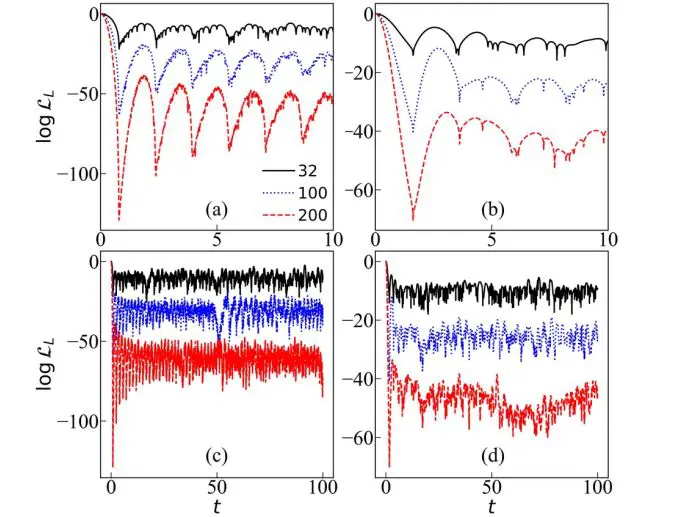
This research investigates dynamical quantum phase transitions in the one-dimensional Bose-Hubbard model, focusing on how these transitions manifest within portions of the larger system. By employing mathematical techniques to calculate time-dependent wavefunctions and the subsystem Loschmidt echo, scientists determined that sufficiently large portions of a quantum system exhibit behaviour mirroring that of the entire system during these transitions, revealing a critical exponent of zero. This work establishes a quantifiable relationship between the size of the observed portion and the ability to detect these transitions, identifying the necessary size and temporal resolution for accurate observation.
The team also addressed the challenges of detecting dynamical phase transitions using measurements of portions of the system, finding that a minimum size is required for observability. This limitation appears to stem from the increasing correlation between particles near the point of transition, hindering the ability of local measurements to capture the global behaviour. Furthermore, the researchers explored the use of the structure factor, a measure of how particles are arranged, as a time-dependent parameter to differentiate between phases before and after the quantum phase transition. They found that changes in the structure factor correlate with Loschmidt echo results and can be extended to portions of the system.
While the structure factor provides a continuously varying function rather than a definitive measurement, it offers a valuable reference point for determining the current phase of the system. The authors acknowledge that the effectiveness of measurements on portions of the system is constrained by size requirements, and that the structure factor provides an indicative, rather than definitive, measure of phase. Future research may focus on exploring alternative measurement techniques or methods to overcome these limitations and improve the detection of dynamical quantum phase transitions in complex systems.
👉 More information
🗞 Spatiotemporal scales of dynamical quantum phase transitions in the Bose-Hubbard model
🧠 ArXiv: https://arxiv.org/abs/2512.11314
The Bose-Hubbard Hamiltonian, which underpins this study, describes the interplay between particle hopping and onsite interaction terms. Specifically, the system Hamiltonian includes terms proportional to the tunneling rate, $J$, and the on-site repulsive interaction strength, $U$. Dynamical phase transitions are typically driven by tuning the ratio $J/U$, a control parameter analogous to varying the interaction potential in a physical setup. Understanding the non-equilibrium dynamics governed by this ratio is crucial, as it dictates how coherently the system evolves following a quench, making it highly relevant for engineering quantum states.
Methodologically, the use of the Loschmidt echo provides a powerful diagnostic tool for non-equilibrium dynamics. Mathematically defined as the overlap between the time-evolved state and the initial state, the echo exponentially decays during periods of strong quantum chaos or rapid phase change. The rate and structure of this decay function are exquisitely sensitive to the underlying quantum correlations, offering a unique window into the system’s information scrambling properties near the critical point, even in limited spatial regions.
The finding of a zero critical exponent suggests a departure from standard mean-field theoretical predictions for critical scaling. Such a result mandates a re-evaluation of how fluctuations, particularly those associated with boundary conditions or finite-size effects, contribute to the system’s macroscopic behavior. It points toward universal behavior that is independent of the specific spatial dimension or lattice geometry, implying a robust, fundamental nature to the observed quantum dynamics.
From an experimental perspective, the Bose-Hubbard model is most readily realized using ultracold atoms trapped in optical lattices. The ability to precisely control the lattice parameters ($J$) and the interatomic interactions ($U$) provides an unparalleled platform for investigating these transitions. Future work will necessarily involve scaling the minimum observable system size, requiring sophisticated techniques to mitigate environmental noise and maintain the required temporal resolution for accurate measurement of the structure factor’s temporal evolution.