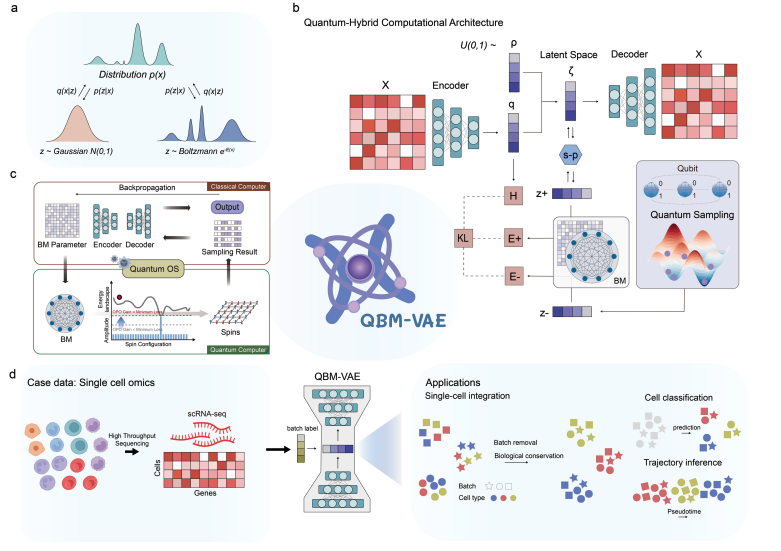
Deep learning models often struggle to accurately represent the complex patterns found in real-world data because they rely on simplified assumptions about probability, limiting their potential for scientific discovery. Feng-ao Wang from Guangzhou National Laboratory, Shaobo Chen and Yao Xuan from Beijing QBoson Quantum Technology Co., Ltd., and colleagues address this limitation by introducing a new framework that harnesses the power of quantum computing. Their research demonstrates a hybrid quantum-classical architecture, the Boltzmann-Variational Autoencoder (QBM-VAE), which uses a quantum processor to efficiently sample from a more realistic probability distribution, overcoming the computational challenges that previously hindered this approach. When applied to large-scale single-cell datasets, the QBM-VAE significantly outperforms conventional deep learning models in critical tasks such as data integration and cell classification, offering a pathway to unlock deeper insights from complex biological data and establishing a transferable model for future hybrid AI development.
RBM-VAE for Single-Cell Data Integration
Researchers have developed a new method, RBM-VAE, to improve the analysis of single-cell RNA sequencing data. This technique combines the strengths of Restricted Boltzmann Machines and Variational Autoencoders to overcome challenges in integrating data from different experiments. Single-cell data is often noisy and affected by variations arising from experimental conditions, making it difficult to obtain a comprehensive understanding of cell types and states. The RBM-VAE method aims to address these issues by learning robust representations of the data and effectively combining information from multiple sources.
The team validated their approach using a diverse set of publicly available datasets, including those focused on immune cells, pancreatic cells, and comprehensive atlases of human lung and ocular tissues. They also incorporated data from bone marrow cells to ensure the method’s broad applicability. This extensive testing demonstrates the method’s ability to generalize across different biological contexts and data types. By comparing RBM-VAE to several established methods for single-cell data integration, the researchers demonstrated its competitive performance. The key innovation lies in the hybrid approach, which combines the unsupervised feature learning capabilities of Restricted Boltzmann Machines with the probabilistic modeling and data generation strengths of Variational Autoencoders. Traditional deep learning models often assume data follows a simple pattern, limiting their ability to accurately represent the intricate patterns found in biological systems. The QBM-VAE instead utilizes a more expressive statistical model, the Boltzmann distribution, to better understand the underlying structure of these complex datasets. This advancement is made possible by a novel computing architecture that combines the strengths of both classical and quantum processors.
The team achieved stable and continuous operation of a quantum processor for over 12 hours with thousands of interconnected processing units, overcoming limitations in current quantum hardware. This sustained stability allows the model to efficiently sample from the Boltzmann distribution, a computationally intensive process that is impractical for classical computers alone. The result is a model capable of generating a more accurate representation of the data, preserving the complex relationships within biological datasets. Evaluations across multiple benchmarks, including data integration, cell-type classification, and cellular development, demonstrate the QBM-VAE’s superior performance. In tests against classical simulated annealing, the quantum hardware significantly outperformed classical computation in solving complex optimization problems, particularly as the scale and complexity of the data increased. The researchers addressed a fundamental limitation of conventional deep models, which rely on simplistic assumptions that fail to capture the complexity of natural data, particularly in biological systems. By leveraging a quantum processor to sample from the more expressive Boltzmann distribution, the QBM-VAE generates representations of the data that better represent complex biological structures, consistently outperforming existing models in tasks such as data integration, cell-type classification, and trajectory inference. The findings establish a practical blueprint for incorporating physically-grounded principles into deep learning, enhancing its ability to model the natural world and potentially unlocking new scientific discoveries. Future research will likely focus on scaling the approach with increasingly powerful quantum processors, with the potential to address problems of even greater complexity as coherent Ising machines continue to increase in scale. This work represents a critical step towards developing AI models that are more insightful, reliable, and grounded in physical reality.
🗞 Quantum-Boosted High-Fidelity Deep Learning
🧠 ArXiv: https://arxiv.org/abs/2508.11190