The looming threat of quantum computers breaking current encryption methods presents a significant challenge to internet security and the infrastructure protecting sensitive data, and researchers are actively seeking solutions to safeguard information in a post-quantum world. Ruwanga Konara, along with colleagues at the University of Sussex, and collaborators, proposes a novel quantum blockchain protocol that combines the strengths of two existing quantum approaches to address this vulnerability. This new system leverages time entanglement and phase encoding to create a blockchain with both absolute security, inherited from time-entangled quantum states, and the scalability needed for practical application, mirroring the efficiency of quantum hypergraph blockchains. The research represents a crucial step towards building a truly secure and efficient blockchain infrastructure capable of withstanding attacks from future quantum computers, potentially revolutionising data security for decades to come
GHZ States Enable Quantum Blockchain Security
This research introduces a novel approach to building a secure and scalable blockchain using principles of quantum mechanics, specifically harnessing the power of quantum entanglement. The core idea revolves around utilizing highly entangled states, known as GHZ states, to create a tamper-evident and fundamentally secure system for recording and verifying transactions. The team proposes leveraging GHZ states and hypergraph states, complex entanglement structures, to represent and link blocks within the blockchain. Quantum entanglement, a phenomenon where two or more particles become linked and share the same fate, acts as the security mechanism; any attempt to alter a block would disrupt this entanglement, immediately revealing malicious activity. This contrasts sharply with classical blockchains, which rely on cryptographic hashing and consensus algorithms vulnerable to increasingly powerful computing attacks.
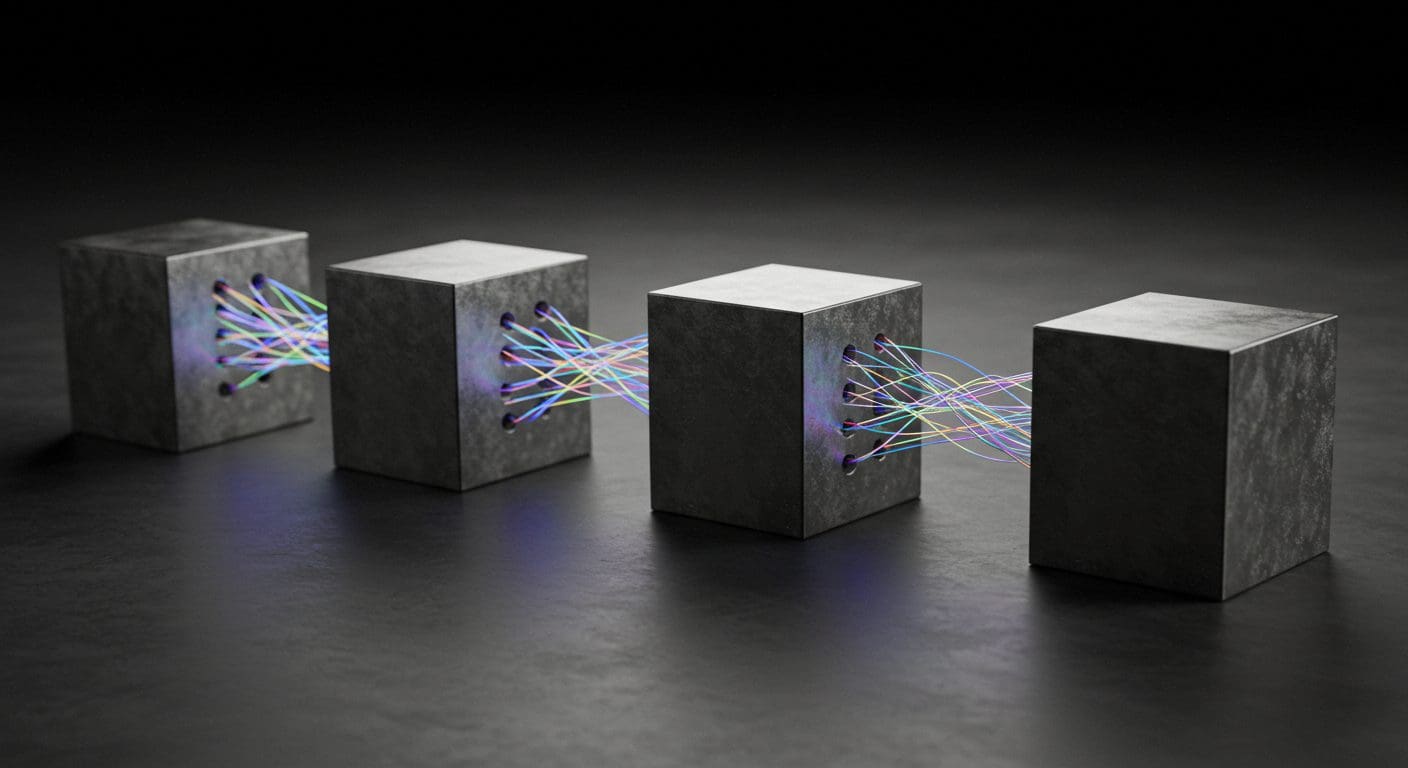
Techniques like quantum teleportation and entanglement swapping are proposed to distribute this entanglement across the network, enabling secure communication and verification between participating nodes. Quantum teleportation, despite its name, does not involve the transfer of matter, but rather the transfer of quantum states between particles using entanglement and classical communication. Entanglement swapping allows the creation of entanglement between particles that have never directly interacted, extending the range of entanglement distribution. The proposed quantum blockchain architecture encodes each block’s data and a record of the previous block using qubits, the quantum analogue of classical bits. Nodes within the network then create and distribute entangled GHZ states, linking the blocks together to form the chain. When a new block is added, its entanglement with the existing chain is rigorously verified through precise measurements of qubit correlations, specifically Bell state measurements. Any disruption to this entanglement signals tampering, as the act of observation collapses the entangled state, immediately alerting the network to the intrusion.
This approach offers a significant departure from traditional blockchains, which rely on computational complexity, instead shifting towards relying on the fundamental laws of physics to secure the blockchain. Representing the relationships between blocks using hypergraph states allows for more complex and flexible blockchain structures, moving beyond the linear chain structure of conventional blockchains. A hypergraph allows multiple edges between nodes, enabling more intricate relationships and potentially improving data storage efficiency. This fundamentally alters the security landscape, making attacks exponentially more difficult, as breaking the entanglement requires violating the laws of quantum mechanics. The research also explores the intriguing possibility of utilizing time-like entanglement, a theoretical concept involving entanglement between the past and future, to further bolster security, though practical realization remains a significant challenge. This concept, if proven viable, could create a blockchain impervious to retroactive attacks.
The team highlights several key contributions, including enhanced security, improved scalability, and the creation of a tamper-evident system. The use of entanglement swapping and quantum teleportation could potentially enable the creation of a scalable quantum blockchain, overcoming limitations of classical systems, which struggle with increasing transaction volumes and network congestion. However, significant technical challenges remain. Generating and distributing high-fidelity GHZ states is a major hurdle, as quantum decoherence, the loss of quantum information due to interaction with the environment, and loss of entanglement pose substantial obstacles. Reliable quantum communication channels and efficient quantum repeaters, devices that extend the range of entanglement distribution, are essential for quantum teleportation and entanglement swapping. These repeaters require quantum memories capable of storing qubits for extended periods, a currently unresolved technological challenge.
Accurate and efficient quantum measurements are also crucial for verifying entanglement and detecting tampering. The precision of these measurements directly impacts the security of the blockchain; imperfect measurements could lead to false positives or missed intrusions. Scaling the quantum blockchain to accommodate a large number of nodes and blocks presents a considerable engineering challenge, as does protecting qubits from errors through quantum error correction, a complex process that requires redundant qubits and sophisticated algorithms. The overhead associated with quantum error correction significantly increases the resource requirements of the blockchain. The potential applications of a quantum blockchain are far-reaching. It could revolutionize secure financial transactions, providing a tamper-proof system for recording and verifying payments, reducing fraud and increasing trust. Supply chain management could benefit from enhanced tracking and verification of goods, ensuring authenticity and preventing counterfeiting, particularly for high-value items.
Secure voting systems could be implemented, offering transparency and preventing fraud, addressing concerns about election integrity. Sensitive data, such as medical records or government secrets, could be protected from unauthorized access and modification, ensuring confidentiality and integrity. Furthermore, quantum blockchains could facilitate secure multi-party computation, allowing parties to jointly compute a function without revealing their individual inputs. This has implications for areas like data privacy and collaborative research. This research presents a compelling vision for a quantum blockchain that leverages the power of quantum entanglement to provide enhanced security and scalability. While substantial technical hurdles remain, particularly in the areas of qubit coherence and quantum communication, the potential benefits are significant, opening up new avenues for exploring the intersection of quantum mechanics and blockchain technology. This work represents a significant step towards realizing a future where quantum principles underpin secure and trustworthy digital systems, potentially ushering in a new era of data security and integrity.
👉 More information
🗞 Time Entangled Quantum Blockchain with Phase Encoding for Classical Data
🧠 DOI: https://doi.org/10.48550/arXiv.2507.14839