Researchers have made a significant breakthrough in automating the preparation and tuning of quantum bits, or qubits, for quantum information processing. A team led by Tomohiro Otsuka, an associate professor at Tohoku University’s Advanced Institute for Materials Research, has successfully demonstrated automatic charge state recognition in quantum dot devices using machine learning techniques.
This achievement brings us closer to realizing large-scale quantum computers. Semiconductor spin qubits, which use semiconductor materials common in traditional electronics, are strong candidates for future qubits due to their compatibility with conventional technology. However, tuning these qubits requires adjusting numerous parameters, a task currently performed by human experts. By developing an estimator capable of classifying charge states using a convolutional neural network and visualization techniques, the researchers have taken a crucial step towards automating this process. This innovation has the potential to significantly accelerate the development of quantum computers.
Automating Quantum Bit Preparation with Machine Learning
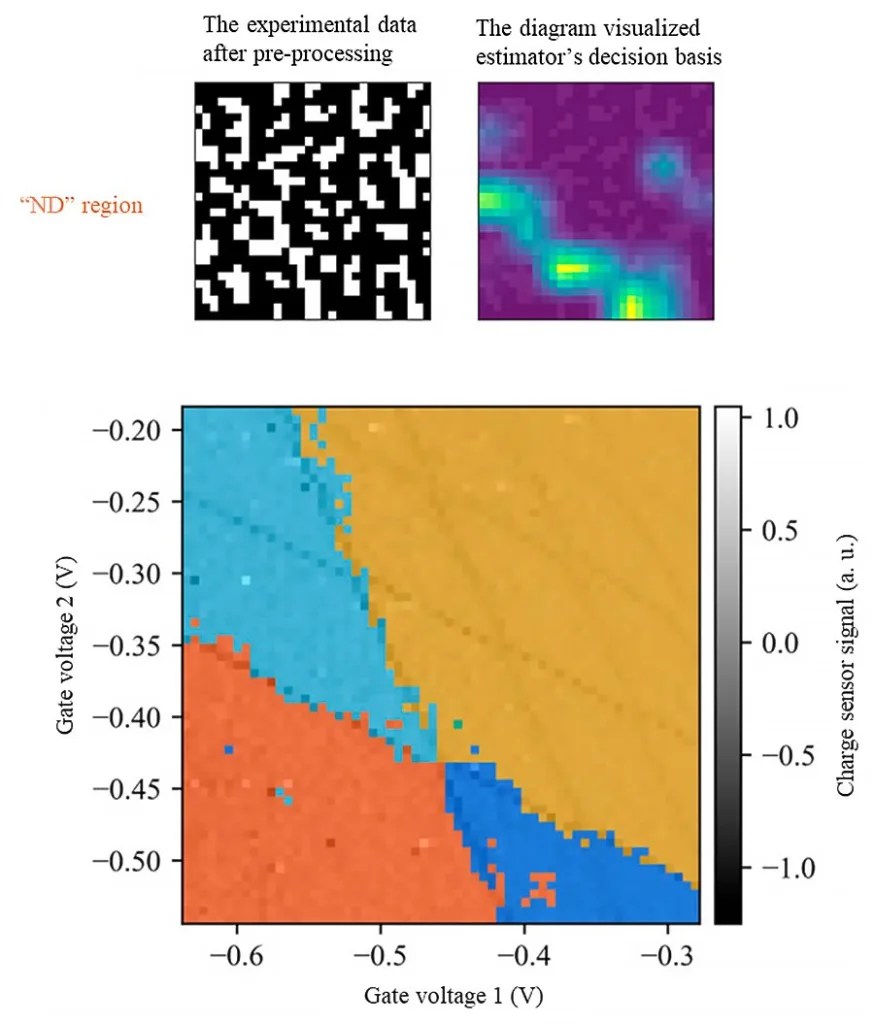
The quest for realizing quantum computers has taken a significant step forward with the successful demonstration of automatic charge state recognition in quantum dot devices using machine learning techniques. Researchers have developed an estimator capable of classifying charge states based on variations in charge transition lines within stability diagrams, paving the way for automating the preparation and tuning of quantum bits (qubits).
Semiconductor qubits, which use semiconductor materials to create quantum bits, are considered strong candidates for future qubits due to their compatibility with conventional semiconductor technology. In these devices, the spin state of an electron confined in a quantum dot serves as the fundamental unit of data or the qubit. However, forming these qubit states requires tuning numerous parameters, such as gate voltage, typically performed by human experts.
As the number of qubits grows, tuning becomes increasingly complex due to the excessive number of parameters. This complexity poses a significant challenge in realizing large-scale quantum computers. To overcome this, researchers have developed an estimator that can automatically estimate charge states in double quantum dots, crucial for creating spin qubits where each quantum dot houses one electron.
Developing the Estimator with Convolutional Neural Networks
The researchers employed a convolutional neural network (CNN) trained on data prepared using a lightweight simulation model: the Constant Interaction model (CI model). Pre-processing techniques were used to enhance data simplicity and noise robustness, optimizing the CNN’s ability to accurately classify charge states. The training data was prepared by simulation using the CI model, and the researchers simplified the data with pre-processing before training the CNN.
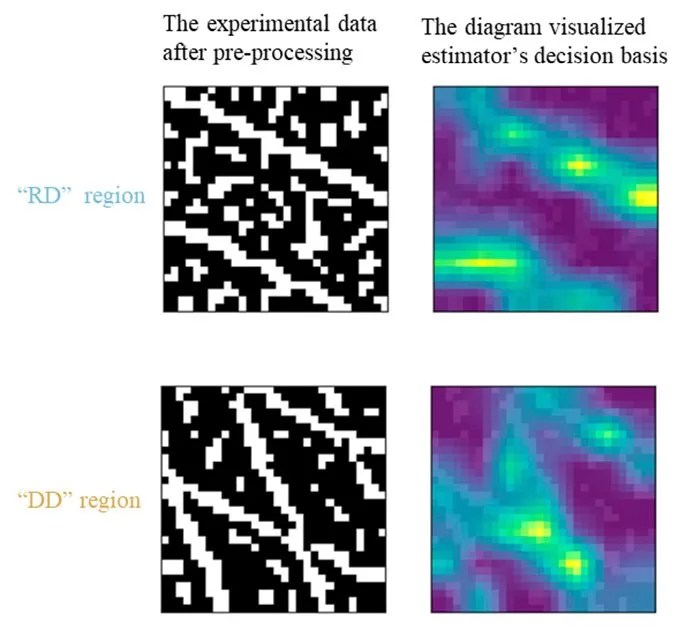
The estimator was tested with experimental data, and initial results showed effective estimation of most charge states, although some states exhibited higher error rates. To address this, the researchers utilized Grad-CAM visualization to uncover decision-making patterns within the estimator. They identified that errors were often attributed to coincidental-connected noise misinterpreted as charge transition lines.
Improving Estimator Performance with Visualization
By adjusting the training data and refining the estimator’s structure, researchers significantly improved accuracy for previously error-prone charge states while maintaining high performance for others. The Grad-CAM visualization technique was instrumental in identifying the decision-making patterns within the estimator, allowing researchers to refine its performance.
The visualization of the estimator’s decision basis revealed that pixels corresponding to the charge transition lines were prominently highlighted, suggesting a possible misidentification as charge transition lines. By addressing these errors, the researchers demonstrated that visualizing the previously black-boxed decision basis can serve as a guideline for improving the estimator’s performance.
Scaling Up Quantum Computers with Automated Tuning
The successful development of an estimator capable of automatically estimating charge states in quantum dot devices marks a significant step towards scaling up quantum computers. By automating the tuning process, researchers can overcome the complexity associated with manual tuning, paving the way for large-scale quantum computing applications.
As noted by Tomohiro Otsuka, associate professor at Tohoku University’s Advanced Institute for Materials Research (WPI-AIMR), “Utilizing this estimator means that parameters for semiconductor spin qubits can be automatically tuned, something necessary if we are to scale up quantum computers.” The research was published in the journal APL Machine Learning on April 15, 2024.
External Link: Click Here For More