The quest to engineer materials with tailored electronic properties has taken a significant step forward with the discovery of massless, chiral fermions within bilayer graphene superlattices, a finding that promises new avenues for controlling quantum transport. Mohit Kumar Jat, Kenji Watanabe, Takashi Taniguchi, and Aveek Bid, from the Indian Institute of Science and the National Institute for Materials Science, demonstrate how precise alignment with hexagonal boron nitride (hBN) induces a unique topological reconstruction of electronic bands. Their experiments reveal that while the main band maintains its characteristics, secondary bands host these unusual massless fermions, exhibiting behaviour confirmed through detailed magnetotransport measurements and Berry phase analysis. This achievement establishes a pathway for manipulating topological quantum transport in these bilayer graphene/hBN superlattices, potentially leading to novel electronic devices and a deeper understanding of quantum materials.
Graphene Moiré Superlattices and Correlated Phenomena
Scientists are exploring graphene and its layered structures, particularly moiré superlattices formed when combined with two-dimensional materials like hexagonal boron nitride. These systems exhibit unusual phenomena, including the quantum and anomalous Hall effects, and the emergence of insulating and superconducting states in specially aligned graphene layers. Researchers also observe topologically protected states with unique band structures and quantum oscillations that reveal details about electron movement within the material. This research highlights the potential of these two-dimensional materials and moiré superlattices as a platform for discovering and engineering new quantum phenomena and electronic properties, paving the way for future electronic devices and fundamental scientific breakthroughs.
Dry Transfer Fabrication of hBN-Encapsulated Bilayer Graphene
Scientists developed a precise method for creating dual-gated devices from bilayer graphene, fully encapsulated within hexagonal boron nitride. This fabrication process utilizes a dry transfer technique to carefully stack layers and induce moiré patterns. Thin flakes of hexagonal boron nitride, bilayer graphene, and graphite were selected based on their optical properties and surface cleanliness, with flakes ranging from 30 to 35 nanometers chosen for device assembly. The process involved carefully stacking layers, including a deliberately misaligned bottom hexagonal boron nitride flake and a graphite flake serving as a bottom gate, before transferring the stack onto a silicon wafer.
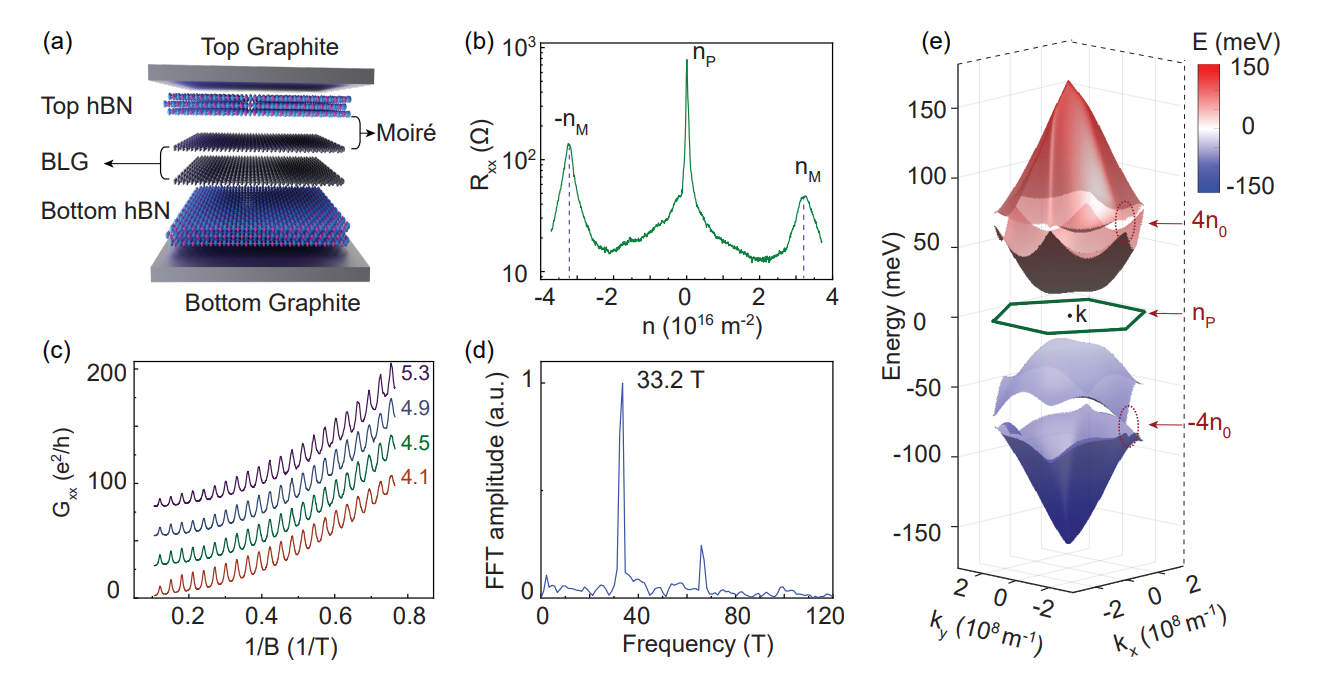
Electrical contacts were patterned and etched to create a Hall bar geometry, and the device was completed with a final layer of graphite and hexagonal boron nitride, creating a clean and electrostatically stable environment. Resistance measurements at low temperatures revealed the presence of a moiré superlattice, with wavelengths of 12 and 12. 4 nanometers corresponding to twist angles of 0. 60 and 0. 55 degrees, confirmed by magnetotransport measurements.
Moiré Alignment Creates Unique Graphene Bands
This research demonstrates how precise alignment of hexagonal boron nitride with bilayer graphene fundamentally alters the electronic band structure, creating unique quantum transport properties. Scientists fabricated heterostructures using a dry transfer technique, carefully aligning the top hexagonal boron nitride layer to within one degree of the bilayer graphene, while intentionally misaligning the bottom layer. This alignment creates a moiré superlattice with a wavelength of 12 nanometers, corresponding to a twist angle of 0. 60 degrees. Experiments reveal the emergence of secondary bands in the bilayer graphene, a consequence of moiré-induced band splitting.
Magnetotransport measurements confirm the distinct topological nature of these secondary bands, exhibiting a Dirac-like band topology contrasting with the primary bilayer graphene band. Magnetoresistance measurements show Landau fan patterns emerging from both bands, but the secondary band’s resistance minima occur at half-integer Landau level filling factors, reminiscent of massless Dirac fermions. Analysis of temperature-dependent oscillations allows extraction of the effective mass of both bands, confirming their topological distinction.
Chiral Fermions and Band Structure Engineering
This research demonstrates how carefully constructed superlattices of bilayer graphene and hexagonal boron nitride reshape electronic band structures and topologies. Through detailed magnetotransport measurements, scientists established that these superlattices host both massive and massless chiral fermions. Specifically, the primary bands retain characteristics of bilayer graphene, while the secondary bands exhibit behaviour consistent with massless Dirac fermions, corroborated by analysis of the Berry phase. The team observed a significant reduction in Fermi velocity within the secondary bands, indicating that the moiré potential induced by the hexagonal boron nitride leads to band flattening. This coexistence of Dirac and massive quasiparticles within a single system offers a unique platform for investigating the interplay between these fundamental particle types and exploring novel quantum transport phenomena, potentially leading to tunable correlated phases.
🗞 Emergent Massless Dirac Fermions in Moiré Bands of Bilayer Graphene/hBN Superlattice
🧠 ArXiv: https://arxiv.org/abs/2510.20309