

Quantum atomic sensors, used in vacuum metrology, measure the density of gas particles in a vacuum by observing the collision rate between particles and sensor atoms. However, discrepancies have been noted in the methods used to determine the total collision rate coefficient. A study was conducted to investigate these discrepancies using a model-free method, which showed results systematically different by 3 to 4 percent from recent measurements. This research has significant implications for the field of quantum atomic sensors, demonstrating a more reliable method for transferring the primacy of one atomic standard to another sensor atom.
What are Quantum Atomic Sensors and How Do They Work?
Quantum atomic sensors are a promising technology for vacuum metrology, the science of measuring vacuum or empty space. These sensors work by determining the density of gas particles in a vacuum. This is achieved by measuring the collision rate between the particles and an ensemble of sensor atoms. The sensor atoms are prepared in a specific quantum state, and the rate of changes in this state is observed. The total collision rate coefficient, a measure of the frequency of state-changing collisions, is then used to convert the rate into a corresponding density.
The total collision rate coefficient can be determined through various methods. These include quantum scattering calculations, which use a computed interaction potential for the collision pair, measurements of the post-collision sensor-atom momentum recoil distribution, or empirical measurements of the collision rate at a known density. However, discrepancies have been observed between the results of these methods, raising questions about their accuracy.
What is the Cross-Calibration of Quantum Atomic Sensors?
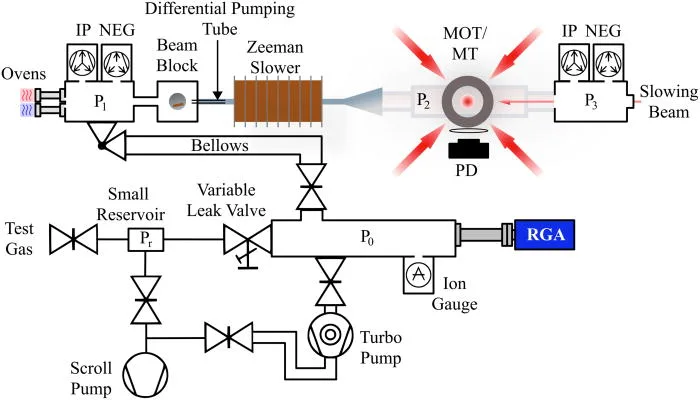
To investigate the discrepancies in the methods used to determine the total collision rate coefficient, a study was conducted on the ratio of collision rate measurements of co-located sensor atoms, specifically 87Rb and 6Li, exposed to natural abundance versions of H2, He, N2, Ne, Ar, Kr, and Xe gases. This method does not require knowledge of the test gas density and is therefore free of the systematic errors inherent in efforts to introduce the test gas at a known density.
The results of this study were systematically different at the level of 3 to 4 percent from recent theoretical and experimental measurements. This work demonstrates a model-free method for transferring the primacy of one atomic standard to another sensor atom and highlights the utility of sensor atom cross-calibration experiments to check the validity of direct measurements and theoretical predictions.
What is the Significance of Ensembles of Cold Atoms in Quantum Atomic Sensors?
Ensembles of cold atoms have been proposed and investigated as drift-free sensors of absolute pressure and particle flux measurements in vacuum and at ambient temperatures. The number density of the gas species at a certain temperature can be determined by measuring the collision rate between the sensor atoms and the ambient atoms and molecules.
The total collision rate coefficient is the product of the relative collision speed and the speed-dependent total collision cross-section. For collisions between gas particles at room temperature and a laser-cooled sensor atom ensemble, the relative speeds are well-approximated by the Maxwell Boltzmann (MB) velocity distribution of the gas. To determine the number density at a certain temperature, the total collision rate coefficient must be known.
How are Quantum Scattering Calculations Used in Quantum Atomic Sensors?
Quantum scattering calculations are used to determine the total collision rate coefficients. These computations rely on electronic potential energy surfaces (PESs), which must be determined by ab initio quantum chemistry computations. However, accurate PESs may be limited to molecular species with a small number of active degrees of freedom.
Alternatively, empirical estimates of the total collision rate coefficients can be obtained from measurements with a gas of known density. This approach is limited to gas species compatible with the operation of existing orifice flow pressure standards.
What is the Quantum Diffractive Collision Universality Law?
A third method for determining the total collision rate coefficient involves using the sensor atom collision recoil energy or momentum distribution. This method is based on the quantum diffractive collision universality law. The validity of this approach was previously shown for heavy collision partners, but deviations from the universality law were found for low mass test species.
The results of these three methods have been found to agree at the level of a few percent, with the exception of a few special cases. Understanding the reasons for the observed disagreements is essential.
What is the Fourth Method for Validating Prior Theoretical and Experimental Work?
The main goal of this work is to report the results of a fourth method for validating prior theoretical and experimental work. This method involves direct experimental comparisons of the total collision rate coefficients of co-located cold ensembles of 87Rb and 6Li atoms exposed to the test gas species H2, He, Ne, N2, Ar, Kr, and Xe.
This method of comparing the total collision rate coefficients is model-independent and is free of some of the systematic errors inherent in other methods. In particular, the fact that the two sensor atom traps are co-located ensures that they are both exposed to the same baseline environment and the same test gas density.
What are the Implications of this Research?
The results of this research have significant implications for the field of quantum atomic sensors. The study demonstrates a model-free method for transferring the primacy of one atomic standard to another sensor atom. This method is free of some of the systematic errors inherent in other methods, making it a more reliable approach.
Furthermore, the research highlights the utility of sensor atom cross-calibration experiments to check the validity of direct measurements and theoretical predictions. This could lead to more accurate and reliable measurements in vacuum metrology, improving the performance and reliability of quantum atomic sensors.
Publication Date: 2024-05-10
Authors: Erik Frieling, Riley A. Stewart, James L. Booth, Kirk W. Madison, et al.
Source: AVS quantum science
DOI: https://doi.org/10.1116/5.0198849


