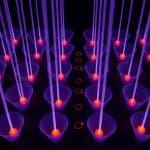
Quantum Art, a company originating from research at the Weizmann Institute of Science, has announced a product roadmap targeting commercially viable quantum computing. The company, which develops full-stack quantum computers based on trapped-ion qubits, aims to achieve a 50-qubit system in 2025, 1,000 qubits with commercial quantum advantage by 2027, and a 1 million physical qubit system by 2033. This progression will be delivered through a series of systems – Montage, Perspective, Landscape, and Mosaic – and relies on an architecture focused on multi-qubit gates, optical segmentation, dynamic reconfiguration, and modular 2D structures to improve qubit density and operational speed.
Quantum Art pursues scalable quantum computing through a focused architectural strategy, aiming to overcome limitations inherent in traditional designs. The company prioritizes coherence and scalability with four key technological pillars, driving innovation in qubit control and system architecture. Quantum Art envisions a future where quantum computers tackle complex problems currently intractable for classical machines, and their roadmap demonstrates a clear path toward achieving this ambitious goal. The company is committed to responsible innovation, ensuring that quantum technologies are used for the benefit of humanity.
The core of Quantum Art’s innovation lies in its four technological pillars. Multi-qubit gates reduce computational time and complexity. Modular design and optical segmentation maintain coherence across large numbers of ions. Dynamic reconfiguration optimizes entanglement generation and distribution for specific algorithms.

Quantum Art’s architectural roadmap unfolds across three distinct series: Perspective, Landscape, and Mosaic, each building upon the advancements of the previous generation. The Perspective series, slated for release in 2027, represents a critical step toward demonstrating commercial quantum advantage with a 1,000 physical qubit system and up to 100 logical qubits. This system aims to surpass the capabilities of classical computers for specific, computationally intensive tasks, opening doors to new discoveries in fields like materials science, drug discovery, and financial modeling.
The Landscape series further refines this foundation, aiming to enhance system performance. Optical segmentation maintains coherence across large numbers of ions by dividing long ion chains into independently operating cores. Dynamic reconfiguration optimizes entanglement generation and distribution for specific algorithms, ensuring the system adapts to diverse computational needs. This architectural strategy, rooted in two decades of research at the Weizmann Institute of Science, focuses on coherent control methods for implementing robust multi-qubit gates.
Quantum Art’s commitment to innovation extends to the Mosaic series, projected for 2033, which targets a 1 million physical qubit system within a compact 50x50mm footprint. This ambitious goal aims to enable fully fault-tolerant quantum computing, addressing inherent error rates in quantum systems through redundancy and error correction protocols. The company confidently claims its architecture will deliver systems with increased gate speeds and parallel operations, alongside a reduced footprint compared to competitor roadmaps. Mosaic represents the culmination of Quantum Art’s vision, promising a quantum computer capable of tackling the most challenging computational problems.
Quantum Art’s commitment to innovation extends beyond hardware, encompassing software and algorithms designed to optimize quantum computations. The company develops specialized programming languages and tools that simplify the development of quantum applications and actively contributes to the open-source quantum computing community, sharing its knowledge and expertise with researchers and developers worldwide. Quantum Art actively engages with policymakers and stakeholders to shape the future of quantum computing.
Quantum Art’s long-term vision is to create a future where quantum computers are accessible to everyone, empowering scientists, engineers, and innovators to solve the world’s most pressing challenges. The company is committed to responsible innovation, ensuring that quantum technologies are used for the benefit of humanity.
More information
External Link: Click Here For More