

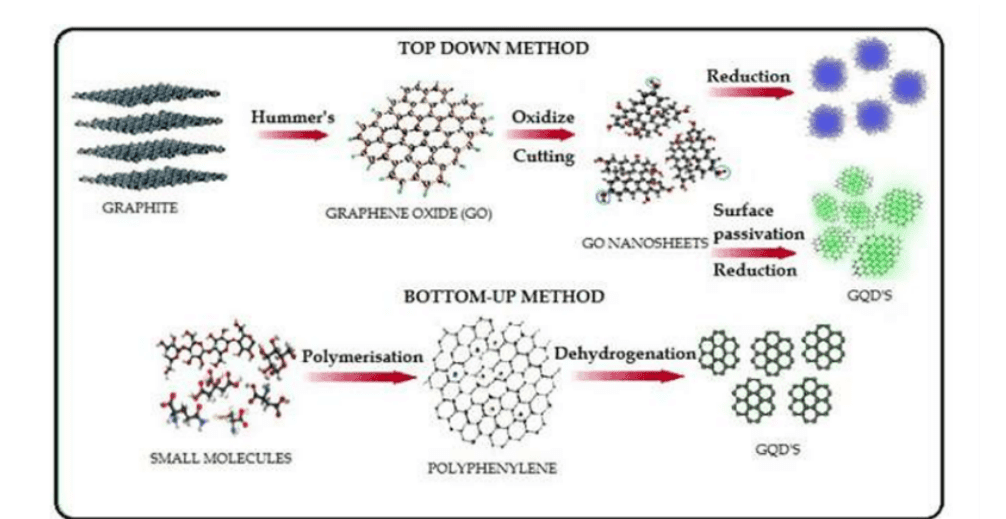
Graphene quantum dots, nanoscale fragments of carbon with exceptional light-emitting and electrical characteristics, represent a significant advance in nanotechnology, and a team led by Kumar Gautam, Kumar Shubham, and Hitesh Sharma are pioneering their development. Traditional quantum dots often contain toxic materials and suffer from instability, limiting their applications, but these graphene-based alternatives offer a safer and more robust solution. The researchers demonstrate the potential of these quantum dots for a wide range of applications, from highly sensitive biosensors and real-time food safety monitoring to innovative smart packaging, all crucial for reducing food waste and improving sustainability. This work highlights the growing importance of graphene quantum dots, not only for practical applications but also as a key component in future quantum technologies and advanced electronic devices.
These GQDs, derived from carbon, demonstrate comparable performance to conventional materials while overcoming concerns about toxicity and environmental impact, opening doors for applications in biosensing, food safety, and environmental monitoring. Research focuses on harnessing the unique optical and electronic properties of GQDs, integrating them into advanced sensor architectures to achieve highly sensitive and selective detection of target substances. Traditional quantum dots, often cadmium-based, require precise synthesis conditions and utilize potentially harmful precursors.
GQDs, however, can be produced through environmentally friendly methods, either by breaking down larger graphene structures or by building them up from small carbon-based molecules like sugars and amino acids. These methods are often cost-effective and sustainable, making GQDs an attractive option for large-scale production. GQDs excel in biosensing applications, offering lower toxicity and improved biocompatibility for use within living systems. Their fluorescence responds to changes in their environment, allowing for the detection of proteins, DNA, and other biomolecules. Furthermore, GQDs enhance electron transfer, boosting the sensitivity of electrochemical sensors and enabling the simultaneous detection of multiple targets, a process known as multiplexed sensing.
In food safety, GQDs demonstrate exceptional sensitivity in detecting mycotoxins like aflatoxin B1, achieving detection limits significantly lower than conventional methods, at 0. 158ng/mL. They also effectively detect heavy metals at nanomolar concentrations, crucial for environmental monitoring, and identify proteins and nucleic acids associated with various diseases. These sensors offer rapid response times, often under 15 seconds, enabling real-time monitoring of critical parameters. GQDs offer several key advantages over traditional materials, including high sensitivity, rapid response, multiplexing capability, biocompatibility, and cost-effectiveness.
They are also chemically and photochemically stable and easily functionalized, allowing for tailored surface chemistry for specific applications. Their compatibility with existing analytical platforms and the Internet of Things (IoT) facilitates real-time monitoring and data analysis. Future research directions include utilizing GQDs in quantum sensing platforms to improve signal-to-noise ratios, employing artificial intelligence to analyze sensor data for pattern recognition, and developing self-powered, autonomous sensor networks for continuous monitoring. GQDs also hold promise for personalized medicine, enabling early disease detection and tailored treatment strategies.
Establishing standardized synthesis protocols and regulatory guidelines will be crucial for widespread clinical and commercial adoption. GQDs represent a significant advancement in biosensor technology, offering a compelling alternative to traditional quantum dots. Their unique combination of quantum confinement effects, high surface-to-volume ratios, tunable bandgaps, and exceptional biocompatibility positions them as a transformative tool for a wide range of applications, including environmental monitoring, food safety, and personalized medicine. Ongoing research and development promise to unlock even greater potential for GQDs in the future.
Graphene Quantum Dots for Sensitive Analyte Detection
Scientists are pioneering the use of graphene quantum dots (GQDs) as a versatile platform for advanced sensing technologies, demonstrating performance exceeding traditional quantum dots and enabling applications from food safety to environmental monitoring. The research centers on harnessing the unique optical and electronic properties of GQDs, nanoscale structures composed of a honeycomb lattice of carbon atoms. GQDs are synthesized and then integrated into a variety of sensor architectures, including aptamer-based immunosensors and electrochemical sensors, to achieve highly sensitive and selective detection of target substances. For food safety applications, researchers developed GQD-based immunosensors capable of detecting aflatoxin B1 in contaminated maize at levels as low as 0.
05ng/g, a value over two orders of magnitude below regulatory thresholds established by both the FSSAI and EU standards. These aptamer-functionalized GQDs exhibit excellent reproducibility with relative standard deviations below 5% and recovery rates ranging from 80. 2 to 98. 3% in complex food matrices. Further refinement using GQD/AuNP nanocomposites pushed the detection limit for aflatoxin B1 down to 0.
008ng/mL in maize, while maintaining 94% current signal retention after four weeks of storage at 4°C. Beyond food safety, GQDs demonstrate exceptional performance in environmental monitoring, enabling the detection of heavy metals like Pb2+ at concentrations as low as 0. 6 nM with response times of just 3 seconds. The team integrated GQDs into polyimide composites to create humidity sensors exhibiting a 96. 36% improvement in sensitivity compared to conventional sensors, with response times of 15 seconds.
Furthermore, GQD-ZnO nanocomposites detect carbon monoxide across a range of 1-100 ppm with 90% accuracy. These sensors are designed for deployment within Internet of Things (IoT) platforms, enabling real-time monitoring of grain warehouses and automated control of ventilation systems when environmental thresholds, such as humidity exceeding 70% or temperature exceeding 25°C, are surpassed. Looking towards future advancements, the research explores the integration of GQDs with quantum-optimized sensor networks, utilizing algorithms like Quantum Particle Swarm Optimization (QPSO) to optimize sensor placement and reduce node requirements by up to 70% in large-scale facilities. QPSO also reduces data transmission energy consumption by 40% compared to classical methods, while the Quantum Approximate Optimization Algorithm (QAOA) prioritizes data routing from high-risk zones, enhancing the efficiency and responsiveness of the sensing ecosystem. Importantly, GQDs offer a significant cost advantage, with material costs ranging from $10-50/g compared to $100-500/g for traditional CdTe quantum dots, making them a viable and sustainable solution for a wide range of sensing applications.
Size-Dependent Band Gap in Graphene Quantum Dots
Scientists are pioneering the development of graphene quantum dots (GQDs), nanoscale fragments of graphene exhibiting remarkable properties due to quantum confinement. These GQDs, differing from traditional quantum dots like cadmium telluride, offer enhanced stability, biocompatibility, and tunable band gaps, making them ideal for diverse applications including biosensing, food safety monitoring, and advanced electronic devices. The research demonstrates that confining graphene to nanoscale dimensions results in a size-dependent band gap, a critical factor in tailoring their optoelectronic properties. Experiments reveal that the band gap of GQDs is inversely proportional to their size, allowing for precise control over their electronic and optical behavior. Specifically, GQDs with diameters of 7 and 8 nanometers exhibit metallic behavior, while the energy gap decreases as the number of graphene layers increases.
👉 More information
🗞 Realization of Graphene Quantum Dots for Innovative Biosensor Development and Diverse Applications
🧠 ArXiv: https://arxiv.org/abs/2509.20547


