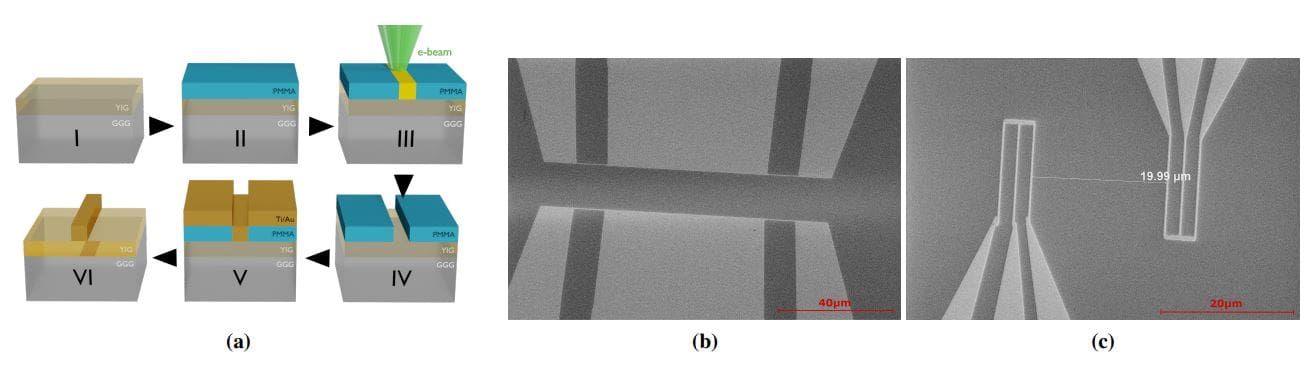
The efficient generation and detection of spin waves underpin advances in both conventional and quantum magnonics, and researchers are continually seeking ways to improve these processes. Andreas Höfinger, Andrey A. Voronov, and David Schmoll, all from the University of Vienna, alongside Sabri Koraltan and Florian Bruckner from TU Wien and Claas Abert from the University of Vienna, have now established a comprehensive framework for all-electrical propagating spin-wave spectroscopy, directly linking realistic electromagnetic fields to the dynamic behaviour of magnetic materials. Their work demonstrates how the design of nanoantennas critically shapes the spectrum of generated spin waves, acting as a tunable filter in ‘k-space’ and enabling precise control over their direction and wavelength. By accurately modelling the interaction between nanoantennas and magnetic films, the team not only achieves quantitative agreement with experimental results, but also provides actionable design rules for creating low-power magnonic devices with potential applications in future quantum technologies.
K-Selective Magnon Excitation with Nanoantennas
Researchers are investigating efficient conversion of electrical signals into spin waves, known as magnons, using nanoantennas designed to generate specific spin wave directions. This work focuses on achieving k-selective excitation, where generated spin waves propagate in a defined direction, crucial for advanced magnonic devices. The team presents a detailed study of nanoantennas with realistic field distributions, moving beyond simplified models often used in this field. The investigation demonstrates that carefully engineered nanoantennas can achieve k-selective excitation of magnons, with the generated spin waves exhibiting a dominant direction determined by the antenna’s design. Simulations reveal that the electric field distribution within the nanoantenna directly controls the direction of the emitted magnons, allowing precise control over spin wave propagation. The results show that tailoring the nanoantenna’s shape and composition significantly enhances k-selectivity and overall efficiency of electrical-to-magnon conversion, providing a detailed understanding of how nanoantenna design, electric field distribution, and magnon excitation are interconnected, paving the way for advanced magnonic devices.
Electrical Excitation of Propagating Spin Waves
Researchers are developing a framework for all-electrical propagating spin-wave spectroscopy, linking realistic electromagnetic fields from nanoantennas to the dynamic behaviour of spin waves within yttrium-iron-garnet films. This establishes a method for studying and controlling spin waves using only electrical signals. Finite-element simulations compute the electromagnetic fields generated by nanoantennas, accurately modelling their geometry and material properties. These calculated fields drive micromagnetic simulations, which solve equations describing the magnetisation response of the material. This method involves a full-wave electromagnetic solver coupled to a micromagnetic solver, allowing a self-consistent calculation of spin-wave excitation and propagation, accurately capturing the spatial distribution of the driving fields and their influence on magnetisation dynamics.
YIG Films and Spin Wave Fundamentals
Current research in magnonics builds upon fundamental understanding of materials and wave behaviour. Yttrium Iron Garnet, or YIG, is a dominant material due to its low energy loss, and many studies focus on optimising YIG films and structures. Early work by Kalinikos and Slavin established foundational theories of spin wave dispersion in thin films, while Vlaminck and Bailleul provided initial modelling of spin wave transduction. Researchers are also exploring magnetic thin film insulators, exhibiting ultra-low damping, crucial for long-distance spin wave propagation. Simulation tools provide frameworks for micromagnetic modelling, essential for designing and analysing magnonic devices.
These foundational studies enable basic understanding of spin wave behaviour, material selection, and initial device design. Current research focuses on controlling spin wave propagation using microstructured waveguides. A major theme is the development of efficient spin wave transducers, converting microwave signals into spin waves and vice versa. Researchers are also developing directional couplers for logic gates, and exploring frequency multiplexing, allowing multiple signals on a single spin wave channel, and creating non-reciprocal propagation, crucial for isolators and circulators. These advancements enable creation of spin wave channels, control over their direction, and increased information density, building blocks for more complex devices.
Research is progressing in magnonic logic and computing, with prototypes of spin-wave majority gates and other logic functions demonstrated. Majority gates are key building blocks for reversible computing. Researchers are building more complex circuits from these basic gates. These advancements enable performing computations using spin waves instead of electrons, potentially leading to lower power consumption and faster processing. Emerging areas of research include the magnonic Hong-Ou-Mandel effect, exploring quantum-like interference effects with spin waves, and exploring achieving Bose-Einstein condensation of magnons for novel quantum effects. Key trends include miniaturization, integration with conventional electronics, non-reciprocity, quantum effects, and increasingly sophisticated simulation and modelling tools. This is a very active field of research, demonstrating the potential for a new generation of low-power, high-speed electronic and photonic devices.
Antenna Design Predicts Spin Wave Behaviour
This research establishes a comprehensive framework for understanding and designing all-electrical propagating spin-wave spectroscopy, linking realistic antenna designs to the behaviour of spin waves within yttrium-iron-garnet films. By combining electromagnetic and micromagnetic simulations, the team accurately modelled how nanoantennas excite and detect these waves, capturing effects previously overlooked in simplified models. The approach successfully predicts the complex filtering of wave vectors, demonstrating how antenna shape and current paths influence the generated spin waves. Validation against experimental data confirms the accuracy of the simulations, showing quantitative agreement in key characteristics such as dispersion ridges and group velocities.
👉 More information
🗞 k-Selective Electrical-to-Magnon Transduction with Realistic Field-distributed Nanoantennas
🧠 ArXiv: https://arxiv.org/abs/2511.10346