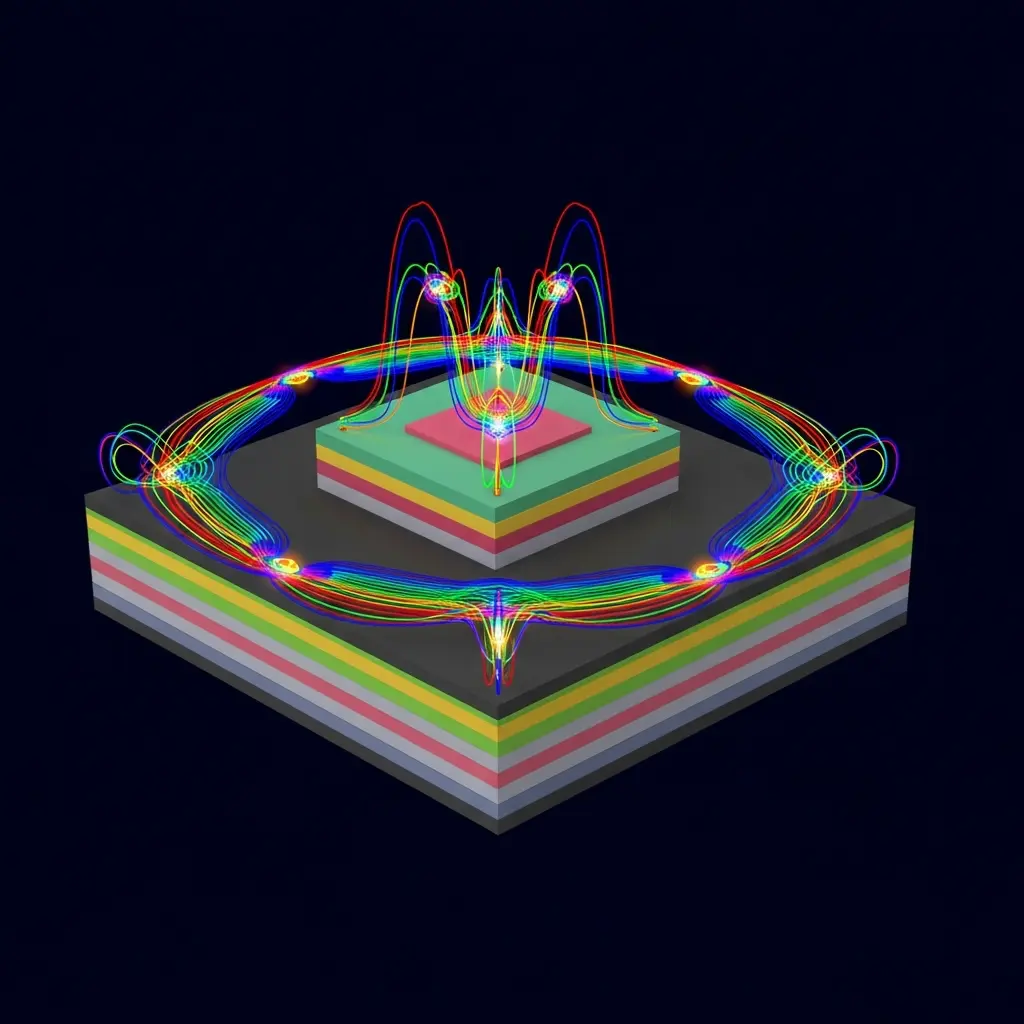
Scientists have long sought materials exhibiting robust quantum phenomena for next-generation electronics, and new research suggests lead-tin-selenium quantum wells could be a significant step forward. Szymon Majewski (International Research Centre MagTop, Institute of Physics, Polish Academy of Sciences), Michał Wierzbicki (Warsaw University of Technology, Faculty of Physics) and Tomasz Dietl, et al, demonstrate, through detailed band structure and Chern number calculations, that these wells offer a promising platform for realising diverse anomalous Hall phases. Their work, focusing on PbSnSe/(PbSe) wells, introduces a novel procedure to analyse wells grown in any crystallographic direction, accounting for crucial material anisotropy. This allows prediction of attainable Chern numbers, ranging from 1 to 3, dependent on well width and composition, potentially paving the way for dissipationless edge channels and ultimately, more efficient devices.
The research unveils a strong correlation between these parameters and the resulting topological properties of the quantum wells, offering a pathway for tailoring materials with specific QAH characteristics. This level of control is unprecedented and opens exciting possibilities for designing materials with customisable electronic behaviour. Furthermore, the study highlights the critical need for appropriate strain compensation to achieve high-quality quantization of the Hall conductance, ensuring robust and reliable QAH performance.
The work builds upon prior qualitative expectations for group IV, VI topological crystalline insulators, providing quantitative theoretical predictions for the QAHE in these semiconductor quantum wells. Researchers employed a multiband envelope function formalism, leveraging recent advancements in epitaxial growth techniques that allow for precise control over Sn content and carrier densities. These advancements, combined with the use of EuS barriers for carrier confinement and strain compensation, create an ideal environment for observing the QAH effect. The results indicate that the combination of material properties and growth techniques can facilitate the realisation of a quantum electrical resistance standard functioning at zero magnetic field, potentially revolutionising metrology and quantum computation.
Experiments show that the proposed system offers a potential solution to limitations observed in existing QAHE materials, such as low coercivity and high defect concentrations. The use of EuS barriers, exhibiting ferromagnetic ordering, introduces time-reversal symmetry breaking necessary for the QAH effect, while maintaining structural compatibility with the IV, VI semiconductor. The study proves that careful control over the composition and growth conditions of these quantum wells can lead to materials with enhanced performance and stability, paving the way for practical applications in spintronics, energy-efficient electronics, and beyond. This breakthrough reveals a new avenue for exploring and harnessing the potential of topological crystalline insulators for next-generation technologies.,.
PbSnSe Quantum Well Anomalous Hall Calculations
To determine the electronic structure, the study pioneered a numerical diagonalization technique; differential operators were replaced with combinations of Kν QW and Kν BR, determined by specific parameter values within each subregion, yielding eigenvalues and eigenvectors representing quantized energy levels and carrier wavefunctions confined within the quantum well. Chern number calculations were conducted using the plaquette method developed by Fukui et al, which discretises the two-dimensional Fermi-Brillouin zone (FBZ) into quadrilaterals to evaluate the Berry curvature F12(k). Eigenvectors of the Hamiltonian were organised into a matrix Υ(k), and unitary overlap matrices Uμ(k) were defined to quantify the phase difference between eigenvectors at neighbouring nodes in k-space. The discrete analogue of the Berry connection Aμ(k) was then calculated as the imaginary part of the logarithm of the determinant of Uμ(k), while the Berry curvature F12(k) was derived from the determinants of U1(k) and U2(k).
Crucially, the plaquette algorithm’s invariance to local phase transformations and applicability on coarser meshes ensured computational efficiency and robustness. Although the k·p approximation is formally valid only near k = 0, it proved adequate for evaluating the Chern invariant in these quantum wells, as the topological properties are determined by band ordering at the gap point. The topological invariant was computed separately for each valley type, and the resulting valley-resolved values were used to deduce the Chern number for each quantum well.
Quantum Hall States in PbSnSe Quantum Wells
Measurements confirm that appropriate strain compensation is crucial for achieving high-quality quantization of the Hall conductance, a key requirement for practical applications. The breakthrough delivers a pathway towards creating robust quantum Hall systems with tunable properties. Experiments revealed that the attainable Chern numbers are directly linked to the material’s composition and structural arrangement. Data shows a clear correlation between the well width and the resulting Chern number, allowing for precise control over the topological state. The research team meticulously calculated the band structures, confirming the presence of topologically non-trivial bands essential for the quantum anomalous Hall effect.
These calculations were performed using a multiband k·p Hamiltonian, providing a highly accurate description of the electronic properties. Results demonstrate that the anisotropy of the isoenergetic surfaces plays a significant role in lifting the L-valley degeneracy upon projection onto different crystallographic directions. The team measured the effects of strain on the band structure, finding that compensation is necessary to maintain a non-zero bandgap and ensure robust quantization. Tests prove that the combination of PbSnSe quantum wells and EuS barriers offers a viable route towards realizing a quantum electrical resistance standard functioning at zero magnetic field. This advancement could potentially revolutionize metrology, spintronics, and quantum computation.
PbSnSe Quantum Wells Enable Tunable Chern Numbers
The findings highlight the necessity of strain compensation to attain high-quality Hall conductance quantization, a crucial step towards practical applications. This work represents the first modelling of the electronic structure of these semiconductor systems using a k·p framework with a growth axis other than the conventional one, expanding the possibilities for material design.
👉 More information
🗞 From many valleys to many topological phases – quantum anomalous Hall effect in IV-VI semiconductor quantum wells
🧠 ArXiv: https://arxiv.org/abs/2601.16137