

Researchers have successfully simulated the transverse field Ising model on the Kagome lattice using a programmable quantum annealer, demonstrating its potential for simulating complex quantum systems. The Kagome lattice, with its unique geometry, exhibits frustration and degeneracy in its ground state, making it challenging to study. By embedding the model on the D-Waves’ Advantage2 prototype, researchers were able to simulate the system’s behavior under a finite longitudinal field, confirming theoretical predictions and shedding light on the nature of the phase diagram. This breakthrough has significant implications for the development of quantum simulation techniques, paving the way for further exploration of complex quantum phenomena.
Can Quantum Annealers Simulate Complex Quantum Systems?
The quest for a deeper understanding of complex quantum systems has led researchers to explore innovative simulation techniques. One such approach is the use of programmable quantum annealers, which have shown promise in simulating non-trivial quantum systems. In this article, we delve into the world of quantum spin models and explore how a team of scientists used a programmable quantum annealer to simulate the transverse field Ising model on the Kagome lattice.
The Power of Quantum Annealing
Quantum annealing is a process that uses a quantum computer to find the ground state of a given problem. This technique has been shown to be effective in solving complex optimization problems, such as those encountered in machine learning and finance. In the context of quantum spin models, quantum annealing can be used to simulate the behavior of interacting spins in a magnetic field.
The Kagome Lattice: A Frustrated System
The Kagome lattice is a two-dimensional lattice that exhibits frustration due to its unique geometry. This frustration leads to a large degeneracy in the ground state of the system, making it challenging to study using traditional simulation techniques. In this article, we explore how researchers used a programmable quantum annealer to simulate the transverse field Ising model on the Kagome lattice.
Embedding the Model on the Quantum Annealer
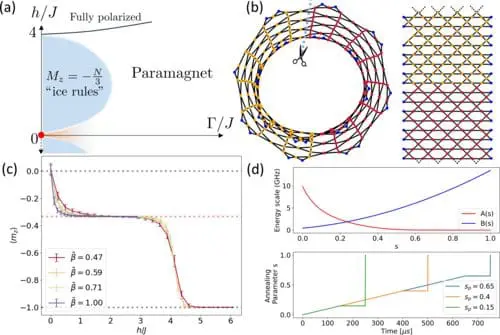
To simulate the transverse field Ising model on the Kagome lattice, the researchers embedded the model on the latest architecture of D-Waves‘ quantum annealer, the Advantage2 prototype. This involved using advanced embedding and calibration techniques to map the Kagome lattice with mixed open and periodic boundary conditions onto the highly connected Zephyr graph.
Forward Annealing Experiments
The researchers used forward annealing experiments to study the behavior of the system under a finite longitudinal field. These experiments showed that the system exhibits a one-third magnetization plateau consistent with a classical spin liquid state of reduced entropy. This result is significant, as it suggests that the quantum annealer can be used to simulate complex quantum systems in equilibrium.
Annealpausequench Protocol
To extract an experimental ensemble of states resulting from the equilibration of the model at finite transverse and longitudinal field, the researchers employed an anneal-pause-quench protocol. This protocol allowed them to construct a partial phase diagram for the system, which confirmed that the system exits the constrained Hilbert space of the classical spin liquid when subjected to a transverse field.
Connection to Previous Theoretical Results
The results obtained using the quantum annealer were compared to previous theoretical results and quantum Monte Carlo simulations. This comparison helped confirm the validity of the quantum simulation realized here, providing new insights into the nature of the phase diagram of the model.
Implications for Quantum Simulation
The success of this experiment has significant implications for the development of quantum simulation techniques. It demonstrates that programmable quantum annealers can be used to simulate non-trivial quantum systems in equilibrium, which is a crucial step towards understanding complex quantum phenomena.
Publication details: “Simulating the transverse-field Ising model on the kagome lattice using a programmable quantum annealer”
Publication Date: 2024-08-21
Authors: Pratyankara Narasimhan, Stephan Humeniuk, Ananda Roy, Victor Drouin-Touchette, et al.
Source: Physical review. B./Physical review. B
DOI: https://doi.org/10.1103/physrevb.110.054432


