

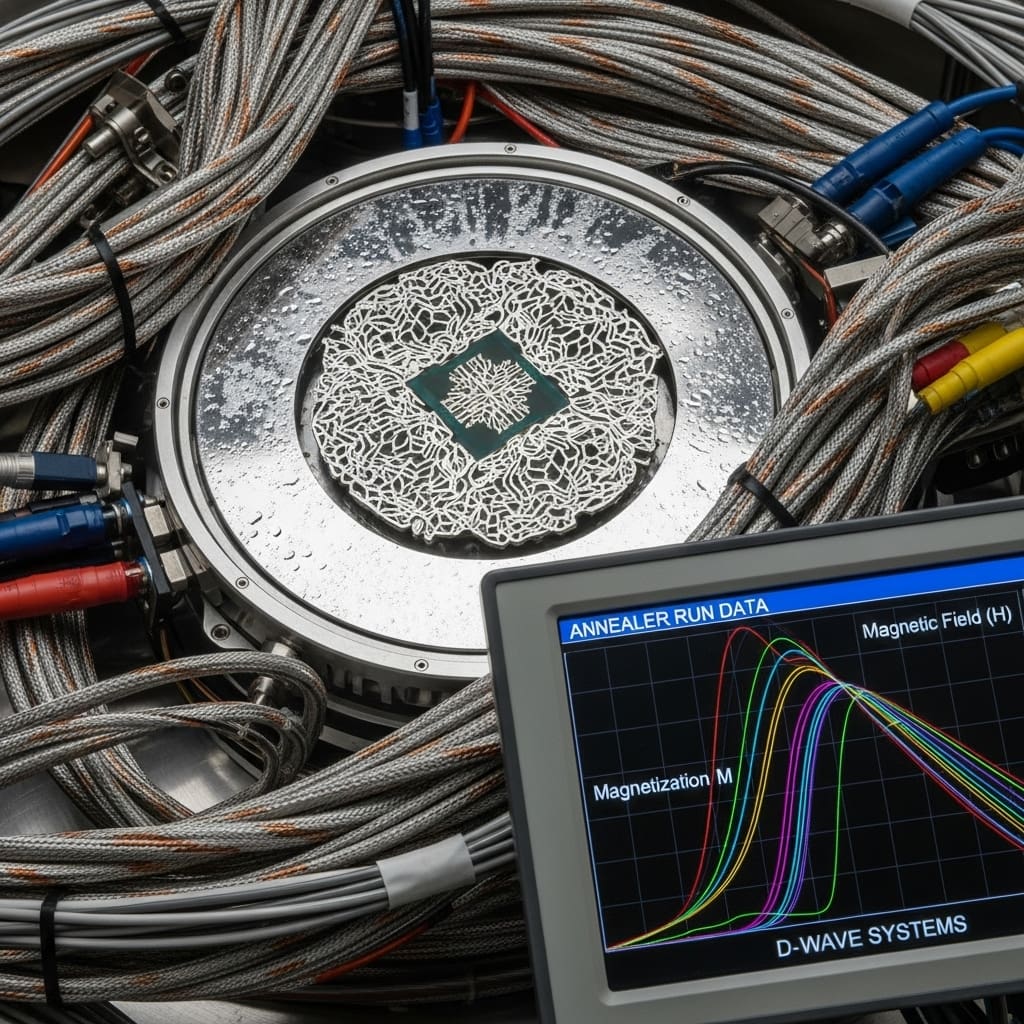
Antiferromagnets, materials with potentially revolutionary applications in data storage, traditionally lack the clear magnetic memory exhibited by their ferromagnetic counterparts, presenting a significant challenge for technological development. Now, Elijah Pelofske, Pratik Sathe, and Cristiano Nisoli, all from Los Alamos National Laboratory, along with Frank Barrows, demonstrate a method for observing and controlling magnetic hysteresis, a key characteristic of magnetic memory, within these complex materials. The team implements a novel sampling-based protocol on programmable quantum annealers, effectively creating a system where they can both induce and measure full reversal of the antiferromagnetic state, revealing emergent magnetic domains driven by internal fluctuations. This achievement represents a crucial step towards harnessing the potential of antiferromagnets for future data storage technologies, offering a pathway to create faster, more energy-efficient devices.
Experiments demonstrate full saturation and reversal of the hysteresis curve, alongside the emergence of magnetic domains driven by fluctuations, confirming the magnetic memory effect within these materials. The team programmed antiferromagnetic models using programmable processors, and addressed inherent noise through a calibration technique that refined the system’s settings for improved stability and measurement accuracy.
D-Wave System Architecture and Quantum Annealing
A comprehensive body of research focuses on quantum annealing, particularly utilizing D-Wave systems. This work covers the fundamental principles of quantum annealing and details the architecture of D-Wave processors. Investigations explore improvements in qubit connectivity and processor design, alongside performance evaluations on diverse problems spanning optimization, machine learning, and materials science. Researchers also concentrate on techniques for embedding complex problems onto the D-Wave hardware and mitigating the limitations of its connectivity. Further studies focus on calibrating and refining D-Wave processors to enhance accuracy and reliability.
Scientists actively investigate sources of noise and develop methods to reduce their impact on performance. Theoretical work explores the foundations of quantum annealing and its relationship to other quantum algorithms and classical optimization techniques. This research extends to applications in various fields, including optimization, machine learning, materials science, and finance. Investigations also explore the use of quantum annealing to study critical phenomena and phase transitions in physical systems. Software tools and programming frameworks for controlling D-Wave processors are also a key area of research, alongside data analysis techniques. Key themes include scaling connectivity, noise mitigation, rigorous benchmarking, application development, and hybrid approaches combining quantum and classical computation.
Antiferromagnet Hysteresis Observed with Analog Processors
Scientists successfully implemented a sampling-based magnetic hysteresis protocol to investigate magnetic memory in antiferromagnets using programmable analog processors. Experiments revealed full saturation and reversal of the hysteresis curve, alongside the emergence of magnetic domains driven by fluctuations, demonstrating the magnetic memory effect within these materials. The team programmed antiferromagnetic models using programmable processors, and addressed noise through a calibration technique that refined the system’s settings for improved stability and measurement accuracy. Data was collected with and without calibration, allowing for a direct comparison of results.
The primary observable measured was the average longitudinal magnetization, calculated from all spins and averaged over many samples to reduce statistical errors. Researchers also extracted the magnetic structure factor, reconstructing it from individual spins and accelerating calculations with specialized software libraries. For two-dimensional models, the Néel order parameter, quantifying long-range antiferromagnetic ordering, revealed a staggered checkerboard pattern. In one-dimensional models, the density of domain walls, boundaries between magnetic regions, was examined, showing a minimum of one domain wall in the ground state configuration.
Antiferromagnet Hysteresis Simulated on Quantum Computer
Researchers have, for the first time, demonstrated large-scale simulations of magnetic hysteresis using quantum computers, successfully modelling the behaviour of antiferromagnets. These simulations reveal that full polarization of antiferromagnets can be achieved with appropriately tuned control parameters, and subsequent reversal closely resembles classical hysteresis observed in disordered magnetic systems. Measurements establish robust dynamical hysteresis in programmable antiferromagnets across different geometries, including one-dimensional rings and two-dimensional samples. The team observed that the shape of the hysteresis loop is determined by a limited number of factors, namely the geometry and coordination of the system, the specific sweep protocol employed, and the strength of the applied fields.
In one-dimensional ring structures, a pre-existing domain wall facilitates reproducible, step-like reversal under a transverse field, while in two-dimensional samples, boundary effects and droplet growth align with the observed evolution of the spin-structure factor. The researchers also demonstrated that calibration of the quantum hardware improves the quality of the simulations, yielding smoother magnetization curves. The authors acknowledge that the hardware’s structure tends to suppress ferromagnetic ordering, resulting in weak hysteresis loops, and plan to explore a wider range of geometries and coordination numbers to further refine the understanding of antiferromagnetic behaviour and optimise the control of magnetic properties in these systems.
👉 More information
🗞 Probing Antiferromagnetic Hysteresis on Programmable Quantum Annealers
🧠 ArXiv: https://arxiv.org/abs/2511.17779


