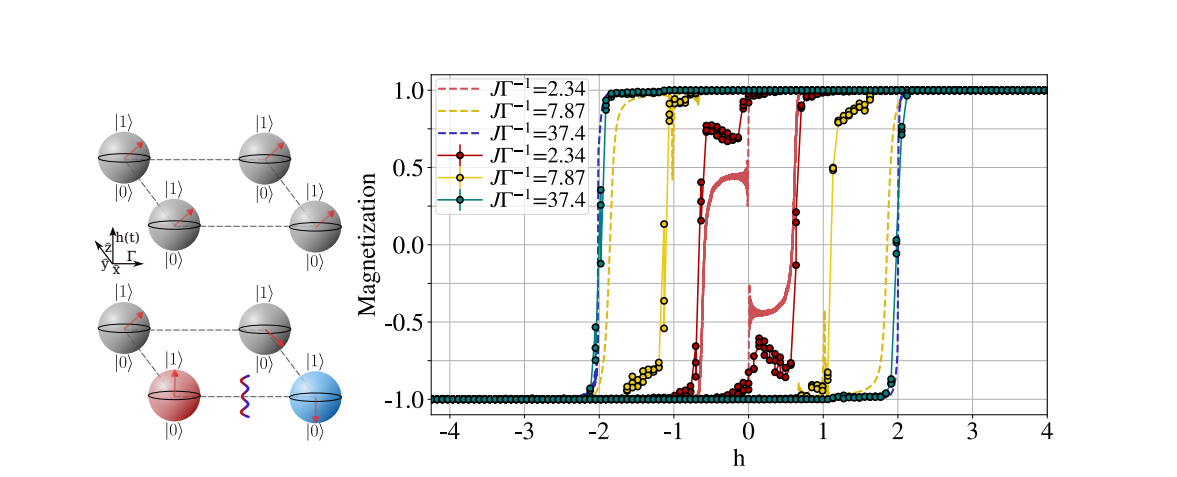
Quantum annealers, devices designed to find optimal solutions to complex problems, typically avoid the memory effects that plague traditional computational methods, but recent experiments reveal a surprising phenomenon: robust hysteresis in these systems. Frank Barrows, Elijah Pelofske, and Pratik Sathe, from Q-MAFIA at Los Alamos National Laboratory, alongside collaborators including Francesco Caravelli from the Universit`a di Pisa and Scuola Normale Superiore, now present a theoretical framework explaining this unexpected behaviour. Their work demonstrates that hysteresis arises from the interplay of quantum transitions and the movement of domain walls within the annealer, effectively creating a form of memory within the system. By testing this model on a quantum annealer containing up to 4,906 qubits, the team reproduces observed patterns in hysteresis loops and confirms the existence of genuine memory effects, establishing these devices as valuable tools for investigating complex dynamics in many-body systems.
Ising Model Hysteresis on D-Wave Annealers
Researchers have conducted detailed simulations exploring magnetic hysteresis using D-Wave quantum annealers. They investigated how systems of interacting spins, described by the Ising model, respond to changing external magnetic fields. Simulations were performed on both one-dimensional chains and two-dimensional lattices of spins, utilizing several generations of D-Wave hardware. The team aimed to observe hysteresis, a phenomenon where a material’s magnetization depends on its past exposure to a field, indicating a form of magnetic memory. The simulations varied the annealing time, the duration the D-Wave machine spends searching for the lowest energy state, using both short and long durations.
To map the problem onto the D-Wave hardware, the researchers employed antiferromagnetic gauge transformations and used periodic boundary conditions in the one-dimensional simulations. The results reveal that two-dimensional simulations produce smoother, more stable hysteresis loops compared to the erratic behaviour observed in one dimension. Longer annealing times consistently led to smoother loops with smaller areas, as the system had more time to settle into its lowest energy state. These findings demonstrate that D-Wave quantum annealers can simulate magnetic hysteresis, although the quality of the simulation is sensitive to the dimensionality of the system and the annealing time.
The study highlights the challenges of simulating low-dimensional systems due to their increased sensitivity to noise. The research confirms that careful control of annealing time is crucial for achieving accurate simulations. The use of antiferromagnetic gauge transformations provides a viable technique for mapping the Ising model onto the D-Wave hardware. These results suggest that D-Wave quantum annealers could be used to study more complex magnetic systems, potentially contributing to a deeper understanding of magnetism.
Quantum Hysteresis Emerges in Quantum Annealers
Researchers have discovered a surprising form of magnetic memory within quantum annealers, devices designed for optimization tasks. This work demonstrates that these systems can exhibit hysteresis, a lagging of magnetization behind an applied field, despite operating on the principle of quantum tunneling. This discovery challenges conventional understanding of how memory arises in physical systems and opens new avenues for exploring quantum phenomena. The team developed a theoretical framework that combines quantum and classical physics to explain these observations, accounting for both discrete quantum transitions and continuous movement of domain walls.
By linking these processes, the researchers successfully reproduced the complex hysteretic behaviour observed in experiments, including non-monotonic magnetization reversals and variations in the area enclosed by the hysteresis loop. Experiments were conducted on D-Wave quantum annealers, utilizing thousands of qubits to create one and two-dimensional magnetic systems. The researchers meticulously controlled the applied field and measured the resulting magnetization, revealing reproducible hysteretic loops even in regimes where classical physics would predict none. The framework accurately predicts how the hysteresis loop changes with variations in the speed of the applied field and reproduces signatures of local entanglement. This ability to model and replicate the observed behaviour establishes quantum annealers as a powerful platform for studying programmable quantum hysteresis and exploring the dynamics of many-body quantum systems. The findings suggest that these devices can serve as testbeds for investigating complex quantum phenomena and potentially contribute to the development of novel quantum technologies.
Quantum Hysteresis and Memory in Annealers
This research establishes a theoretical framework that explains the surprising observation of hysteresis, a memory effect, in quantum annealers. By combining concepts of Landau-Zener transitions with semiclassical domain-wall kinetics, the team successfully models the behaviour of these systems and reproduces experimental data from multiple annealers. Importantly, the model identifies transiently negative susceptibilities as genuine memory effects, demonstrating that the annealers retain information about their history. These findings confirm that programmable annealers are valuable tools for investigating complex, non-equilibrium dynamics in many-body systems, offering a platform to explore memory-endowed behaviour.
The authors acknowledge that their model simplifies certain aspects of the hardware, which could be explored in future work. Further research could also investigate the relationship between these findings and other systems exhibiting hysteresis, while accounting for their underlying mechanisms. This work provides a crucial step towards understanding the fundamental principles governing quantum memory and its potential applications. By bridging the gap between theoretical models and experimental observations, the researchers have opened new avenues for exploring the rich and complex behaviour of quantum systems. The findings suggest that quantum annealers can serve as a valuable platform for investigating novel quantum phenomena and developing innovative quantum technologies.
🗞 Magnetic Memory and Hysteresis from Quantum Transitions: Theory and Experiments on Quantum Annealers
🧠 DOI: https://doi.org/10.48550/arXiv.2507.18079