Nonlinear spectroscopy routinely extracts detailed information about materials, but quantum nonlinear spectroscopy (QNS) promises an even more powerful approach by accessing exponentially more types of correlations than traditional methods. Li Sun, Chong Chen, and Ren-Bao Liu investigate how these higher-order correlations in QNS are governed by symmetries that go beyond spatial considerations, focusing on particle-hole, time-reversal, and chiral symmetries. Their work reveals that these non-spatial symmetries impose unique selection rules on QNS signals and establish surprising connections between correlations measured in QNS and those found in out-of-time-order correlations, which are otherwise difficult to observe. By uncovering these deep structural relationships, the researchers not only enhance our understanding of higher-order correlations but also open new avenues for probing previously inaccessible quantum phenomena.
Symmetry and Out-of-Time-Order Correlators Explained
This research comprehensively explores out-of-time-order correlators (OTOCs), their connection to quantum chaos, and methods for their experimental detection. The study positions OTOCs as crucial indicators of chaotic behavior in quantum systems, linking their growth rate to the Lyapunov exponent, a measure of chaoticity. A key strength of the work lies in its emphasis on symmetry, demonstrating how symmetries, or their absence, influence OTOCs and the classification of quantum systems, particularly within the framework of Altland-Zirnbauer symmetry classes, which are relevant to topological phases. The paper provides a thorough overview of experimental techniques used to measure OTOCs, bridging the gap between theoretical concepts and practical realization.
These techniques include nonlinear spectroscopy, spin noise spectroscopy, random matrix theory, and quantum simulation using platforms like trapped ions, NMR, and superconducting qubits. The research also touches upon the relevance of OTOCs to quantum information processing, specifically in the context of scrambling and entanglement growth. The study acknowledges that other measures, such as the Kolmogorov-Sinai entropy, could also be valuable, and further exploration of open quantum systems, including the impact of decoherence on OTOCs, would be beneficial. Investigating the relationship between OTOCs and many-body localization, and applying machine learning techniques to analyze OTOC measurements could yield valuable insights.
Overall, this is an excellent and comprehensive review of out-of-time-order correlators and their experimental detection. It serves as a valuable resource for researchers in quantum physics, condensed matter physics, and quantum information. The breadth and depth of coverage, combined with the focus on experimental realization, make it a standout contribution to the field.
Probing Quantum Correlations Beyond Time Ordering
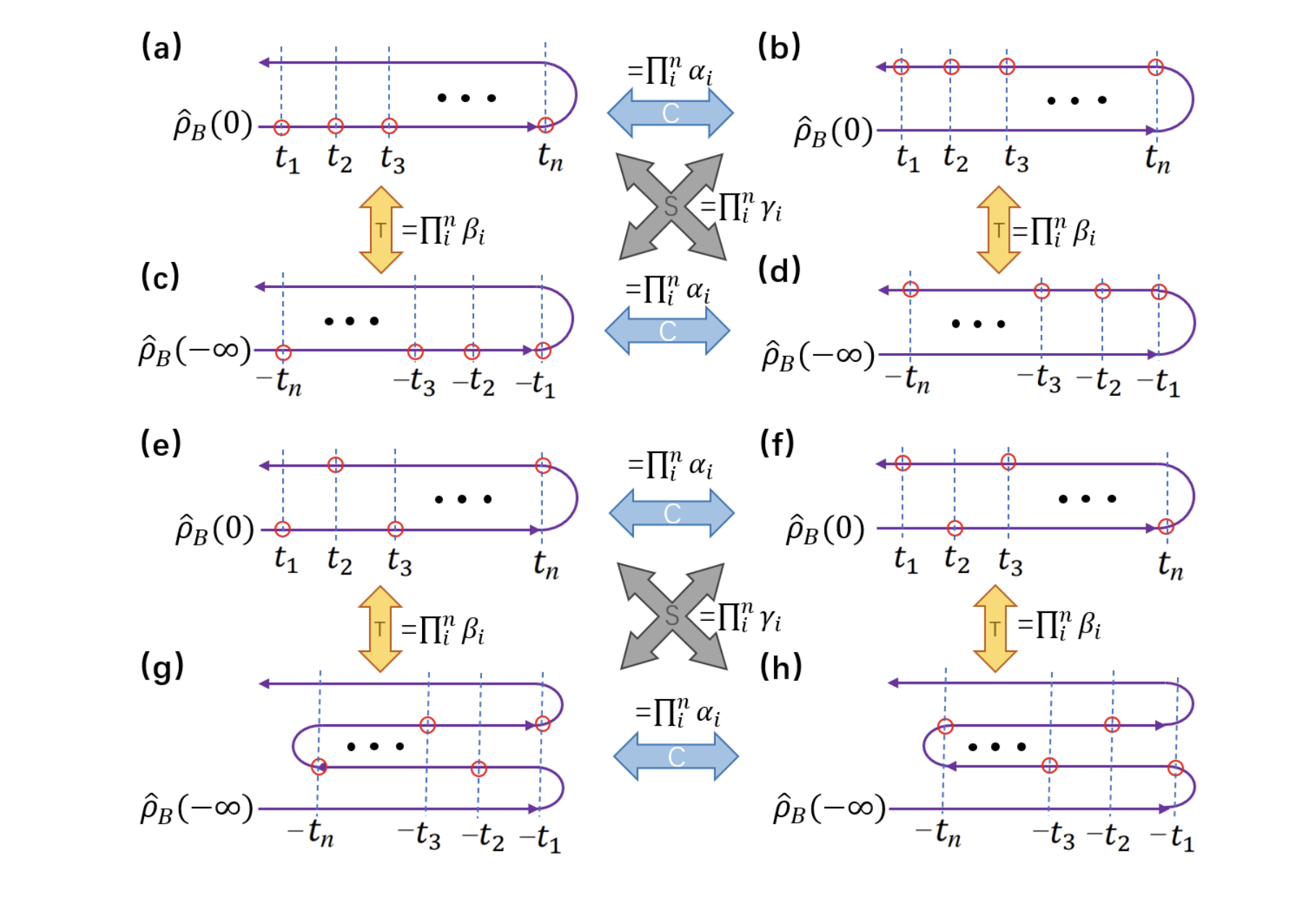
Researchers developed a novel quantum nonlinear spectroscopy (QNS) approach to investigate higher-order correlations within quantum systems, moving beyond the limitations of traditional methods. This technique accesses correlations inaccessible to conventional spectroscopy, revealing deeper insights into quantum dynamics. The core of this advancement lies in the ability to probe correlations beyond those governed by time-ordered sequences, specifically out-of-time-order correlations (OTOCs). Scientists overcame the experimental challenges of measuring OTOCs by demonstrating how non-spatial symmetries, particle-hole, time-reversal, and chiral, constrain these correlations and establish connections between different ranks of OTOCs.
This allows for the potential measurement of certain OTOCs using QNS without requiring physically unrealistic time-reversal processes. The team rigorously analyzed how these symmetries impact QNS, establishing that particle-hole symmetry imposes specific selection rules, reducing the number of necessary measurements. Furthermore, they demonstrated that time-reversal and chiral symmetry connect OTOCs of varying ranks, potentially enabling the measurement of rank-2 OTOCs using QNS. These findings were validated through analysis of the transverse-field Ising model, confirming the predictive power of the symmetry-based approach.
Symmetries Constrain Higher-Order Quantum Correlations
Researchers demonstrate a deep connection between symmetries and higher-order quantum correlations, revealing constraints on how information is processed in quantum systems. The team investigated how fundamental symmetries, particle-hole, time-reversal, and chiral, influence these correlations, uncovering selection rules that govern quantum nonlinear spectroscopy (QNS). These findings show that QNS is uniquely sensitive to non-spatial symmetries. Experiments and theoretical analysis confirm that particle-hole symmetry imposes specific selection rules on QNS, effectively filtering which correlations can be observed.
Furthermore, the research establishes a link between time-reversal and chiral symmetries and out-of-time-order correlations (OTOCs), demonstrating that certain OTOCs can be accessed through QNS without requiring unphysical time reversal. Specifically, the team proved that rank-2 OTOCs and certain contour-time-ordered correlations (CTOCs) are identical under specific conditions, providing a pathway to measure OTOCs using QNS. This connection between CTOCs and OTOCs has significant implications for understanding information scrambling in quantum many-body systems. The results suggest that information scrambling is constrained by these symmetries, or that CTOCs may exhibit diverging behaviors in systems possessing these symmetries. This breakthrough delivers a powerful tool for probing the fundamental properties of quantum materials and exploring the frontiers of quantum information science.
Symmetries Constrain Quantum Information Scrambling
Researchers demonstrate a deep connection between symmetries and higher-order quantum correlations, revealing constraints on how information is processed in quantum systems. The team investigated how fundamental symmetries, particle-hole, time-reversal, and chiral, influence these correlations, uncovering selection rules that govern quantum nonlinear spectroscopy (QNS). These findings show that QNS is uniquely sensitive to non-spatial symmetries. Experiments and theoretical analysis confirm that particle-hole symmetry imposes specific selection rules on QNS, effectively filtering which correlations can be observed.
Furthermore, the research establishes a link between time-reversal and chiral symmetries and out-of-time-order correlations (OTOCs), demonstrating that certain OTOCs can be accessed through QNS without requiring unphysical time reversal. This connection between CTOCs and OTOCs has significant implications for understanding information scrambling in quantum many-body systems. The results suggest that information scrambling is constrained by these symmetries, or that CTOCs may exhibit diverging behaviors in systems possessing these symmetries.
🗞 Non-spatial symmetries in quantum nonlinear spectroscopy
🧠 ArXiv: https://arxiv.org/abs/2508.20445