

Graphene, a single-atom-thick sheet of carbon, exhibits remarkable electronic properties that scientists are striving to harness for future technologies. Divya Sahani from the Indian Institute of Science, Sunit Das and Amit Agarwal from the Indian Institute of Technology Kanpur, and Kenji Watanabe and Takashi Taniguchi from the National Institute for Materials Science, report a breakthrough in understanding how strain within graphene creates effects that mimic magnetic fields, but without disrupting fundamental symmetries. The team demonstrates that precise measurements of electrical conductivity reveal unique patterns arising from the quantization of energy levels under these strain-induced fields, allowing them to quantify these ‘pseudomagnetic fields’ with unprecedented accuracy, even at extremely small strengths. This achievement establishes a new method for probing and controlling these subtle effects, paving the way for the development of graphene-based devices where electron flow can be manipulated by both mechanical strain and electrical fields.
D Materials, Heterostructures and Magnetotransport Studies
This body of research encompasses a vast range of studies concerning two-dimensional materials, primarily graphene and related structures, alongside investigations into magnetotransport phenomena and their underlying physics. The work explores core materials like graphene and hexagonal boron nitride, alongside more complex heterostructures created by layering different materials to engineer novel functionalities and electronic properties. Fabrication techniques, including mechanical exfoliation and chemical vapor deposition, are employed to create high-quality samples, which are then characterized using techniques like Raman spectroscopy and microscopy to understand their structure and properties. A central theme is the study of magnetotransport, examining how materials conduct electricity in magnetic fields to reveal insights into their electronic structure and scattering mechanisms.
Key phenomena investigated include Shubnikov-de Haas oscillations, which reveal carrier density and effective mass, and the quantum Hall effect, a precise topological phenomenon. Researchers also explore magnetoresistance, encompassing ordinary, anisotropic, giant, and tunnel magnetoresistance, alongside quantum interference effects like weak localization and weak antilocalization, which can indicate spin-orbit coupling. Ballistic transport, where electrons travel without scattering, and the longitudinal and nonlinear magnetoconductivity are also investigated. Advanced research areas include Moiré superlattices, formed by twisting 2D materials, which can exhibit correlated insulating states and superconductivity, and the study of correlated electron systems, topological insulators, and superconductivity in 2D materials.
Spin-orbit coupling, valleytronics, and odd-parity longitudinal magnetoconductivity are also explored, representing cutting-edge areas of research. This research is significant because it advances fundamental physics, explores new states of matter, and lays the groundwork for next-generation electronics, spintronics, and quantum computing. The development of highly sensitive sensors is also a key potential outcome. In summary, this represents a comprehensive overview of cutting-edge research in 2D materials, a rapidly evolving field with the potential to revolutionize science and technology.
Strain Detects Pseudomagnetic Fields in Graphene
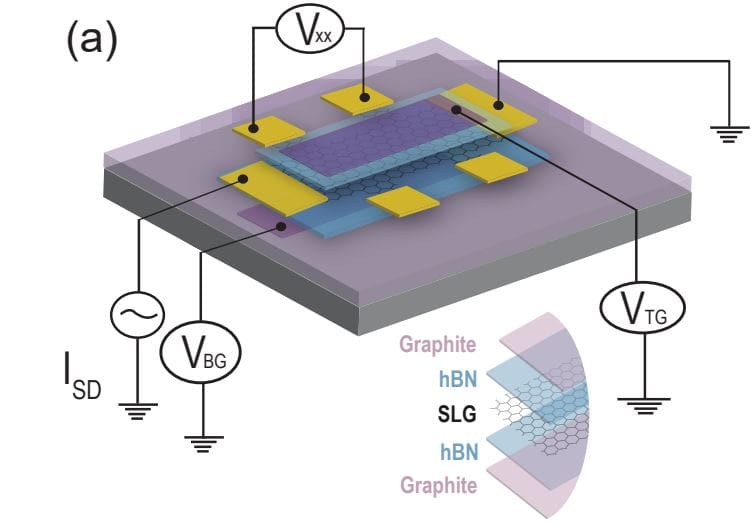
Scientists have achieved quantitative detection of strain-induced pseudomagnetic fields in high-mobility graphene, establishing a new method for probing emergent gauge fields in Dirac materials. The research demonstrates distinct beating patterns in Shubnikov-de Haas oscillations, arising from interference between valley-resolved Landau quantizations under the combined influence of an applied magnetic field and the strain-induced pseudomagnetic field. These observations provide a direct means of characterizing the effects of mechanical strain on the electronic properties of graphene. The team fabricated graphene devices exhibiting exceptional charge-carrier mobility, confirming extremely low disorder and long quantum lifetimes within the material.
Well-resolved Shubnikov-de Haas oscillations were observed, exhibiting a periodic suppression of amplitude, forming a well-defined beating envelope that indicates interference between closely spaced oscillation frequencies. Detailed analysis revealed that the position of amplitude minima systematically shifted with increasing magnetic field. Mapping the carrier density corresponding to each minimum yielded a consistent slope, demonstrating a quadratic relationship between node carrier density and magnetic field. These scaling relations, confirmed by data from a second device, provide crucial insight into the underlying quantum interference mechanism and Landau quantization within graphene.
This breakthrough delivers a quantitative method for extracting pseudomagnetic fields as small as a few milliteslas, establishing quantum oscillation spectroscopy as a robust probe of emergent gauge fields in Dirac materials and opening avenues for mechanically reconfigurable valleytronic and straintronic devices. These findings represent a significant step toward harnessing the potential of strain engineering for advanced electronic applications. This research establishes a new method for quantifying emergent gauge fields in two-dimensional materials, specifically demonstrating the detection of pseudomagnetic fields induced by strain in graphene. The observed linear and quadratic scaling provides unambiguous evidence of valley interference, confirming the origin of the beating patterns. This work paves the way for the development of strain-tunable valleytronic devices and novel quantum-sensing technologies, offering a route to reconfigurable quantum phases through mechanical control.
👉 More information
🗞 Quantum Transport Spectroscopy of Pseudomagnetic Field in Graphene
🧠 ArXiv: https://arxiv.org/abs/2511.14888

