

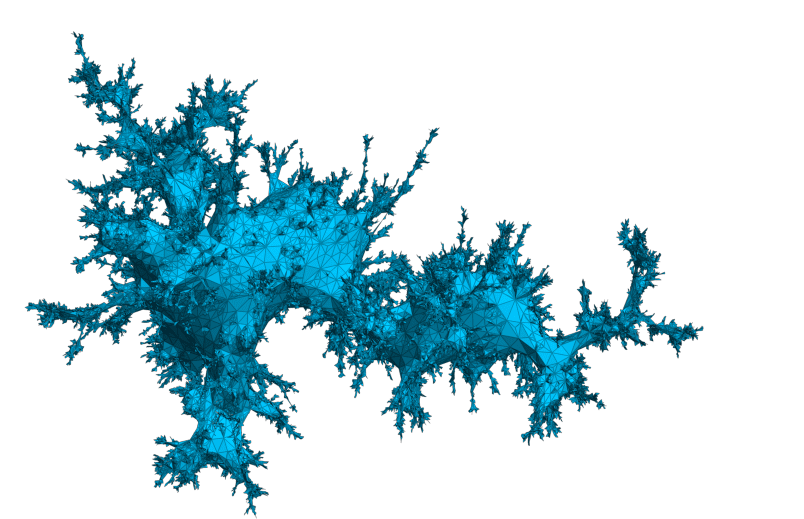
The fundamental nature of spacetime at its smallest scales remains one of the greatest challenges in modern physics, with many theories suggesting it deviates dramatically from the smooth fabric described by classical general relativity. J. van der Duin, R. Loll, M. Schiffer, and A. Silva investigate this question by applying techniques from topological data analysis to explore the possibility that spacetime resembles a fluctuating “foam” at the Planck scale. Their work introduces a new method for characterising the complex shapes arising in quantum gravity calculations, using mathematical tools to identify and quantify the connectivity of spacetime histories. This approach reveals a fractal structure in two dimensions, offering a new way to probe the geometry of quantum spacetime and potentially distinguish between different theoretical models of gravity.
This research introduces new methods to investigate the geometry of spacetime as it emerges from calculations of quantum gravity, specifically utilising causal dynamical triangulations. These methods quantify the number and types of closed loops and higher-dimensional voids present in the spacetime geometry, allowing researchers to probe the structure of spacetime at the smallest scales. The results demonstrate the emergence of a four-dimensional spacetime structure from the underlying quantum dynamics, characterised by consistent numbers of one-dimensional loops and a non-trivial number of zero-dimensional voids.
This approach offers a new way to study quantum gravity and the emergence of classical geometry, providing insights into whether quantum spacetime resembles a “quantum foam” at the Planck scale. The team investigates the Betti numbers of simulated spacetime histories, regularized using dynamical triangulations, as a function of the scale of observation. In two dimensions, the analysis confirms the well-known fractal structure of Euclidean quantum gravity, demonstrating the potential of computational tools to access the nonperturbative realm of quantum field theory.
Quantum Spacetime Foam Characterized by Topology
This research explores the quantum geometry of spacetime, specifically within the framework of two-dimensional quantum gravity. Scientists employ computer simulations based on causal dynamical triangulations and topological data analysis to investigate the foaminess of spacetime at the Planck scale. They aim to develop tools to quantitatively characterise this quantum spacetime, moving beyond purely theoretical descriptions. The core idea is to use topological data analysis to identify and quantify topological features, such as bubbles or holes, in the quantum geometry, providing a way to observe the underlying structure of spacetime.
Causal dynamical triangulations build spacetime from fundamental building blocks while enforcing a causal structure. Topological data analysis is a set of techniques used to study the shape of data, identifying and quantifying topological features in the triangulated spacetime. Key concepts include persistent homology, which detects and tracks topological features as the scale of observation changes, and Betti numbers, which quantify the number of topological features of different dimensions. The research focuses on observable topological features of the quantum geometry, using coarse-graining to simplify the geometry and focus on the most prominent features.
The team performs simulations of 2D quantum gravity using causal dynamical triangulations, generating numerous triangulated spacetime geometries. They then apply a coarse-graining procedure, merging adjacent triangles to reduce complexity. Topological data analysis tools, specifically persistent homology, are used to analyse the coarse-grained triangulations, identifying and quantifying topological features like connected components, loops, and voids. They define bubbles as topologically spherical regions connected to the rest of the triangulation and develop an algorithm to detect and count them. Statistical analysis of the topological features and bubble counts characterises the quantum geometry.
The results demonstrate that the simulations exhibit a foamy structure at the Planck scale, evidenced by numerous bubbles and other topological features. The team shows that topological data analysis can quantitatively characterise the topology of the quantum geometry, measuring Betti numbers and bubble counts to describe the structure of spacetime. They find a connection between the detected bubbles and the concept of baby universes in 2D quantum gravity, and calculate a string susceptibility related to the density of bubbles, providing a measure of the foaminess of spacetime. The research also shows how the level of coarse-graining affects the observed topological features.
This work demonstrates the potential of combining causal dynamical triangulations and topological data analysis as a powerful tool for studying quantum gravity. The identified topological features could potentially serve as observational signatures of quantum gravity effects, providing new insights into the nature of spacetime foam and its role in quantum gravity. The authors suggest that these methods could be extended to study quantum gravity in higher dimensions, providing a concrete way to move beyond purely theoretical descriptions of quantum spacetime and develop a more quantitative understanding.
Quantum Spacetime Foam via Topological Data Analysis
This research introduces a novel method for investigating the fundamental structure of spacetime using tools from topological data analysis. Scientists developed new observables to characterise quantum geometry as it emerges from calculations of quantum gravity, specifically employing dynamical triangulations. By measuring topological features, known as Betti numbers, of these calculations, the team assessed the potential “foaminess” of spacetime at extremely small scales. The analysis of two-dimensional quantum gravity revealed a fractal structure consistent with previous findings, demonstrating the viability of this approach.
Importantly, the observed behaviour of these Betti numbers provides a quantitative way to study the elusive concept of quantum spacetime foam, offering a concrete tool for future investigations. While the current work focuses on two dimensions, the researchers anticipate that applying this method to higher dimensions will reveal a richer and more complex array of topological features, potentially deepening our understanding of quantum gravity.
👉 More information
🗞 Exploring Quantum Spacetime with Topological Data Analysis
🧠 ArXiv: https://arxiv.org/abs/2510.05693


