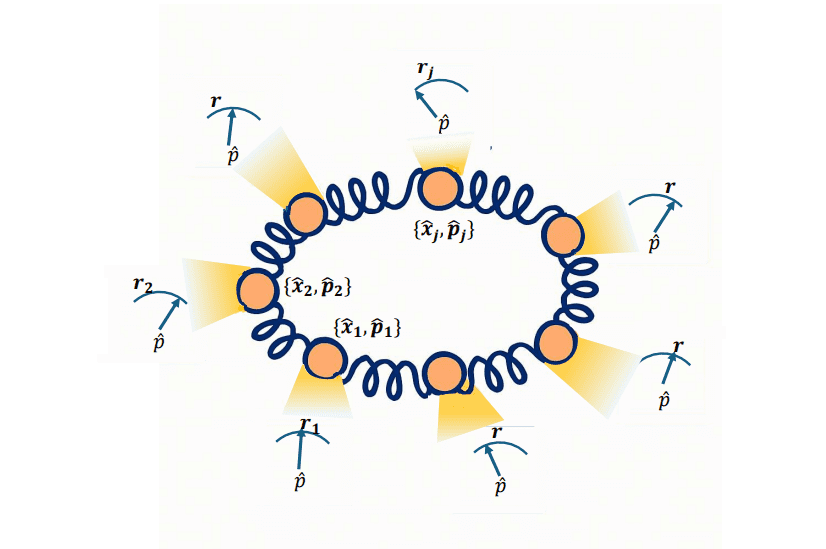
Understanding how continuous observation affects quantum systems presents a fundamental challenge in physics, and recent work by Anna Delmonte, Zejian Li, and Rosario Fazio, alongside Alessandro Romito, offers a significant step forward. The researchers developed a new theoretical approach that focuses on identifying the most likely path a quantum system takes when constantly monitored, moving beyond descriptions of average behaviour. This method accurately describes Gaussian systems and, crucially, extends to more complex interacting systems like the Sine-Gordon model, revealing a surprising entanglement phase transition, where the system’s behaviour shifts from predictable area-based scaling to a more complex logarithmic relationship. This discovery provides new insight into the delicate balance between measurement and quantum coherence, and has implications for understanding the behaviour of many-body quantum systems under continuous observation.
Entanglement, Measurement, and One-Dimensional Systems
This compilation represents a comprehensive overview of research into measurement-induced phase transitions, entanglement, and related topics in quantum physics, particularly within one-dimensional systems. Core concepts include continuous quantum measurement and path integrals, with foundational work establishing the theoretical framework for describing these processes. Further developments apply stochastic path-integrals to specific quantum systems, such as the harmonic oscillator. The bibliography also encompasses essential entanglement measures and properties, detailing entanglement in continuous-variable systems and exploring entanglement properties of the harmonic chain.
Several papers reference classic, integrable models like the Sine-Gordon and Thirring models, often used as benchmarks for understanding more complex systems. The quantum Ising chain and the Sachdev-Ye-Kitaev (SYK) model also feature prominently as frequently studied systems. Free bosons and fermions are often employed as simplified models to explore measurement-induced transitions, providing insights into fundamental mechanisms. The central theme focuses on how continuous measurement can drive systems into new phases of matter or alter their entanglement properties, with researchers utilizing matrix product states to study these transitions in various systems.
The bibliography details how entanglement measures and probes can be used to detect and characterize measurement-induced phase transitions, with studies focusing on entanglement negativity and full counting statistics. Researchers investigate the role of multipartite entanglement in these transitions. The collection also covers non-equilibrium dynamics and approximations, with time-dependent variational approaches and self-consistent techniques used to study the dynamics of quantum systems. Recent publications indicate that this is a rapidly evolving field, with ongoing research building on earlier theoretical foundations and exploring new systems and phenomena. Key techniques include path integrals, matrix product states, variational methods, self-consistent approaches, and entanglement measures.
Single Trajectory Describes Monitored Bosonic Dynamics
Scientists have developed a new theoretical method to describe the dynamics of monitored bosonic systems, focusing on identifying the most likely trajectory of quantum states under continuous measurement. This approach simplifies the description of complex monitoring processes by representing them through a single, representative trajectory, significantly reducing computational demands. The team validated this method using Gaussian bosons, demonstrating its exact equivalence to established stochastic equations of motion and reproducing previous findings. Extending this work, researchers applied the method to the Sine-Gordon model, an interacting bosonic system where traditional approaches become significantly more challenging.
To manage the complexity of interactions, they employed the Self-Consistent Time-Dependent Harmonic Approximation, effectively mapping the interacting system into a quadratic, time-dependent theory. Combining this with the most likely trajectory method, the team derived a closed set of deterministic equations, enabling the description of monitored many-body systems without solving an infinite set of coupled stochastic equations. Experiments revealed an entanglement phase transition in the steady state of the monitored Sine-Gordon model, characterized by a shift in scaling from an area-law to a logarithmic-law, demonstrating the power of the method to capture complex quantum phenomena.
Continuous Monitoring Drives Entanglement Phase Transition
This work presents a new theoretical approach to understanding the dynamics of monitored quantum systems, focusing on identifying the most likely trajectory within the vast probability distribution of possible measurement outcomes. Researchers demonstrate the method’s accuracy for Gaussian theories and extend it successfully to the Sine-Gordon model, a significant achievement in describing interacting quantum systems under continuous monitoring. Through this approach, the team reveals how continuous measurement can drive a phase transition in the steady state of the system, altering the scaling of entanglement from an area-law to a logarithmic-law. The study successfully captures dynamics through a self-consistent time-dependent harmonic approximation, even when an exact solution is not possible, highlighting the method’s robustness and broad applicability. The authors acknowledge that the harmonic approximation introduces limitations, particularly when dealing with strongly interacting systems where higher-order corrections may become important. Future research directions include exploring the method’s performance on a wider range of models and investigating the potential for applying it to analyse experimental data from platforms capable of implementing continuous monitoring of quantum systems.
👉 More information
🗞 Measurement-induced phase transition in interacting bosons from most likely quantum trajectory
🧠 ArXiv: https://arxiv.org/abs/2509.24520