The pursuit of efficient learning algorithms receives considerable attention across diverse fields, from robotics to financial modelling. Recent advances combine the principles of quantum computation with classical reinforcement learning, offering potential acceleration for specific computational tasks. Oliver Sefrin, from the Institute of Quantum Technologies at the German Aerospace Center (DLR), and Manuel Radons, alongside colleagues, now investigate the application of this “hybrid agent” to dynamic environments, where conditions change over time. Their work, entitled “Quantum reinforcement learning in dynamic environments”, details an enhancement to the existing agent incorporating a dissipation mechanism and demonstrates improved performance against a classical reinforcement learning agent in a time-dependent reward scenario. This research suggests a pathway towards more adaptable and effective learning systems.
Machine learning continues to advance, and researchers are exploring hybrid quantum-classical approaches to tackle complex problems. A recent study presents an enhancement to a hybrid reinforcement learning agent, initially designed for static environments, and successfully adapts it to dynamic, time-dependent challenges. The team addresses a critical limitation of previous hybrid agents, which struggled with scenarios featuring evolving reward structures, and demonstrates improved performance in dynamic reinforcement learning (RL) environments. Reinforcement learning is a type of machine learning where an agent learns to make decisions by receiving rewards or penalties for its actions, aiming to maximise cumulative reward.
This work focuses on enabling the agent to respond effectively to changes within the Markov decision process, the mathematical framework underpinning reinforcement learning, and establishes a foundation for more robust and intelligent learning agents. A Markov decision process models sequential decision-making under uncertainty, defining states, actions, transition probabilities, and rewards. Central to the adaptation is the implementation of a ‘purging’ process, whereby the agent selectively discards previously learned sequences based on their recent success. This dissipation mechanism actively manages the agent’s memory, preventing reliance on outdated information when the reward function changes, and prioritises learning from current environmental feedback. The algorithm operates by estimating the probability of success for each action sequence and then removing those with insufficient recent reinforcement, allowing for quick adjustments to behaviour.
The core innovation lies in the introduction of the Rfound set, a repository of previously rewarded action sequences, and the associated procedures for its maintenance. The agent estimates success probabilities by summing the occurrence probabilities of sequences within Rfound, effectively leveraging past experiences, and crucially incorporates a mechanism to purge sequences from Rfound when they are no longer rewarded. This enables the agent to discard obsolete information and adapt to evolving environmental conditions, facilitating a balance between exploration – attempting new actions – and exploitation – utilising known successful actions – in dynamic environments.
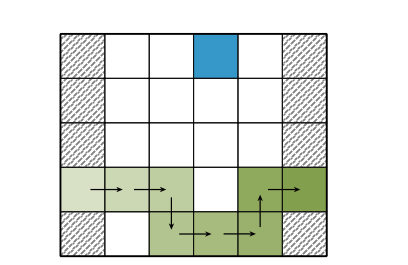
Empirical evaluation pits the modified hybrid agent against a classical RL agent within an environment featuring a time-dependent reward function, and the results demonstrate the hybrid agent’s superior adaptability. The hybrid agent achieves a higher average success probability compared to the classical counterpart, and the dissipation mechanism effectively mitigates the impact of changing rewards.
The study demonstrates the successful adaptation of a hybrid quantum-classical reinforcement learning agent to dynamic environments, extending its applicability beyond stationary problems. The research addresses a key limitation of prior hybrid agents, which were previously confined to scenarios lacking temporal dependencies within the Markov decision process.
Should all previously rewarded sequences be removed from Rfound, a fallback mechanism ensures continued learning, preventing complete knowledge loss and maintaining a baseline level of performance. The supplementary material provides a comprehensive explanation of the algorithm’s nuances, including a detailed description of the purging process and the rationale behind specific design choices. Mathematical notation and algorithmic details are presented clearly, allowing for easy replication and extension of the work.
Future research directions include exploring different strategies for managing the Rfound set, such as using a sliding window or a forgetting mechanism. The team also plans to investigate the performance of the agent in more complex and realistic environments, and to compare it with other state-of-the-art reinforcement learning algorithms. The study’s findings have implications for a wide range of applications, including robotics, game playing, and financial modeling.
👉 More information
🗞 Quantum reinforcement learning in dynamic environments
🧠 DOI: https://doi.org/10.48550/arXiv.2507.01691