Research demonstrates that variational quantum algorithms utilising disordered Ising chains exhibit improved trainability when initialised in a many-body-localised phase. This approach mitigates barren plateaus, a common scalability issue in quantum computation, by exploiting the relationship between phases of matter and algorithm performance.
The pursuit of practical quantum computation currently focuses on variational algorithms, methods designed to extract useful results from near-term quantum devices. A significant obstacle to this approach is the phenomenon of ‘barren plateaus’, where the optimisation landscape becomes excessively flat, hindering the algorithm’s ability to learn. New research demonstrates a connection between the physical phases of matter and the trainability of these algorithms, specifically within analog quantum computation. Kasidit Srimahajariyapong, Supanut Thanasilp, and Thiparat Chotibut, from the Chula Intelligent and Complex Systems Lab at Chulalongkorn University, alongside researchers at the Ecole Polytechnique Fédérale de Lausanne, explore this relationship in their article, “Connecting phases of matter to the flatness of the loss landscape in analog variational quantum algorithms”. Their work investigates how initialising a quantum algorithm within a ‘many-body-localized’ phase, a state of matter where quantum coherence is preserved despite disorder, can mitigate barren plateaus and improve optimisation performance.
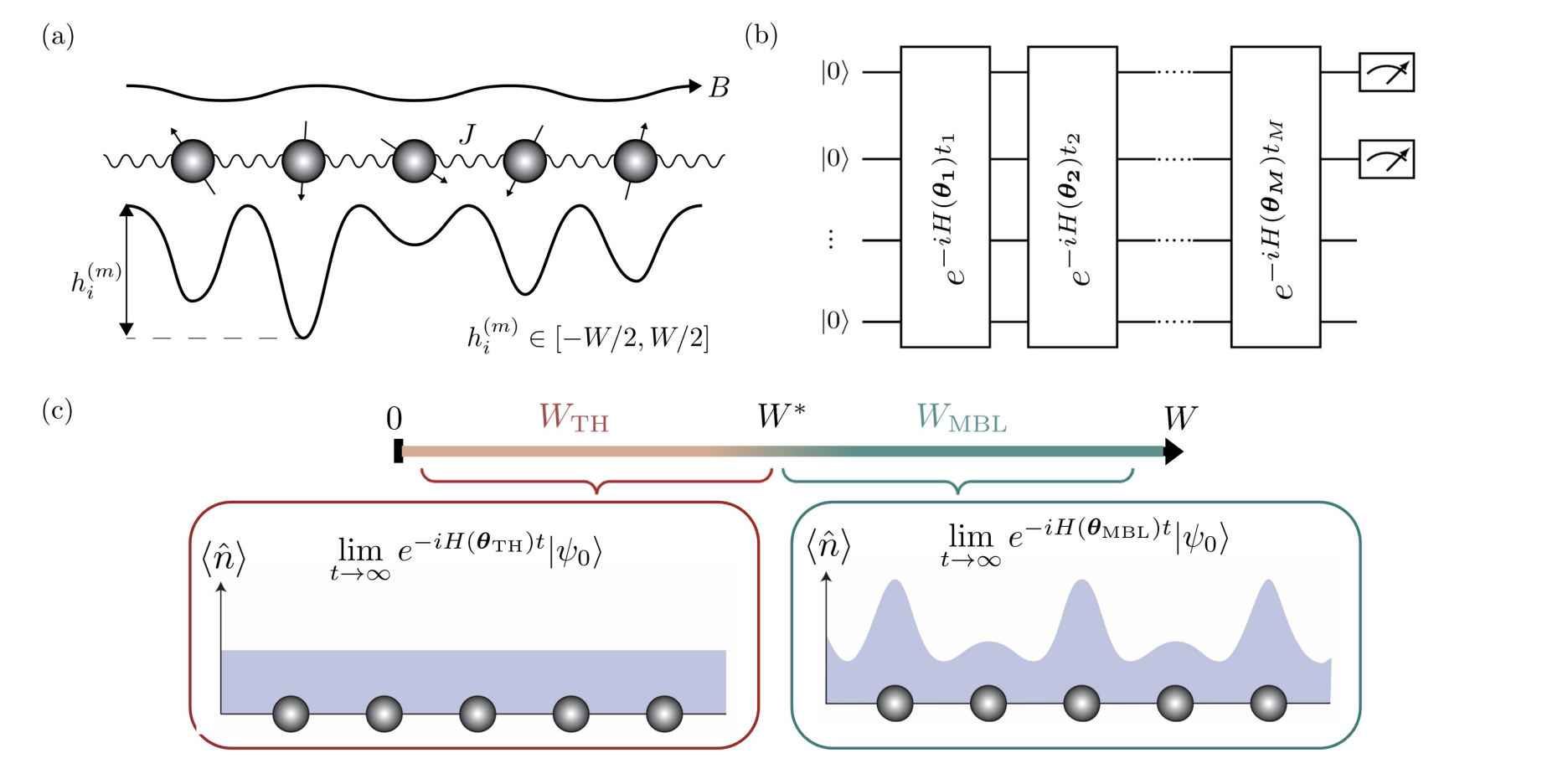
Variational quantum algorithms represent a promising route to utilising quantum computation on currently available hardware, yet frequently encounter optimisation challenges arising from barren plateaus, which impede performance. Recent research investigates a novel approach to mitigating these difficulties by applying principles from many-body localisation (MBL) to construct variational ansätze, potentially leading to more robust and efficient algorithms. Researchers demonstrate the efficacy of utilising MBL principles to build these ansätze, specifically by constructing them from sequences of ‘quenches’ applied to a disordered Ising chain and utilising the system’s inherent dynamics for analog quantum computation. Results indicate that ansätze employing MBL exhibit improved trainability compared to those operating in a thermalised phase, maintaining expressivity during optimisation.
The study establishes a clear link between the phase of matter and the trainability of variational quantum algorithms, moving beyond traditional optimisation techniques and embracing concepts from condensed matter physics. ‘Quenches’ refer to sudden changes in a system’s parameters, and the researchers carefully tuned the disorder strength to position these quenches within either a thermalised or MBL phase, subsequently analysing the resulting expressivity and scaling of loss variance to understand the impact of each phase on algorithm performance. Findings reveal that barren plateaus emerge at significantly smaller values in the thermalised phase, highlighting the distinct advantage of utilising MBL to preserve crucial gradient information during optimisation and enabling more effective exploration of the solution space.
Performance evaluation encompassed two benchmark problems widely used in quantum algorithm development: the Variational Quantum Eigensolver (VQE) and the Max-Cut problem, providing a comprehensive assessment of the proposed MBL-inspired approach. VQE is a hybrid quantum-classical algorithm used to find the ground state energy of a molecule, while the Max-Cut problem is a combinatorial optimisation problem aiming to partition the nodes of a graph to maximise the number of edges between different partitions. Increasing the number of quenches within the ansätze generally improves the accuracy of ground state energy estimation in VQE and the approximation ratio in Max-Cut. Notably, the nearest-neighbour Ising Hamiltonian consistently yielded superior results compared to the more complex long-range Ising Hamiltonian, suggesting that Hamiltonian complexity plays a crucial role in algorithm performance and highlighting the importance of careful model selection. The 6-quench ansatz, utilising the nearest-neighbour Hamiltonian, achieved a high approximation ratio of approximately 99.61% for the Max-Cut problem, demonstrating the potential of this approach to deliver near-optimal solutions.
The study proposes an innovative MBL initialisation strategy, whereby ansätze are initialised in the MBL regime at intermediate quench values, offering a practical guideline for scaling analog-hardware variational quantum algorithms. This approach aims to strike a delicate balance between initial trainability, ensuring that the algorithm can quickly begin to converge towards a solution, and sufficient expressivity, allowing it to explore a wide range of possible solutions. By carefully selecting the initial conditions, researchers can significantly improve the performance and robustness of variational quantum algorithms, making them more suitable for implementation on near-term quantum devices. The ability to successfully identify degenerate ground states in the Max-Cut problem further validates the effectiveness of the MBL-inspired ansätze, demonstrating their ability to handle complex optimisation landscapes.
Future research should focus on exploring the limits of scalability, investigating how well this approach performs as the size of the problem increases, and addressing the impact of noise, a pervasive challenge in quantum computing, on the performance of MBL-inspired ansätze. Understanding how noise affects the algorithm and developing strategies to mitigate its effects are crucial steps towards building practical quantum algorithms. Further investigation into the optimal number of quenches, determining the ideal balance between expressivity and computational cost, and the relationship between disorder strength and algorithm performance is also warranted, providing valuable insights for optimising the algorithm’s parameters. These findings contribute to the growing body of evidence suggesting that leveraging principles from condensed matter physics can unlock new possibilities for developing robust and efficient quantum algorithms for near-term quantum devices.
👉 More information
🗞 Connecting phases of matter to the flatness of the loss landscape in analog variational quantum algorithms
🧠 DOI: https://doi.org/10.48550/arXiv.2506.13865