Lattice gauge theories (LGTs), a type of quantum field theory, are crucial in theoretical physics, cosmology, and condensed matter physics. However, their complexity often requires numerical methods for study. The Schwinger model, a simple gauge theory, is used as a benchmark for these methods. Quantum algorithms may offer a more scalable computation of LGTs, but understanding the resources required is still lacking. Researchers have used the quantum subspace expansion (QSE) algorithm and a novel method called qubitization to compute the ground state of the Schwinger model, offering a more efficient method for computing LGTs. Further research is needed to fully realize this potential.
What are Lattice Gauge Theories and Why are They Important?
Lattice gauge theories (LGTs) are a type of quantum field theory (QFT) that play a crucial role in various fields of theoretical physics. They describe fundamental particles and their interactions through the exchange of force carriers. The gauge symmetry of these theories determines their nature, with quantum electrodynamics (QED) arising from an abelian U1 symmetry and quantum chromodynamics (QCD) from a non-abelian SU3 symmetry. LGTs also play significant roles in cosmology and condensed matter physics.
Many gauge theories are too complex to study analytically, and because many phenomena of interest arise non-perturbatively, efficient numerical methods have become increasingly important in studying gauge theories. These theories are often studied using LGTs, in which space-time is discretized onto a lattice of points on which the values of matter and gauge fields are defined. This approach was originally formulated by Wilson and is now routinely used to study such phenomena.
However, applying Monte Carlo algorithms to some Hamiltonians leads to the so-called sign problem or complex action problem, in which the integrand contains negative terms or the action becomes complex. This makes it difficult to interpret the Boltzmann weight as a probability density function. This issue poses a significant challenge to simulations involving interacting electrons, as well as lattice QCD with nonzero Baryon density.
What is the Schwinger Model and How is it Used?
One of the most widely studied gauge field theories is the Schwinger model, which describes charged particles and their interactions with electromagnetic fields within QED in 1+1D. Being the simplest gauge theory, the Schwinger model plays an important role as a benchmark for numerical methods for solving gauge theories, as well as a pedagogical tool that can be used to study a range of complex phenomena that arise in more complex quantum field theories.
Such phenomena include chiral symmetry breaking, in which an effective fermionic mass arises from pairing of fermion and antifermions, confinement where fermions only exist alongside their corresponding antiparticle and separating such pairs requires increasing energy as they are drawn further apart, and phase transitions between massive and massless phases.
Simulating the real-time dynamics of the Schwinger model, as well as the ground state in the presence of a chemical potential imbalance between different fermion flavours, both give rise to the sign problem. Consequently, the lattice Schwinger model has been used to benchmark novel computational approaches which do not suffer from the sign problem.
How Can Quantum Algorithms Help Solve LGTs?
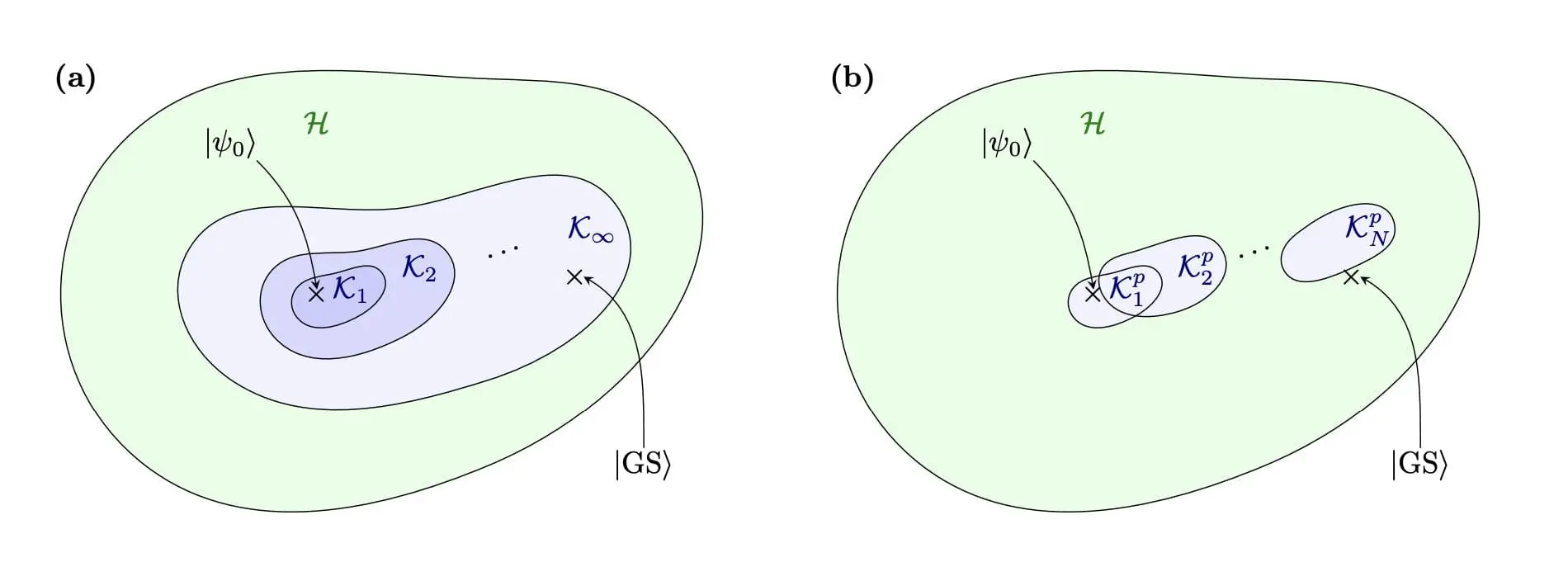
Quantum algorithms may offer a pathway towards more scalable computation of ground-state properties of LGTs. However, a comprehensive understanding of the quantum computational resources required for such a problem is thus far lacking. In this work, the researchers investigate using the quantum subspace expansion (QSE) algorithm to compute the ground state of the Schwinger model.
They perform numerical simulations including the effect of measurement noise to extrapolate the resources required for the QSE algorithm to achieve a desired accuracy for a range of system sizes. Using this, they present a full analysis of the resources required to compute LGT vacuum states using a quantum algorithm using qubitization within a fault-tolerant framework.
What is Qubitization and How Does it Improve Computation?
Qubitization is a novel method for performing computation of a LGT Hamiltonian based on a linear combination of unitaries (LCU) approach. The cost of the corresponding block encoding operation scales as O(N) with system size N. Including the corresponding prefactors, this method reduces the gate cost by multiple orders of magnitude when compared to previous LCU methods for the QSE algorithm, which scales as O(N^2) when applied to the Schwinger model.
While the qubit and single circuit T-gate cost resulting from this resource analysis is appealing to early fault-tolerant implementation, the researchers find that the number of shots required to avoid numerical instability within the QSE procedure must be significantly reduced in order to improve the feasibility of the methodology.
What are the Future Implications of This Research?
This research presents a significant step forward in the use of quantum algorithms to solve LGTs. The development of the QSE algorithm and the use of qubitization within a fault-tolerant framework offer a more scalable and efficient method for computing the ground-state properties of LGTs.
However, the researchers note that the number of shots required to avoid numerical instability within the QSE procedure must be significantly reduced in order to improve the feasibility of the methodology. This suggests that further research and development are needed to fully realize the potential of quantum algorithms in this field.
In conclusion, this research represents a significant contribution to the ongoing efforts to harness the power of quantum computing to solve complex problems in theoretical physics. The findings provide valuable insights into the computational resources required to solve LGTs and offer a promising pathway towards more efficient and scalable quantum computations.
qubitization”
Publication Date: 2024-03-13
Authors: Lewis W. Anderson, Martin Kiffner, Tom O’Leary, Jason Crain, et al.
Source: arXiv (Cornell University)
DOI: https://doi.org/10.48550/arxiv.2403.08859