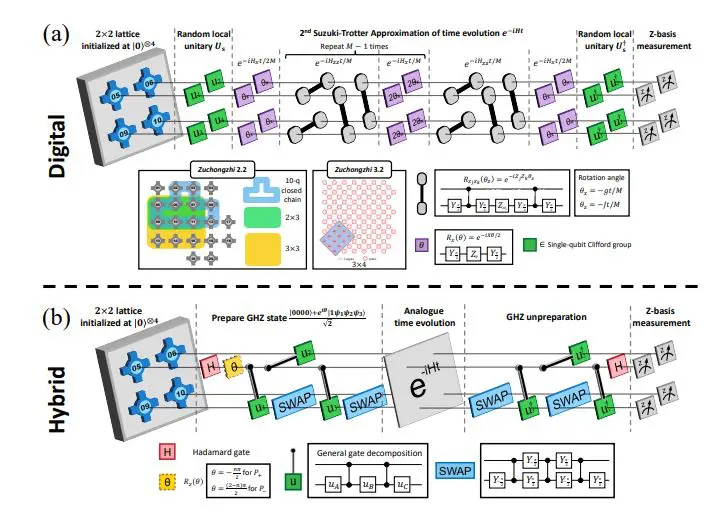
Understanding the behaviour of materials at realistic temperatures is crucial for tackling complex thermodynamic challenges, and a team led by Yangsen Ye, Jue Nan and Dong Chen from Fudan University now presents a new method for simulating these systems on quantum hardware. The researchers develop algorithmic protocols that calculate free energy as a precise function of temperature, achieving uniform convergence and allowing for detailed thermodynamic analysis. They demonstrate the power of their approach by successfully simulating the transverse field Ising and XY models using superconducting qubits, and importantly, the simulation results align closely with established theoretical predictions. This general framework unlocks access to vital thermodynamic properties, such as entropy and heat capacity, promising significant advances in fields ranging from materials design to pharmaceutical development.
Heralded Entanglement for 102km Quantum Key Distribution
Scientists have demonstrated a quantum key distribution (QKD) system capable of secure communication over 102 kilometres using existing optical fibre infrastructure. This achievement enhances QKD performance by utilising heralded entanglement, a technique that improves photon transmission reliability and achieves a key rate of 100 kilobits per second. This approach effectively reduces errors caused by multiple photon events, bolstering the security and efficiency of the communication link. The system employs a specialised photon source based on spontaneous parametric down-conversion, optimising the generation of entangled pairs, and sensitive single-photon detectors operating with minimal background noise.
By encoding information using photon timing, the system further enhances its resilience to interference. This high-performance QKD system represents a significant step towards practical quantum communication networks, offering comparable security to trusted-node systems. The system achieves a low quantum bit error rate, indicating high-quality communication, and estimates a secure key rate of 118 kilobits per second after accounting for real-world imperfections. While performance is currently limited by signal loss and detector sensitivity, further improvements are possible with more advanced components.
Quantum Kernel Estimation of the TFIM Model
Researchers have successfully simulated the one-dimensional Transverse Field Ising Model (TFIM), a complex quantum system, using a novel Quantum Kernel Function Estimation (QKFE) algorithm on superconducting qubits. This work demonstrates a powerful new technique for probing quantum many-body physics, particularly at points where the system undergoes dramatic changes in behaviour. The TFIM’s unique self-duality was leveraged to validate the accuracy of the simulation. The experiment involved carefully calibrating and controlling the superconducting qubits, ensuring high-fidelity gate operations and measurements.
To minimise the impact of noise and imperfections, the team implemented error mitigation techniques, including noise estimation and probabilistic error cancellation. These techniques are essential for achieving accurate and reliable results in quantum simulations. The researchers calculated the free energy of the system and measured quantities like the Loschmidt amplitude and out-of-time-ordered correlators, providing insights into the system’s dynamics and quantum chaos. This work demonstrates the potential of QKFE as a powerful tool for exploring complex quantum systems and advancing our understanding of quantum many-body physics.
Quantum Thermodynamics Simulated with High Precision
Scientists have developed a new method for simulating quantum thermodynamics on quantum hardware, achieving precise calculations of crucial thermodynamic properties like free energy, entropy, and heat capacity. This breakthrough utilises a Quantum Kernel Function Expansion (QKFE) algorithm, which translates the time evolution of a quantum system into a corresponding temperature scale, opening new avenues for advancements in material design and drug development. The team accurately estimated the density of states, a crucial component in determining thermodynamic properties, by employing a mathematical expansion and extracting key parameters from the quantum processor. Experiments successfully simulated both transverse field Ising and XY models, demonstrating quantitative agreement with established theoretical predictions and confirming the algorithm’s ability to accurately capture the behaviour of complex quantum systems. Specifically, the QKFE algorithm accurately captured the quantum ferromagnetic-paramagnetic duality in one-dimensional systems and critical behaviours in two dimensions. Measurements of the heat capacity in two-dimensional transverse field Ising models demonstrated extensive scaling, confirming the algorithm’s ability to handle complex quantum systems with high precision.
Quantum Simulation Yields Accurate Thermodynamic Properties
Researchers have developed new algorithmic protocols for simulating thermodynamic properties on quantum hardware using kernel function expansion. This approach successfully produces the free energy as an analytic function of temperature, demonstrating uniform convergence and quantitative agreement with exact results when applied to transverse field Ising and XY models using superconducting qubits, offering access to crucial properties like entropy, heat capacity, and criticality. By circumventing the limitations of classical methods caused by the exponential scaling of the complexity of quantum systems, this quantum simulation technique provides a promising route to address complex thermodynamic problems. Experiments successfully captured finite-temperature phase transitions in two-dimensional models and observed the quantum ferromagnetic-paramagnetic duality in one-dimensional systems, validating the approach on relatively small systems. While acknowledging current system size limitations, the authors anticipate that this hybrid digital-analogue protocol is readily scalable, potentially unlocking new opportunities to explore phenomena like vortex proliferation in superfluid phase transitions and furthering both fundamental scientific understanding and practical applications.
🗞 Algorithmic Quantum Simulations of Quantum Thermodynamics
🧠 ArXiv: https://arxiv.org/abs/2511.22898