Understanding the behaviour of many-particle systems presents a significant challenge in physics, and accurately calculating the energy of individual excitations within these systems remains a key goal. Sumeet, M. Hörmann, and K. P. Schmidt from the Friedrich-Alexander-Universität Erlangen-Nürnberg have developed a new quantum algorithm that addresses this problem, enabling the calculation of one quasi-particle excitation energies in complex systems. Their approach combines numerical linked-cluster expansions with a variational eigensolver, and crucially, incorporates a post-processing step to ensure the accuracy and convergence of calculations, even when fundamental symmetries are broken. This advancement extends the capabilities of variational algorithms to excited-state calculations, offering a powerful new tool for investigating the properties of materials and furthering our understanding of many-body physics in the thermodynamic limit.
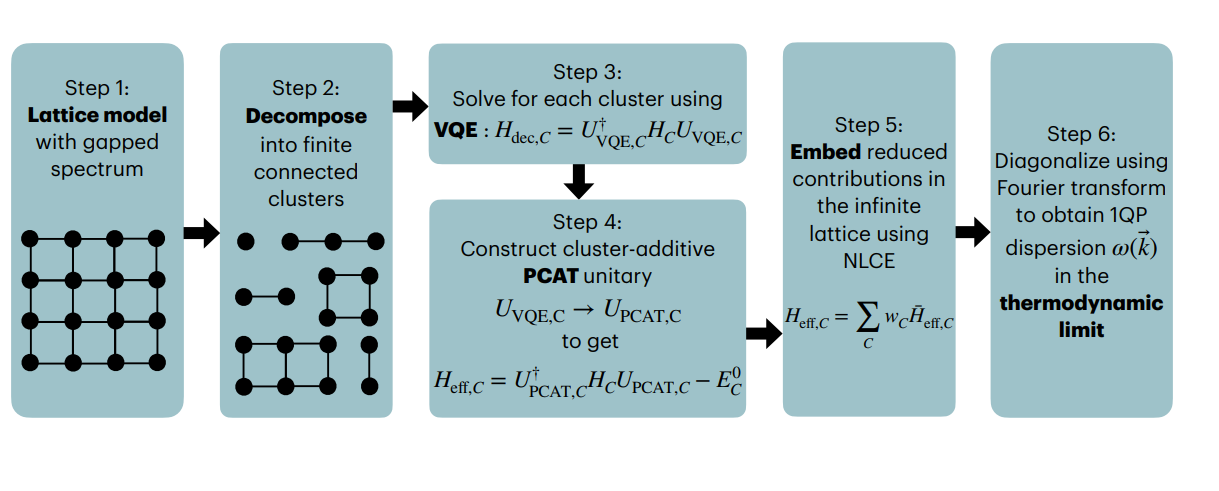
This research combines variational quantum algorithms, utilizing both quantum and classical computers, with a powerful classical technique called linked cluster expansion. The team’s innovation lies in a method called projective cluster-additive transformation, which reshapes the mathematical description of the system to improve the accuracy of quantum computations. This new method allows for more efficient and accurate calculations of excited states by addressing the challenges of complex quantum systems and reducing computational demands.
By integrating linked cluster expansion for classical pre-processing with variational quantum algorithms for quantum computation, the researchers achieved better results than using either method alone. The projective cluster-additive transformation also overcomes a common problem in variational quantum algorithms, known as barren plateaus, where optimization becomes difficult. The method involves transforming the original mathematical description of the system, called the Hamiltonian, into a new form using the projective cluster-additive transformation. This separates the Hamiltonian into simpler components, making it easier to handle within a variational quantum algorithm.
The researchers implemented a variational quantum eigensolver, using a parameterized quantum circuit to prepare trial wavefunctions and estimate the energy of each trial state. Classical calculations using linked cluster expansion determined the appropriate parameters for the quantum algorithm and analyzed the results, ensuring accuracy and reliability. The results demonstrate that this new method accurately calculates the energies of excited states, even for relatively large systems, and reduces computational cost. Comparisons with exact solutions validate the accuracy of the proposed method, and the team analyzed how the calculations scale with system size and the number of qubits.
This work represents a significant step forward in quantum simulation, with potential applications in materials science, chemistry, and drug discovery. The method could be extended to study other quantum systems, such as those with long-range interactions or disorder, and the results could guide the development of quantum hardware for simulating complex quantum systems. By improving variational quantum algorithms, this research opens new avenues for understanding and designing materials and molecules with specific properties, and for accelerating the discovery of new drugs and technologies.
Cluster Additivity Achieved with Hybrid Algorithm
Scientists have developed a new hybrid quantum-classical algorithm for computing the energies of quasi-particle excitations in many-body systems, combining numerical linked-cluster expansions with the variational eigensolver. This work addresses a significant challenge in extending linked-cluster expansion methods to excited states, specifically ensuring cluster additivity, a key requirement for accurate convergence in calculations. The team successfully implemented the variational eigensolver to simplify the mathematical description of the system using a single transformation, subsequently refining this transformation with the projective cluster-additive transformation to guarantee cluster additivity. Experiments benchmarked the method on the transverse-field Ising model in one and two dimensions, including systems with a longitudinal field, computing the dispersions of one quasi-particle.
Results demonstrate the effectiveness of two cost function classes, trace minimization and variance-based, when used with the Hamiltonian variational ansatz. For the simplest systems, the team found that using approximately half the available qubits was sufficient to achieve results matching exact diagonalization. Further investigations into the transverse-field Ising model with a longitudinal field, where symmetry is broken and the projective cluster-additive transformation becomes essential, revealed that both using half and all of the qubits converged with increasing system size. Notably, using all qubits provided improved accuracy in these calculations. Measurements confirm that this approach establishes the projective cluster-additive transformation as a robust cluster-additive framework, extending variational quantum algorithms to excited-state calculations in the thermodynamic limit via linked-cluster expansion. The breakthrough delivers a method where the projective cluster-additive transformation, requiring only low-energy information, is applicable to any quantum eigenstate preparation method, broadening its potential impact.
🗞 Quantum algorithm for one quasi-particle excitations in the thermodynamic limit via cluster-additive block-diagonalization
🧠 ArXiv: https://arxiv.org/abs/2511.06623