Solving linear systems of equations represents a fundamental challenge across numerous scientific and engineering disciplines, and a team led by Lucas Q. Galvão, Anna Beatriz M. de Souza, and Alexandre Oliveira S. Santos, all from the Latin America Quantum Computing Center at SENAI CIMATEC, now presents a comprehensive tutorial on a potentially revolutionary approach. Their work focuses on the Harrow, Hassidim, and Lloyd (HHL) quantum algorithm, which promises exponential speedups over classical methods for solving these equations under certain conditions. While classical algorithms typically require a number of operations proportional to the size of the system, the HHL algorithm offers a significantly faster route, potentially unlocking breakthroughs in fields like machine learning, differential equation solving, and cryptography. Recognising a gap in accessible educational materials, the researchers provide a detailed explanation of the algorithm’s underlying mathematical and physical principles, alongside illustrative examples and a comparative analysis with classical simulations, making this complex topic approachable for undergraduate students.
The work encompasses foundational quantum algorithms like Shor’s algorithm, which has significant implications for modern cryptography due to its ability to factor large numbers, and Grover’s algorithm, offering a quadratic speedup over classical methods. Research highlights the HHL algorithm, a key method for solving linear systems of equations, potentially offering exponential speedups under specific conditions, and explores its applications. Research also addresses quantum error correction, essential for building fault-tolerant quantum computers, and explores promising qubit technologies like topological, superconducting, trapped ion, and photonic qubits. The compilation also includes research on classical high-performance computing techniques, such as parallel computing and the conjugate gradient method, alongside foundational texts on algorithm design and computational complexity. Recognizing the potential of quantum computing to outperform classical methods, the researchers focused on the HHL algorithm, which demonstrates a complexity of poly(log N), a significant improvement over classical methods, particularly for sparse matrices. To bridge the gap between theoretical potential and practical understanding, the team developed a comprehensive tutorial aimed at undergraduate students in physics and computer science. The study establishes the mathematical foundations of the HHL algorithm and translates this into a practical implementation using the Qiskit quantum computing framework.
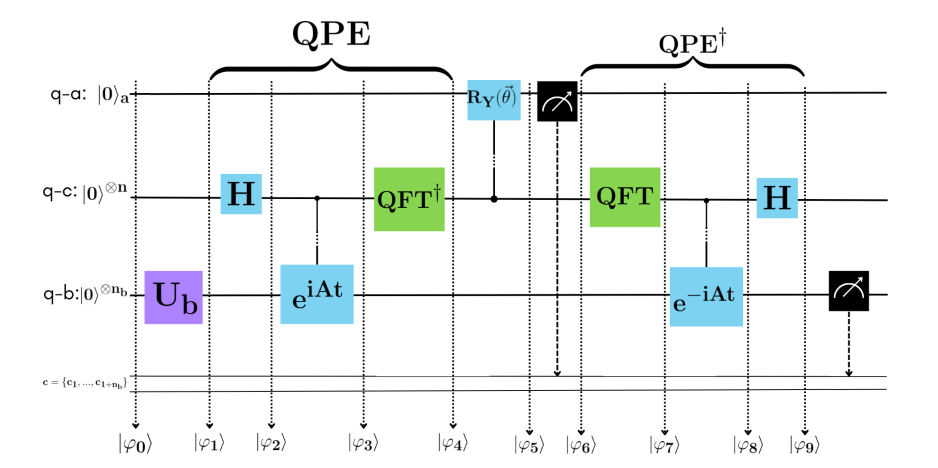
A numerical example is presented, allowing readers to trace the evolution of the quantum circuit as it solves a system of linear equations, providing a clear understanding of both the theoretical underpinnings and the practical application of the algorithm. To ensure accessibility, the tutorial emphasizes guided implementation exercises, allowing students to actively engage with the material and solidify their understanding. The research achieves a detailed representation of the quantum circuit as a state vector, laying the groundwork for subsequent calculations. The team successfully applied controlled unitary operators, achieving a transformation that encodes phase information onto the qubits, a crucial step in the algorithm. This transformation cancels out terms unless a specific condition is met, demonstrating the filtering property inherent in the Fourier transform. Further analysis reveals a crucial relationship between the Hamiltonian and the unitary operator, allowing the team to express the final state in a specific form. The researchers demonstrate how the HHL algorithm offers potential exponential speedup over classical methods, particularly for certain types of problems encountered in fields like machine learning and cryptographic analysis. They achieve this by outlining the algorithm’s steps and illustrating its operation through numerical examples. They highlight the trade-offs involved in choosing the number of qubits used in QPE, noting that increasing precision requires more qubits but also increases computational cost and susceptibility to errors. They suggest that future research should focus on mitigating these limitations and exploring error correction techniques to fully realize the potential of the HHL algorithm for solving complex computational problems.
👉 More information🗞Solving Linear Systems of Equations with
🗞 Solving Linear Systems of Equations with the Quantum HHL Algorithm: A Tutorial on the Physical and Mathematical Foundations for Undergraduate Students
🧠 ArXiv: https://arxiv.org/abs/2509.16640