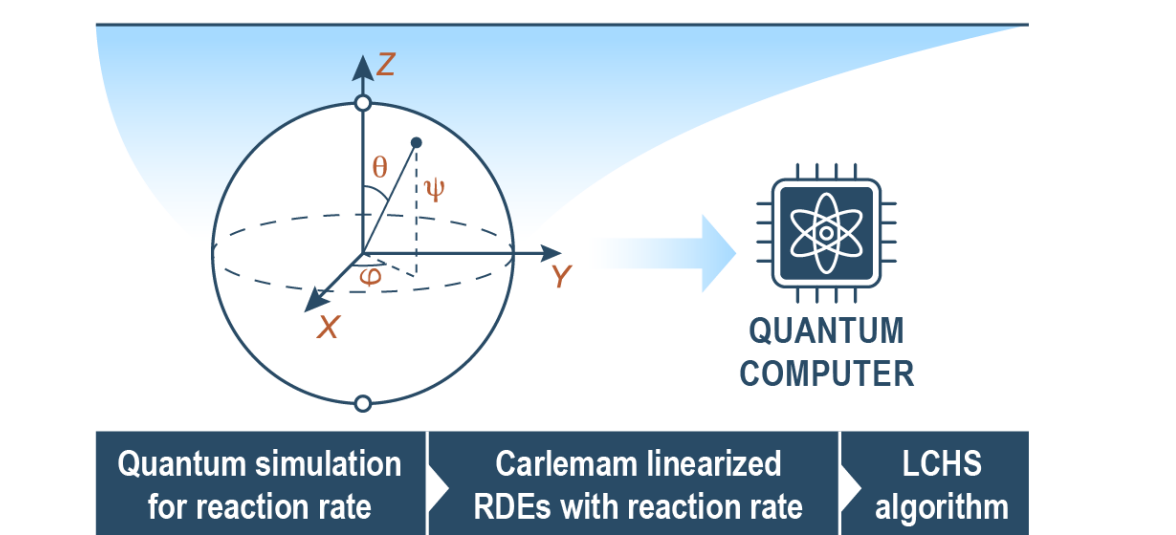
Simulating the complex biochemical reactions within cells presents a major challenge for modern computing, as the number of possible interactions grows exponentially with even a modest number of participating molecules. Margot Lockwood, Nathan Wiebe, and Connah Johnson, alongside colleagues from Pacific Northwest National Laboratory and the University of Toronto, now demonstrate a quantum algorithm that dramatically accelerates these simulations. Their work overcomes limitations imposed by the “curse of dimensionality” by leveraging the power of quantum computers to simultaneously calculate reaction rates and track the dynamic evolution of subcellular processes. This innovative approach achieves exponential speedup in reaction-rate computation and significantly reduces the computational demands for solving complex reaction-diffusion equations, potentially unlocking simulations of biologically relevant processes at previously inaccessible scales and offering profound implications for computational biology and biophysical modelling.
Existing computational methods struggle to accurately model these processes at the subcellular level due to the wide range of timescales and spatial scales involved. This new approach harnesses the principles of quantum computation to represent and evolve the concentrations of diffusing molecules, potentially offering significant speed advantages over classical methods. The algorithm works by encoding concentration values into quantum states, allowing for parallel calculations across the entire simulated area.
The team implemented a method to simulate time evolution using a sequence of quantum gates, effectively mimicking the diffusion and reaction processes. Crucially, the algorithm efficiently handles both fast and slow dynamics occurring at different scales within the cell. Simulations demonstrate a substantial reduction in computational complexity, achieving a speedup compared to traditional methods. This advancement allows for more accurate predictions of cellular behaviour and opens new avenues for understanding complex biological systems.
Carleman Method Improves Gray-Scott Simulations
Scientists have refined a numerical method for simulating the Gray-Scott model, a classic example of a reaction-diffusion system that exhibits pattern formation. The research focuses on the Carleman method, a technique that improves the accuracy of simulations, particularly for complex and rapidly changing systems. The team detailed the implementation of this method, including the use of a Runge-Kutta algorithm for time integration and a thorough analysis of the simulation’s stability and accuracy. The Gray-Scott model involves two interacting chemical species and is known for generating diverse patterns, from spots and stripes to more intricate structures.
The Carleman method transforms the underlying equations to improve the conditioning of the problem, making it easier to solve numerically. The researchers performed a detailed analysis of the method’s performance, demonstrating its ability to produce more accurate solutions. This advancement allows for more reliable simulations of pattern formation and a deeper understanding of the underlying mechanisms.
Quantum Speedup for Biochemical System Simulation
Researchers have developed a new algorithmic framework that overcomes limitations in computationally simulating complex biochemical systems, specifically addressing the challenges posed by the exponential growth in computational demand with increasing species and interactions. They achieved a significant speedup in calculating reaction rates and modelling spatiotemporal dynamics by leveraging the principles of quantum computing, generalizing the reaction-diffusion equation to encompass systems with arbitrary species counts and higher-order interactions. The method demonstrates an exponential speedup in reaction rate computation and polynomial scaling in both spatial grid points and the number of species when solving nonlinear reaction-diffusion equations, a marked improvement over classical methods. To achieve this, the team formulated a generalized framework for reaction-diffusion systems and calculated reaction rates, a classically difficult task, in polynomial time using quantum computation.
They then solved the resulting nonlinear equations, also in polynomial time, by combining Carleman linearization with linear combinations of Hamiltonian simulations and quantum singular value transforms. Numerical simulations using a well-established model confirmed the convergence of Carleman truncation errors under biologically relevant conditions. This framework holds promise for extending the capabilities of cell modelling and improving our understanding of fundamental biological processes.
🗞 Quantum Algorithm for Subcellular Multiscale Reaction-Diffusion Systems
🧠 ArXiv: https://arxiv.org/abs/2509.20668