

Contextuality, a fundamental limitation on our ability to describe quantum systems with classical hidden variables, presents a significant challenge for determining the boundaries between quantum and classical behaviour. Colm Kelleher and Frédéric Holweck, from the Laboratoire Interdisciplinaire Carnot de Bourgogne and Université de Technologie de Belfort-Montbéliard, alongside their colleagues, now demonstrate a quantum algorithm that efficiently computes the degree of contextuality, a calculation known to be exceptionally difficult for classical computers. Their method, built upon Grover’s search algorithm, achieves this speedup for specific quantum states, offering a potential pathway to explore the limits of quantum behaviour. This advancement tackles a computationally intensive problem linked to a broader class of optimisation challenges, and while current quantum hardware introduces errors that limit conclusive testing, the team’s work paves the way for future investigations with more robust technology.
Detailed descriptions of quantum states face inherent constraints. When measuring N-qubit spin operators, these constraints arise from the fundamental rules governing quantum mechanics and classical limitations determined by the degree of contextuality, a computationally challenging property to determine. Scientists now present a quantum algorithm, building upon Grover’s search algorithm, to compute this degree of contextuality in N-qubit states, achieving a speedup over classical brute-force methods. The team also investigated variations of Grover’s algorithm that encode information in the phases of quantum states, reducing the complexity of the required quantum circuits.
Quantum Algorithm for Geometric Invalidity Minimisation
Scientists have developed a quantum algorithm to find the minimum number of invalid lines in geometric configurations, such as triangles and grids. The core problem involves finding the configuration of invalid lines that minimises a specific cost function within a geometric structure. The quantum algorithm utilises a variation of Grover’s search algorithm to efficiently search for this minimum. Researchers experimented with two circuit designs, one using ancilla qubits and another designed to minimise their use. The algorithm was tested using both classical simulators and simulators that model the noise characteristics of real quantum hardware, as well as on actual IBM quantum processors.
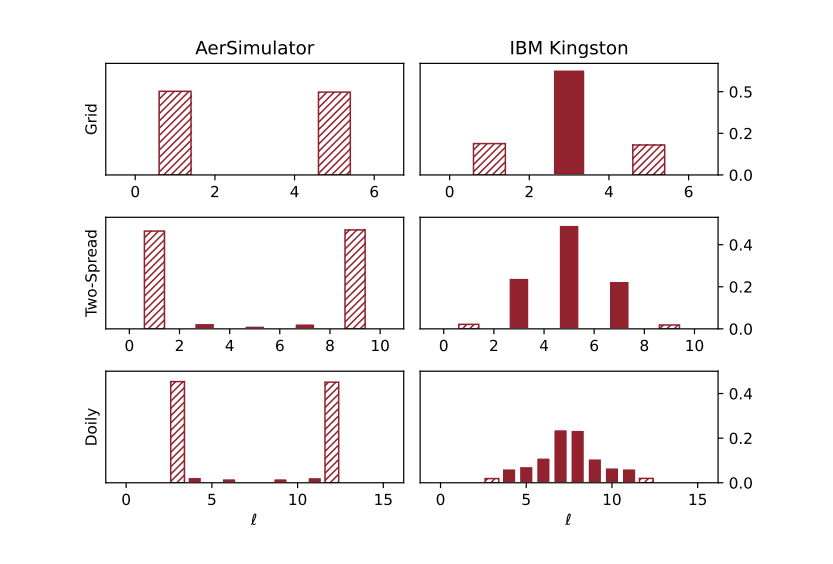
In noiseless simulations, the algorithm successfully identified the correct solution for both triangle and grid geometries. However, adding noise to the simulations significantly degraded performance, making it harder to consistently find the correct solution. Running the algorithm on real IBM quantum computers yielded results similar to the control, suggesting that the noise and limitations of the hardware overwhelmed any potential quantum advantage. Researchers emphasise that noise introduced during the conversion of the quantum circuit into a form executable on the hardware was a major source of error. This research demonstrates that noise is a significant obstacle to achieving quantum advantage on current quantum devices, highlighting the need for error mitigation techniques and circuit optimisation to unlock the full potential of quantum computation.
Contextuality Degree Computation via Grover’s Algorithm
Scientists have achieved a breakthrough in computing the degree of contextuality, a fundamental property of quantum systems, by developing a new quantum algorithm. This algorithm leverages Grover’s search algorithm to compute contextuality in N-qubit states, demonstrating a significant speedup over classical methods. Researchers formally defined the degree of contextuality as the minimal number of unsatisfied constraints when attempting to assign classical values to quantum operators within a given geometry. The work demonstrates that certain arrangements of quantum operators, like the Peres-Mermin Magic Square, exhibit contextuality, meaning no classical assignment can simultaneously satisfy all associated constraints.
Researchers formally defined the degree of contextuality, demonstrating its connection to the number of unsatisfied constraints when attempting to model quantum behaviour with classical variables. They constructed a geometric representation of the MaxLin2 problem, allowing for a clear visualisation of contextual constraints. This breakthrough delivers a new method for quantifying a fundamental quantum property, opening avenues for advancements in quantum computing, random access codes, and quantum error-correcting codes.
Max Lin 2 Solved With Quantum Speedup
This research presents a new quantum algorithm designed to efficiently find solutions to Max Lin 2 problems, achieving a quadratic speedup compared to classical methods. The team developed a standard Grover-based implementation exhibiting a time complexity of O(√n log log n). Recognising limitations imposed by noise in current quantum hardware, the researchers also proposed a quasi-Grover algorithm that significantly reduces circuit width without needing to pre-define a search threshold. This innovative approach encodes information about invalid lines within the relative phases of quantum states, resulting in a time complexity of O(n1/3(log n)2 log log n).
Testing across various geometries yielded high probabilities of measuring the desired solution after a relatively small number of queries. While comparable to standard Grover complexity, this method offers a substantial reduction in required circuit width. The authors acknowledge that current quantum backends introduce noise that hinders performance improvements. Future work should explore alternative diffusion operators alongside the phase-encoding quasi-Grover operator, seeking methods to further distinguish between basis states based on their relative phases. This generalisation of Grover’s algorithm, encoding numeric information in relative phases, represents a novel contribution.
👉 More information
🗞 A Quantum Algorithm For Computing Contextuality Bounds
🧠 ArXiv: https://arxiv.org/abs/2509.20250

