Quantum metrology promises increasingly precise measurements, and researchers continually seek ways to push the boundaries of precision, particularly in phase estimation which has applications ranging from fundamental physics to practical sensing. Giorgio Minati, Enrico Urbani, and Nicolò Spagnolo, alongside Valeria Cimini and Fabio Sciarrino, have developed a new approach to multiparameter quantum-enhanced metrology that overcomes limitations in existing techniques. Their work introduces an adaptive strategy using squeezed light which achieves unprecedented precision without requiring pre-calibration of the squeezing level, a significant advantage in real-world applications prone to instability. This self-calibrating scheme not only enhances measurement accuracy across the full range of possible values, but also establishes a robust and reliable framework for scalable quantum sensor networks utilising squeezed light, paving the way for practical advancements in quantum sensing technology.
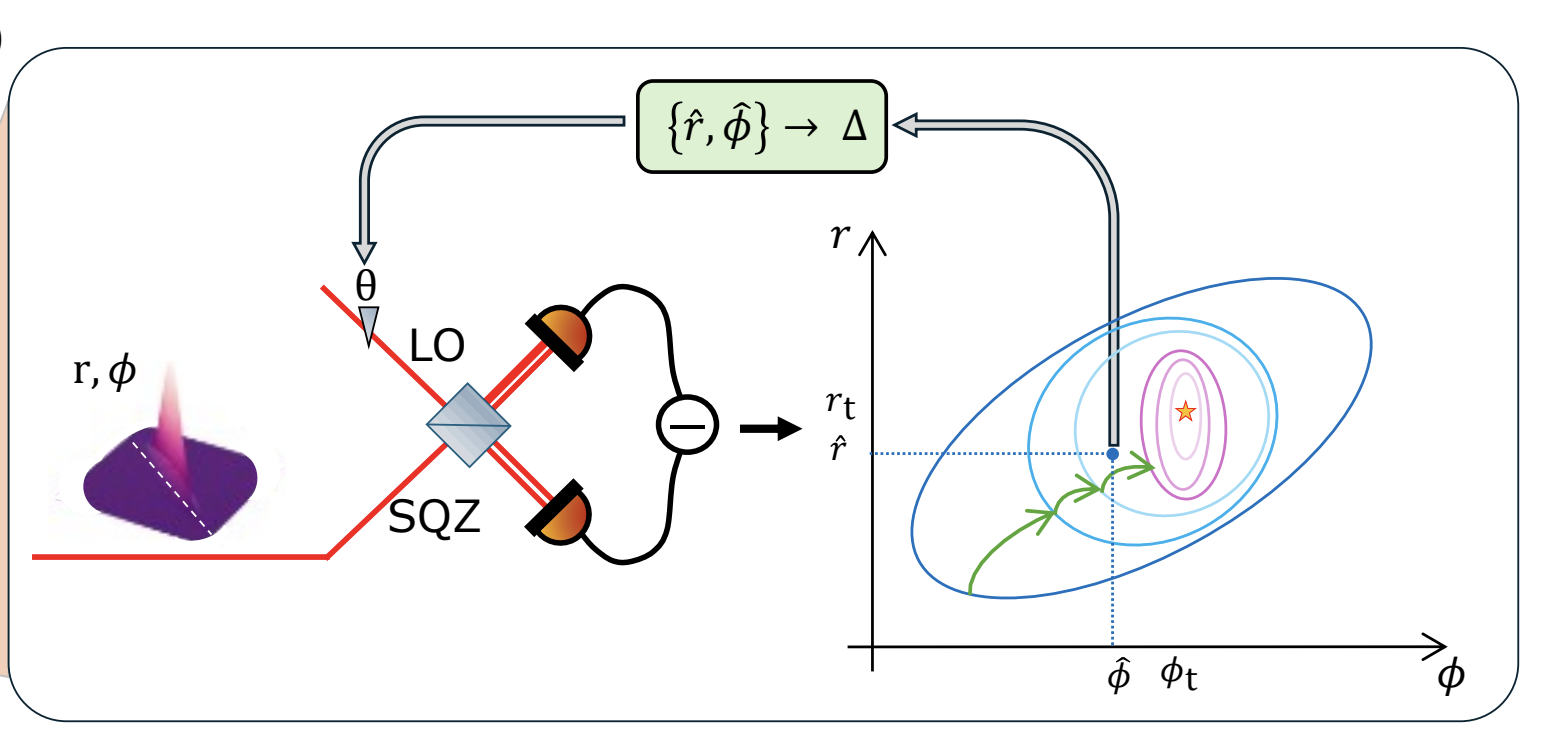
The team engineered an adaptive multiparameter estimation strategy, employing homodyne detection combined with Bayesian inference to simultaneously learn both the unknown optical phase and relevant probe parameters, establishing a robust quantum-enhanced sensing framework. The experimental setup centers around generating squeezed-vacuum probes by pumping an optical parametric amplifier with a continuous-wave laser. To maximize squeezing levels, both the pump and local oscillator beams undergo spatial filtering, ensuring optimal overlap at the homodyne beamsplitter.
A phase-locked loop stabilizes the relative phase between the squeezed state and the local oscillator, while a piezoelectric stage finely tunes the local oscillator phase. An FPGA-based feedback system dynamically selects and locks the measurement quadrature, allowing for precise control over the measurement process. The core of the method involves a multistep estimation procedure where homodyne data is used to reconstruct the multiparameter posterior distribution at each step. From this distribution, the estimate is updated and the optimal measurement angle is computed, applying a feedback signal to adjust the local oscillator phase for the next measurement.
This iterative process progressively refines the posterior until the estimates converge to the true values of both the phase and the squeezing parameter. This study extends phase estimation to the entire range of 0 to π radians, directly inferring both the phase and squeezing strength from the data, a significant advancement over previous methods confined to a limited range. Results demonstrate variances in phase estimation significantly below the classical coherent state bound, approaching the ultimate sensitivity attainable with Gaussian resources.
Adaptive Phase Estimation Beyond Standard Quantum Limit
Scientists have achieved precision beyond the standard quantum limit in phase estimation across the full periodicity interval of π, without relying on prior knowledge of the squeezing parameter. This breakthrough delivers a robust and self-calibrating quantum-enhanced sensing framework, employing an adaptive multiparameter estimation strategy. The research team implemented an online adaptive protocol, initially collecting data to remove ambiguity present in squeezed-state interferometry. Experiments revealed that by employing the Sequential Monte Carlo technique, the team could efficiently determine the online feedback necessary for adaptive measurements.
This involved discretizing the posterior distribution into particles, associated with weights updated with observed homodyne measurements, allowing for efficient computation of the posterior mean and variance. The team also determined the effective squeezing parameter, accounting for the combined impact of squeezing and loss, and used this to optimize the measurement basis. By implementing an adaptive protocol that infers both the phase and relevant nuisance parameters, the researchers overcame the limitations of calibration while maintaining a quantum advantage throughout the entire unambiguous phase range. This adaptive cycle, repeated with increasing data, yields progressively sharper posteriors and improved parameter determination.
Adaptive Phase Estimation Beyond Standard Limit
This research demonstrates the first experimental realization of adaptive multiparameter quantum phase estimation using squeezed vacuum states, achieving precision beyond the standard quantum limit across a full range of measurement possibilities. The team developed a method that simultaneously determines the optical phase and the level of squeezing, eliminating the need for prior calibration of system parameters. This is particularly significant because these parameters are prone to fluctuations in real-world conditions, which typically compromise the stability of calibration-based approaches. This method proves robust to consistent fluctuations, sustaining quantum-enhanced performance across a wide operating range and establishing a pathway toward practical applications of squeezed light for precision sensing. These findings pave the way for self-calibrating quantum metrology protocols resilient to probe instabilities and experimental drifts, with potential for scalable implementations in advanced interferometric platforms and distributed quantum sensor networks. The authors acknowledge that further research is needed to explore performance in more complex scenarios, potentially optimizing the adaptive algorithm for different quantum states and extending the technique to multi-parameter estimation problems relevant to diverse sensing applications.
🗞 Multiparameter quantum-enhanced adaptive metrology with squeezed light
🧠 ArXiv: https://arxiv.org/abs/2510.14739