

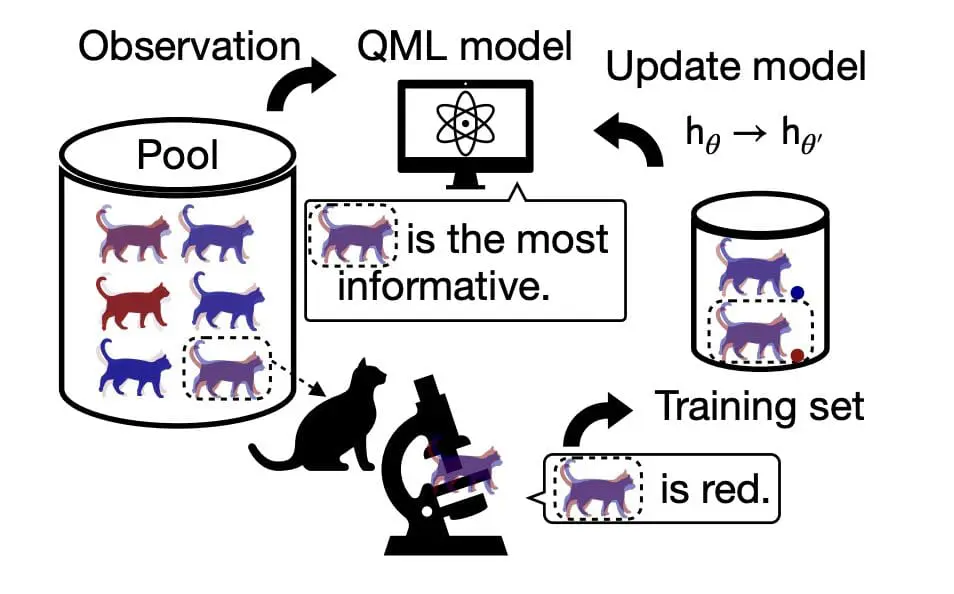
Researchers Yongcheng Ding, Yue Ban, Mikel Sanz, Jose D. Martín-Guerrero, and Xi Chen have developed a method called Quantum Active Learning (QAL) to improve the efficiency of quantum machine learning. QAL estimates the uncertainty of quantum data to select the most informative samples for labeling, thereby reducing the need for large labeled training sets. The team used an equivariant quantum neural network to generalize from fewer data with geometric priors. The researchers found that QAL effectively trains the model, achieving performance comparable to fully labeled datasets by labeling less than 7% of the samples.
Quantum Active Learning: A New Approach to Quantum Machine Learning
Quantum machine learning (QML) is a burgeoning field that combines the principles of quantum mechanics with machine learning. It offers the potential for efficient learning from data encoded in quantum states. However, training a quantum neural network (QNN) typically requires a substantial labeled training set, which can be costly and time-consuming to produce. To address this challenge, a team of researchers has proposed a new approach known as Quantum Active Learning (QAL).
QAL is a method that estimates the uncertainty of quantum data to select the most informative samples from a pool for labeling. This approach aims to maximize the knowledge accumulated by a QML model as the training set comprises labeled samples selected via sampling strategies. Importantly, the QML models trained within the QAL framework are not restricted to specific types, enabling performance enhancement from the model architecture’s perspective towards few-shot learning.
The researchers recognized symmetry as a fundamental concept in physics ubiquitous across various domains. They leveraged the symmetry inherent in quantum states induced by the embedding of classical data for model design. They employed an equivariant QNN capable of generalizing from fewer data with geometric priors. The performance of QAL was benchmarked on two classification problems, yielding both positive and negative results.
Quantum Active Learning: The Results
The researchers found that QAL effectively trains the model, achieving performance comparable to that on fully labeled datasets by labeling less than 7% of the samples in the pool with unbiased sampling behavior. However, they also observed a negative result of QAL being overtaken by random sampling baseline. This was elucidated through miscellaneous numerical experiments.
Quantum Active Learning: Theoretical Framework
The theoretical framework of QAL is based on the principles of Active Learning (AL) and Quantum Neural Network (QNN). AL operates under the hypothesis that a machine learning model can be efficiently trained using only a small subset of samples from a larger pool of unlabeled data. These selected samples should be highly representative and informative, contributing significant knowledge when labeled by annotators.
On the other hand, a QNN is a parameterized unitary applicable in quantum devices. It serves as the cornerstone of QAL. For classical data, it consists of unitary ansatze with trainable parameters and encoders for data loading, followed by measurements of observables. QNN can also be employed to analyze quantum data represented as a density matrix from quantum experiments.
Quantum Active Learning: Future Directions
The researchers believe that QAL holds promise as a framework for reducing the overall cost of analyzing quantum experiment results and designing quantum experiments via QML. Future research could explore QAL strategies that mitigate the biased sampling behaviors illustrated in this study.
Moreover, an intriguing avenue for future research entails applying QAL to quantum data, particularly data generated from quantum experiments. QAL can effectively collaborate with Geometric Quantum Machine Learning (GQML), as quantum data commonly possesses label symmetries dependent on the classification method employed.
Finally, integrating QAL with various other QML models, such as quantum support vector machines, quantum convolutional neural network, or recurrent quantum neural networks, could address diverse problems with limited samples. For applications requiring few-shot learning, meta-learning techniques could prove valuable by optimizing classical parameters to initialize quantum neural networks efficiently.
External Link: Click Here For More


