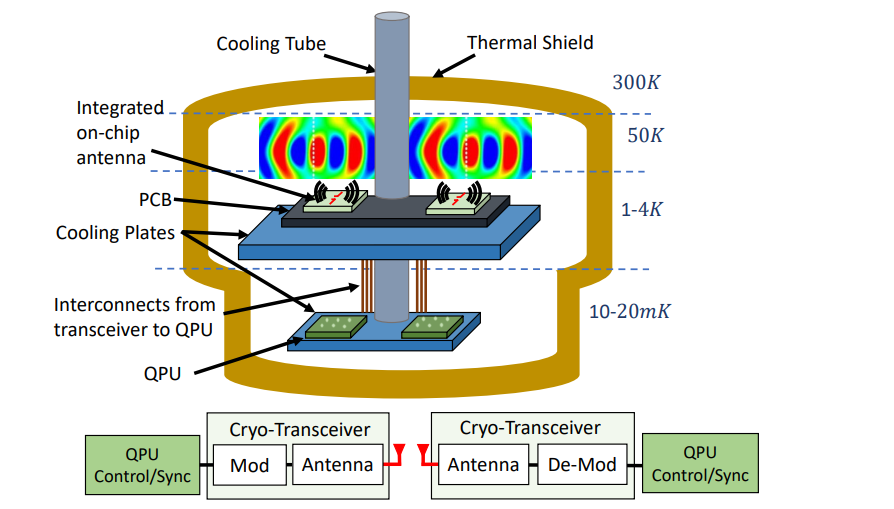
The increasing complexity of quantum computing systems presents significant challenges in managing the wiring and heat generated by controlling and reading data from multiple quantum processors at extremely low temperatures. To overcome these limitations, Ama Bandara, Viviana Centritto Arrojo, Heqi Deng, et al. investigate the potential of wireless communication within a cryostat, the specialised refrigerator used to maintain the quantum computer’s operating temperature. Their work focuses on characterising the wireless channel at 28GHz inside a cryostat at 4 Kelvin, demonstrating the feasibility of on-chip antennas for short-range communication. The team’s simulations and measurements reveal a promising signal quality with limited sensitivity to antenna position, paving the way for scalable quantum computers with reduced wiring complexity and thermal load.
The scalability of quantum computing systems is constrained by the wiring complexity and thermal load introduced by dense wiring for control, readout, and synchronization at cryogenic temperatures. To address this challenge, researchers explore the feasibility of wireless communication within a cryostat for a multi-core quantum computer, focusing on wireless channel characterization at cryogenic temperatures. They propose to place on-chip differential dipole antennas within the cryostat, designed to operate at 28GHz in temperatures as low as 4 K. Researchers model the antennas inside a realistic cryostat and, using full-wave electromagnetic simulations, analyse impedance matching and spatial field distribution.
Cryogenic Wireless Quantum Control System
Scientists have achieved a breakthrough in wireless communication within cryostats, essential for scaling multi-core quantum computers. The research addresses the limitations imposed by dense wiring for control, readout, and synchronization at extremely low temperatures, demonstrating the feasibility of wireless links for interconnecting quantum processing units. The team designed and modeled on-chip differential dipole antennas, optimized to operate at 28GHz within temperatures as low as 4 Kelvin. Detailed electromagnetic simulations analyzed impedance matching, spatial field distribution, and energy reverberation within a realistic cryostat model. Experiments revealed a promising wireless channel with high Signal-to-Noise Ratio (SNR) and limited sensitivity to antenna position, crucial for reliable short-range communication.
Wireless Links for Cryogenic Quantum Control
Scientists have demonstrated the feasibility of wireless communication within cryogenic environments, specifically for multi-core computing systems. The team successfully modeled and tested on-chip dipole antennas operating at 28GHz and temperatures as low as 4K, revealing efficient radiation and good impedance matching even in these extreme conditions. Channel characterization showed that, despite energy reverberation and multipath effects inherent in the cryostat environment, a high signal-to-noise ratio can be maintained with limited sensitivity to receiver position. The results indicate that wireless links can deliver adequate received power across short ranges, offering a potential solution to the wiring complexity and thermal load traditionally associated with cryogenic computing.
Wireless Communication in Cryogenic Environments
While acknowledging the presence of delay spread due to multipath effects, the team demonstrated that the low noise figures at cryogenic temperatures, combined with antenna design, can overcome these challenges. Future work will focus on exploring different antenna designs and analyzing the performance of classical-quantum interconnects, including assessing error rates and potential interference with qubit operation, with the ultimate goal of enhancing scalability and reliability in multi-core quantum systems. Researchers also plan to investigate and mitigate any potential radiation impacting quantum processors.
🗞 28 GHz Wireless Channel Characterization for a Quantum Computer Cryostat at 4 Kelvin
🧠 ArXiv: https://arxiv.org/abs/2510.16962