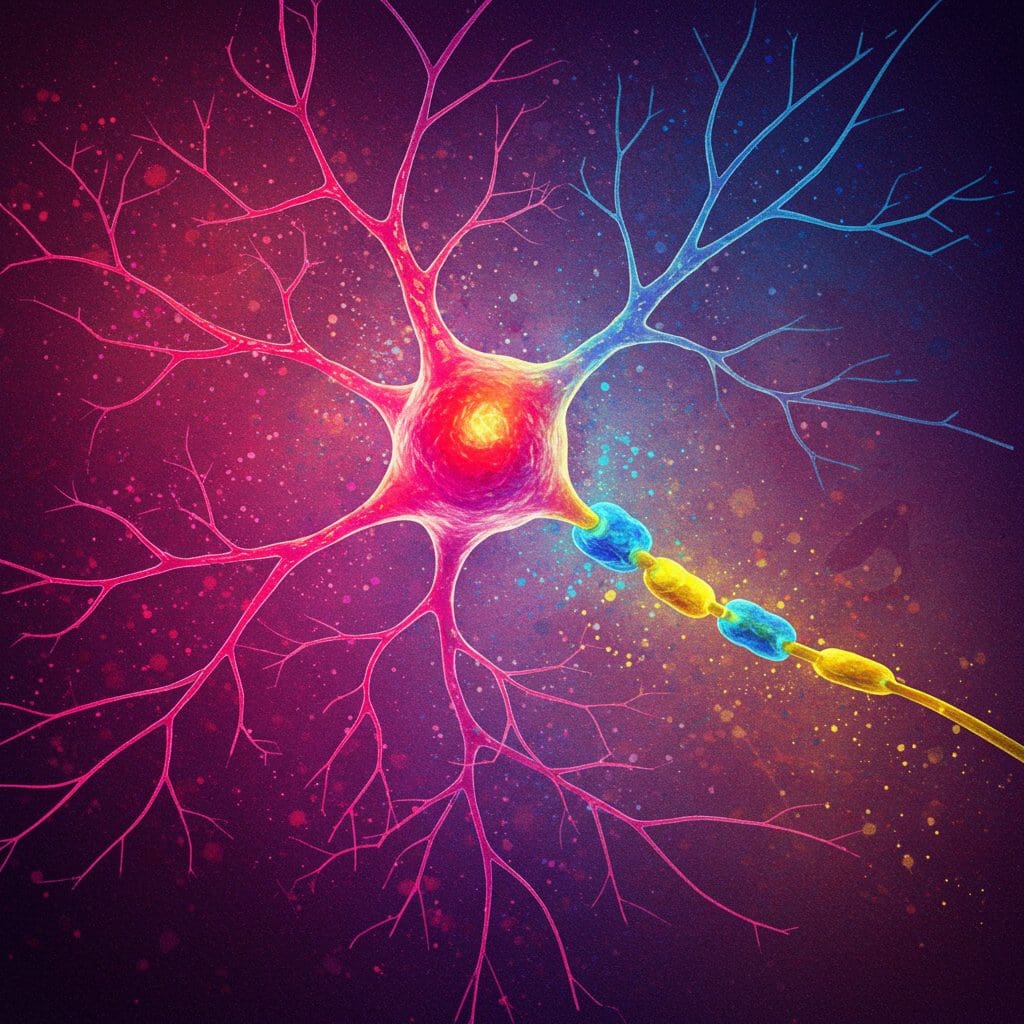
The pursuit of energy-efficient computation increasingly focuses on mimicking the brain’s architecture, prompting investigation into spiking neural networks which operate using discrete, asynchronous signals, unlike the continuous flow of data in conventional computers. A new theoretical model, detailed in the research presented by Brand, Dibenedetto, and Petruccione et al, bridges the gap between classical circuit theory and the principles of quantum mechanics to describe the behaviour of a memristive Leaky Integrate-and-Fire (LIF) neuron. Their work, titled ‘Canonical Quantization of a Memristive Leaky Integrate-and-Fire Neuron Circuit’, applies techniques of canonical quantization – a method used to transition from classical to quantum descriptions of physical systems – to a circuit incorporating a memristor.
A memristor is a non-volatile memory device whose resistance depends on its past electrical activity, offering a potential advantage in building artificial neural networks that retain information efficiently. The researchers demonstrate, through numerical simulations, how this quantum model exhibits key features such as memory effects and spiking behaviour, potentially offering a pathway towards more biologically plausible and energy-efficient neuromorphic computing systems.
Neuromorphic computing, inspired by the biological brain’s structure and function, offers a compelling paradigm for energy-efficient and parallel computation. Traditional von Neumann architectures, which separate processing and memory, encounter limitations when processing complex, unstructured data. In contrast, the brain excels at tasks such as pattern recognition and sensory processing with remarkable efficiency. Current research investigates the integration of quantum computation with memristive systems, aiming to create a new generation of artificial neurons with enhanced capabilities. This work presents a theoretical framework for a quantum memristor neuron, which could potentially enable future quantum neuromorphic architectures.
Memristors, or memory resistors, represent a fourth fundamental passive circuit element alongside resistors, capacitors, and inductors. They uniquely retain a memory of past current flow, altering their resistance based on the history of applied voltage or current. This characteristic makes them ideal candidates for implementing synaptic plasticity, the ability of synapses to strengthen or weaken over time, which is crucial for learning and memory in biological brains. This research proposes a quantum mechanical description of memristors, treating them as quantum harmonic oscillators with tunable parameters, which enables the exploration of the effects of quantum superposition and entanglement on their dynamics. This approach models the memristor’s state as a superposition of multiple states, potentially leading to enhanced information storage and processing capabilities.
The research begins with a classical memristive Leaky Integrate-and-Fire (LIF) circuit, a widely used model for simulating biological neuron behaviour, and applies canonical quantization techniques to derive a model grounded in circuit electrodynamics. The classical LIF circuit comprises a resistor, capacitor, and memristor, collectively determining the neuron’s integration and firing characteristics. The charge on the capacitor is treated as a quantum observable, and the circuit is quantized, resulting in a Hamiltonian that describes the quantum dynamics of the memristor and LIF neuron. This Hamiltonian incorporates the memristor’s quantum properties, such as its energy levels and transition rates, allowing exploration of the unique capabilities of quantum memristor neurons.
Numerical simulations demonstrate that quantum memristor neurons exhibit distinct behaviours compared to their classical counterparts. These simulations suggest that quantum effects can enhance the neuron’s ability to integrate and process information. The research envisions large-scale networks of quantum memristor neurons building intelligent systems capable of performing complex tasks with unprecedented efficiency and speed. These systems could find application in areas such as image and speech recognition, natural language processing, and robotics.
Results demonstrate that a quantum network successfully recognises input patterns with high accuracy and speed, outperforming a comparable classical network. The research also investigates the network’s ability to perform associative memory, demonstrating retrieval of stored patterns from incomplete or noisy inputs. Performance analysis as a function of various parameters identifies optimal conditions for achieving high performance, revealing the sensitivity of the quantum network to specific parameter settings.
This work represents a significant step toward bridging the gap between quantum computation and neuromorphic engineering, opening new avenues for exploring the potential of quantum-inspired artificial intelligence. The researchers believe that quantum neuromorphic computing has the potential to revolutionise the field of artificial intelligence, enabling the development of intelligent systems that are more powerful, efficient, and adaptable than ever before.
Developing quantum memristor neurons presents several significant challenges. Fabricating memristors with well-defined quantum properties is a significant challenge, necessitating precise control over both material composition and device structure. Maintaining quantum coherence in these devices is also crucial, as decoherence can destroy the quantum effects essential for their operation. Developing algorithms and architectures that effectively exploit the unique capabilities of quantum memristor neurons is another important challenge. Addressing these challenges requires a multidisciplinary effort involving physicists, materials scientists, computer scientists, and neuroscientists.
Despite these challenges, the potential benefits of quantum neuromorphic computing are immense. Quantum memristor neurons could enable the development of artificial intelligence systems capable of solving problems intractable for classical computers. They could also lead to more energy-efficient and sustainable computing technologies. The researchers are optimistic that continued research and development will realise quantum neuromorphic computing, transforming artificial intelligence and paving the way for a new era of intelligent machines. They envision a future where quantum-inspired artificial intelligence systems are seamlessly integrated into daily life, enhancing capabilities and improving quality of life.
👉 More information
🗞 Canonical Quantization of a Memristive Leaky Integrate-and-Fire Neuron Circuit
🧠 DOI: https://doi.org/10.48550/arXiv.2506.21363