

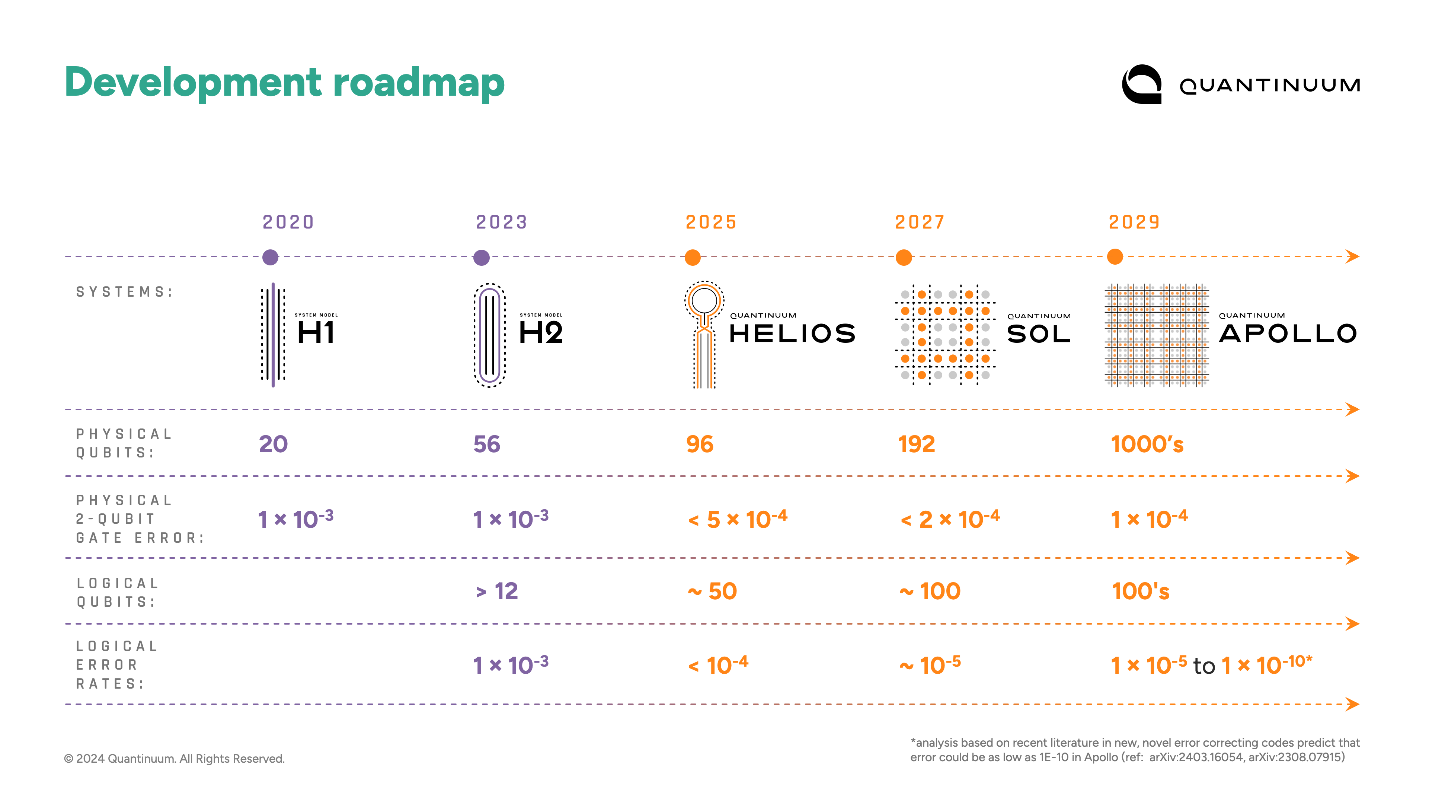
Quantinuum, a leading quantum computing company, is accelerating its roadmap to develop more powerful and accurate quantum computers. The company’s next-generation system, Helios, will offer roughly twice as many qubits with twice lower two-qubit gate errors while operating more than twice as fast as its current 56-qubit H2 system. Following Helios, Quantinuum will introduce Sol, a commercially available 2D-grid-based quantum computer that will feature hundreds of physical qubits with extremely low error rates, allowing users to execute complex circuits with up to 10,000 quantum operations.
These advancements are made possible by recent breakthroughs, including the solution to the “wiring problem” and significant reductions in two-qubit physical gate errors. With these developments, Quantinuum is on track to deliver a fully fault-tolerant quantum computer, Apollo, by the end of the decade, which will revolutionize scientific discovery in fields such as physics, materials, and chemistry.
In a significant development, Quantinuum, a leading quantum computing company, has announced an accelerated roadmap for its quantum computing systems. The new roadmap promises to bring fault-tolerant, commercially viable quantum computers to the market by the end of the decade.
At the heart of this ambitious plan are two new systems: Helios and Sol. Helios will be the first commercial system to use 137Ba+ qubits, which offer lower two-qubit gate errors and less complex laser systems at a lower cost. Additionally, Helios will employ junction-based qubit routing, resulting in a “twice-as-good” system with roughly twice as many qubits, twice lower two-qubit gate errors, and operating speeds more than twice as fast as the current 56-qubit H2 system.
Following Helios, Quantinuum will introduce Sol, its first
Following Helios, Quantinuum will introduce Sol, its first commercially available 2D-grid-based quantum computer. Sol is expected to offer hundreds of physical qubits with two-qubit gate errors less than 2×10⁻⁴, operating approximately twice as fast as Helios. The fully 2D-grid architecture of Sol marks a significant scalability milestone, paving the way for the substantial size increase planned for Apollo.
The low error rates of Helios and Sol create opportunities for early value creation discovery through quantum error detection (QED) and quantum error mitigation (QEM). For instance, the [[k+2, k, 2]] iceberg code, a lightweight QED code, can be used to encode k+2 physical qubits into k logical qubits with only two additional ancilla qubits. This approach offers the non-Clifford variable angle entangling ZZ-gate directly without the overhead of magic state distillation.
The acceleration of Quantinuum’s roadmap is made possible by recent breakthroughs in three key areas: solving the “wiring problem” through the demonstration of scalable trap chip control using the novel center-to-left-right (C2LR) protocol; continued reduction of two-qubit physical gate errors, with current rates less than 1×10⁻³ across all pairs of qubits; and the development of highly efficient quantum error correction (QEC) codes enabled by the all-to-all connectivity offered by Quantinuum’s systems.
These advances put Quantinuum on track to deliver
These advances put Quantinuum on track to deliver Apollo, a fully fault-tolerant quantum advantaged machine, by the end of the decade. This milestone will mark a commercial tipping point, ushering in an era of scientific discovery in physics, materials, chemistry, and more. Along the way, users will have opportunities to discover new enabling use cases through quantum error detection and mitigation in Helios and Sol.
With its accelerated roadmap, Quantinuum solidifies its position as a leader in the quantum computing industry, poised to deliver commercially viable, fault-tolerant quantum computers that will revolutionize various fields of science and beyond.
External Link: Click Here For More


