

Quantinuum, a quantum computing company, has developed a new quantum charge-coupled device (QCCD) trapped-ion quantum computer. The system, which resembles a race track, incorporates several technologies crucial to future scalability, including electrode broadcasting, multilayer rf routing, and magneto-optical trap (MOT) loading. The system initially operates with 32 qubits, with plans for future upgrades to allow for more. The quantum processor’s performance was assessed using mirror benchmarking, linear cross-entropy benchmarking, and a quantum volume measurement of QV (2^16). The team also tested application benchmarks using qubit reuse, including Hamiltonian simulation, QAOA, error correction on a repetition code, and dynamics simulations.
Quantum Processor Development
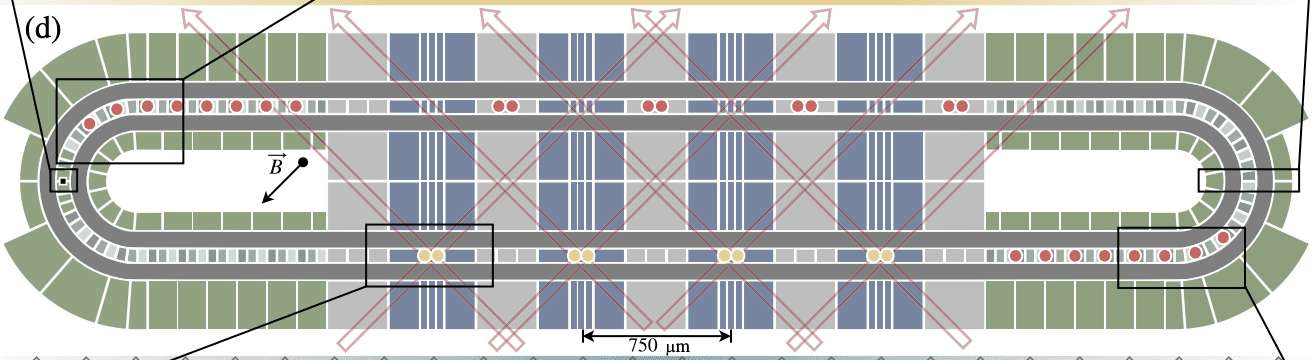
A team of researchers from Quantinuum, a quantum computing company, has developed a new quantum charge-coupled device (QCCD) trapped-ion quantum computer. Quantinuum System Model H2 is based on a linear trap with periodic boundary conditions resembling a race track.
The new quantum processor incorporates several technologies crucial to future scalability, including electrode broadcasting, multilayer rf routing, and magneto-optical trap (MOT) loading. The system is initially operated with 32 qubits, but future upgrades will allow for more. The performance of primitive operations, including an average state preparation and measurement error of (1.6 × 10^−3), an average single-qubit gate infidelity of (2.5 × 10^−5), and an average two-qubit gate infidelity of (1.84 × 10^−3), has been benchmarked.
Quantum Processor Benchmarking
The system-level performance of the quantum processor is assessed with mirror benchmarking, linear cross-entropy benchmarking, a quantum volume measurement of QV (2^16), and the creation of 32-qubit entanglement in a GHZ state. Application benchmarks, including Hamiltonian simulation, QAOA, error correction on a repetition code, and dynamics simulations using qubit reuse, were also tested. Future upgrades to the new system aimed at adding more qubits and capabilities are also discussed.
The new trap design of the quantum processor introduces rf tunnels, voltage broadcasting to multiple control electrodes, and MOT loading of the trap to increase the ion loading rate. The trap has two rows of gate zones, four on the top and four on the bottom. In this work, both rows are used for ion rearrangement, but only the bottom zones are used for quantum operations.
Quantum Processor Application Benchmarks
The system-level benchmarks of the quantum processor serve to verify quantum computer performance on a well-defined set of volumetric circuits. The measured effective 2Q error rates for these circuits show that the component-level benchmark performance is translated to larger circuits. However, problems of practical interest tend to involve structured circuits with very specific demands on gate set and connectivity.
“The new machine, Quantinuum System Model H2, significantly increases the qubit number and decreases the physical resources per qubit, all while matching—and in some instances surpassing—the high circuit fidelity of our previous generation system”
S. A. Moses et al.
Summary
A new quantum charge-coupled device (QCCD) trapped-ion quantum computer, resembling a race track, has been developed and benchmarked. The system incorporates several technologies crucial to future scalability, initially operates with 32 qubits, and has been tested on application benchmarks including Hamiltonian simulation and quantum error correction.
- A new quantum charge-coupled device (QCCD) trapped-ion quantum computer has been developed by a team at Quantinuum, a quantum computing company.
- The new system, called Quantinuum System Model H2, is based on a linear trap with periodic boundary conditions, resembling a race track.
- The system incorporates several technologies crucial to future scalability, including electrode broadcasting, multilayer rf routing, and magneto-optical trap (MOT) loading.
- The system initially operates with 32 qubits, with plans for future upgrades to allow for more.
- The performance of the quantum processor was assessed using various benchmarking methods, including mirror benchmarking, linear cross-entropy benchmarking, and a quantum volume measurement.
- The team also tested application benchmarks, including Hamiltonian simulation, QAOA, error correction on a repetition code, and dynamics simulations using qubit reuse.
- Future upgrades to the system are planned to add more qubits and capabilities.


