Quantinuum and Microsoft have achieved a significant breakthrough in quantum computing, generating the most reliable logical qubits ever recorded. This advancement, made possible by Microsoft’s qubit-virtualization system and Quantinuum’s System Model H2 quantum computer, challenges current assumptions about the timeline for large-scale, reliable quantum computing.
Quantinuum and Microsoft performed 14,000 individual instances of a quantum circuit with no errors, an unprecedented result. This achievement is crucial to building a hybrid supercomputing system that could transform research and innovation across many industries.
Quantum Computing Breakthrough: Reliable Logical Qubits
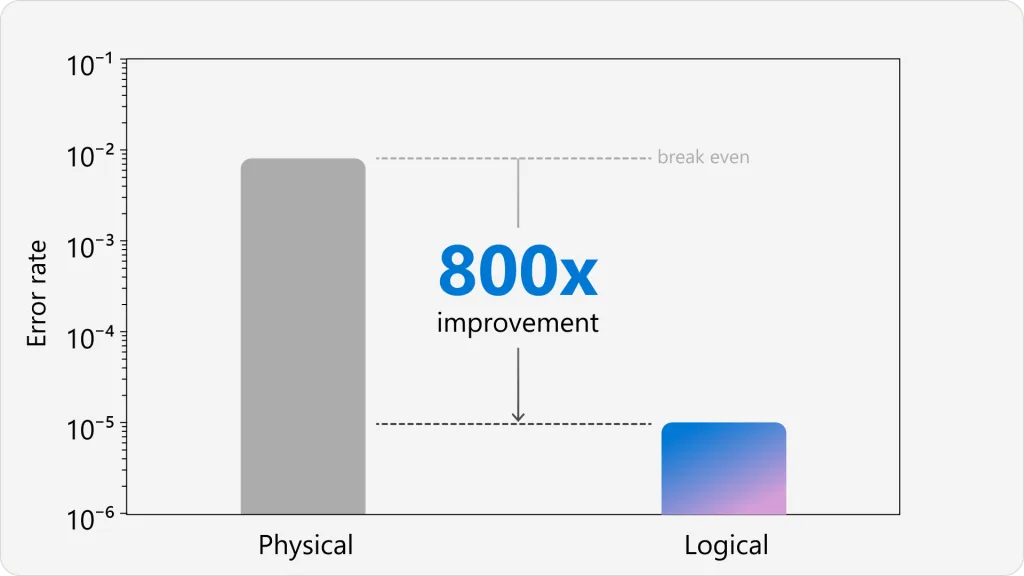
Quantinuum and Microsoft have announced a significant advancement in quantum computing, demonstrating the most reliable logical qubits to date. This achievement, made possible by integrating Microsoft’s qubit-virtualization system with Quantinuum’s System Model H2 quantum computer, has resulted in logical circuit error rates that are 800 times lower than the corresponding physical circuit error rates. This breakthrough is a milestone for the two companies and a significant step forward for the entire quantum computing ecosystem.
The achievement challenges the widely held assumptions about the physical qubits needed for large-scale fault-tolerant quantum computing and the timeline for quantum computers delivering real-world value. Until now, it was believed that such an achievement was still years away. However, this collaboration between Quantinuum and Microsoft has proven that fault-tolerant quantum computing is now a reality.
“Breakthroughs in quantum error correction and fault tolerance are important for realizing the long-term value of quantum computing for scientific discovery and energy security. Results like these enable continued development of quantum computing systems for research and development.”
Dr. Travis Humble, Director, Quantum Science Center, Oak Ridge National Laboratory
The New Era of Quantum Computing
Quantinuum’s System Model H2 has become the first quantum computer to advance to Microsoft’s Level 2—Resilient phase of quantum computing. This is a significant milestone as no other computer has been capable of producing reliable logical qubits until now. Using Microsoft’s qubit-virtualization system, the teams could perform 14,000 individual instances of a quantum circuit without any errors, an unprecedented result.
This breakthrough has also demonstrated multiple rounds of active syndrome extraction, an essential error correction capability for measuring and detecting the occurrence of errors without destroying the quantum information encoded in the logical qubit. As the teams prepare to bring this logical quantum computing breakthrough to commercial users, there is a sense of anticipation about what this new era means for partners, customers, and the global quantum computing ecosystem.
Today’s results mark a historic achievement and are a wonderful reflection of how this collaboration continues to push the boundaries for the quantum ecosystem. With Microsoft’s state-of-the-art error correction aligned with the world’s most powerful quantum computer and a fully integrated approach, we are so excited for the next evolution in quantum applications and can’t wait to see how our customers and partners will benefit from our solutions especially as we move towards quantum processors at scale.
Ilyas Khan, Founder and Chief Product Officer, Quantinuum
Collaboration and Innovation: The Key to Success
The breakthrough would not have been possible without the close collaboration of the two exceptional teams at Quantinuum and Microsoft over many years. The Microsoft team optimized their error correction innovation, reducing an original estimate of 300 required physical qubits 10-fold to create four logical qubits with only 30 physical qubits. This was made possible by architectural features unique to the System Model H2, including a market-leading 99.8% two-qubit gate fidelity, 32 fully connected qubits, and compatibility with Quantum Intermediate Representation (QIR).
Understanding Quantum Error Correction
For a quantum computer to be functional, it must be able to compute correctly even when errors (or faults) occur—this is what scientists and engineers describe as fault tolerance. In classical computing, fault tolerance is well understood, and we have come to take it for granted. However, getting to the same point in quantum computing is more challenging.
The solution involves entangling groups of physical qubits (thereby creating a logical qubit), storing the relevant quantum information in the entangled state, and, via some complex functions, performing computations with error correction. This process is all done with the sole purpose of creating logical qubit errors lower than the errors at the physical level.
The Future of Quantum Computing
As we build upon today’s milestones and lead the field on the path to fault tolerance, we are committed to making significant strides in research that will enable the rapid advancement of technologies. In the short term, organizations can start seeing scientific advantages with a hybrid supercomputer powered by a hundred reliable logical qubits. They will be able to accelerate valuable progress toward some of the most critical problems that mankind faces. Over the long term, if we can scale closer to ~1,000 reliable logical qubits, we can unlock the commercial advantages that can ultimately transform the commercial world.
Logical Qubits, The End of NISQ?
Near-term Intermediate-Scale Quantum (NISQ) technology represents a pivotal phase in the evolution of quantum computing. Characterized by quantum processors with a modest number of qubits—ranging from a few dozen to a few hundred—NISQ devices operate within the constraints of today’s technological capabilities. This has been the quantum computing paradigm that John Preskill espoused. However, the world doesn’t want to deal with noisy qubits, and instead, there is a massive push towards fully error-corrected qubits. NISQ technology is a stepping stone towards more advanced quantum computing, providing invaluable insights and benchmarks for the ongoing development of quantum algorithms and hardware. However, researchers want to get to fully error-corrected qubits.
While not yet generally capable of implementing full error correction, current quantum systems offer the potential to solve specific problems beyond the reach of classical computers, exploring algorithms and applications unique to quantum processing.
Logical qubits emerge from the realm of quantum error correction, a necessity for achieving fault-tolerant quantum computing. Logical qubits are formed by encoding multiple physical qubits designed to protect quantum information against errors and decoherence. This encoding allows for correcting mistakes without measuring or disturbing the quantum state. Developing logical qubits is crucial for realizing practical, large-scale quantum computers, enabling them to perform complex calculations over extended periods without significant loss of fidelity.
Logical qubits represent a more mature stage of quantum computing, where devices harness the full power of quantum mechanics to tackle a broad spectrum of challenging computational tasks.
The development strategy of the H-Series hardware has been dual-focused, emphasizing the scaling of qubit numbers and the creation of user-friendly quantum computing systems integrated within a comprehensive vertical stack.
The Quantinuum and Microsoft approach entails significant enhancements across all levels of the technology stack. A notable milestone was achieved recently when it was demonstrated that our qubits are scalable, as evidenced by the successful resolution of critical challenges related to qubit interconnections and optimization algorithms. By maintaining superior qubit counts and exceptional fidelity, we empower our collaborators and clientele to achieve accelerated progress in various domains, including materials science, pharmaceuticals, artificial intelligence, and financial analytics.
Looking ahead to 2025, the introduction of the new H-Series quantum computer, named Helios, is eagerly anticipated. Helios represents the culmination of the H-Series’ technological advancements, featuring substantial improvements in the number of physical qubits and their fidelity. This enhancement is poised to propel our systems and users past the threshold for a broader array of error-correcting codes, thereby enabling the support of at least ten highly reliable logical qubits. This leap forward underscores our commitment to pushing the boundaries of quantum computing technology and its applications, fostering breakthroughs previously beyond reach.

External Link: Click Here For More