
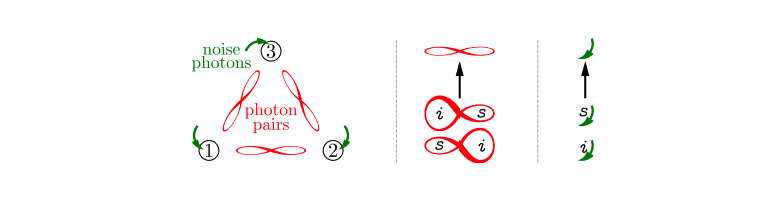
Analyses of three-beam symmetric Gaussian states reveal correlations quantified by intensity moments and universal invariants – one-, two-, and three-beam purities. Experiments utilising photon pairs demonstrate the coexistence of bi-, tripartite, and genuine tripartite entanglement, mirroring behaviours observed in noisy Greenberger-Horne-Zeilinger (GHZ) and W states.
The subtle interplay of quantum correlations within multi-photon systems remains a central challenge in quantum physics. Understanding these correlations is crucial not only for fundamental tests of quantum mechanics, but also for developing advanced quantum technologies. Researchers are now detailing an analysis of three-beam symmetric Gaussian states, utilising photon-number-resolving detection to access universal invariants – quantifiable measures of a quantum state’s properties. This approach allows for the characterisation of correlations, revealing the coexistence of both bipartite and multipartite entanglement, akin to noisy Greenberger-Horne-Zeilinger (GHZ) and W states. The work, detailed in a recent publication, is led by Jan Peřina Jr. and Antonín Černoch from the Joint Laboratory of Optics of Palacký University and Institute of Physics of CAS, alongside Nazarii Sudak and Artur Barasiński from the Institute of Theoretical Physics, University of Wroclaw, and is titled ‘Quantum Correlations in Three-Beam Symmetric Gaussian States Accessed via Photon-Number-Resolving Detection and Quantum Universal Invariants’.
Quantifying Correlations in Multi-Beam Gaussian States
Researchers have conducted a detailed investigation into the generation, characterisation, and quantification of quantum correlations within multi-beam symmetric Gaussian states, offering a potential resource for quantum information processing. These states, possessing multiple independent spatial modes, allow for encoding and manipulation of quantum information. The core of this work centres on the analysis of universal invariants – specifically, one-, two-, and three-beam purities – which fully describe the state’s properties up to sixth-order intensity moments. This provides a robust framework for quantifying correlations.
The team generated these states using spontaneous parametric down-conversion (SPDC), a process where a photon splits into two lower-energy photons. SPDC is a common method for creating entangled photon pairs. It allows for precise determination of the invariants and subsequent correlation analysis.
This research extends to understanding the relationship between bi- (two-party) and tripartite (three-party) entanglement. Generated states exhibit characteristics analogous to noisy Greenberger-Horne-Zeilinger (GHZ) and W states – foundational benchmarks in quantum information theory used to demonstrate non-classical correlations. GHZ states exhibit maximal entanglement, while W states are robust to particle loss. The observed similarities, despite the presence of noise, suggest the potential for utilising these multi-beam states in practical quantum applications.
The Expectation-Maximisation (EM) algorithm and maximum likelihood estimation were employed to optimise state generation and perform quantum state tomography. Quantum state tomography reconstructs the complete quantum state from a series of measurements. Machine learning techniques further refined these processes, enabling more efficient and accurate characterisation of complex quantum systems.
The analytical framework developed in this study provides a robust method for quantifying the correlations present in these multi-beam states, crucial for applications in quantum communication and computation. Reliable generation and characterisation of entangled states are paramount for these applications, and this work demonstrates a pathway towards achieving this with multi-mode entangled states. The study also demonstrates the scalability of this understanding to more complex systems, suggesting a versatile approach to quantifying correlations in a wider range of quantum states.
👉 More information
🗞 Quantum Correlations in Three-Beam Symmetric Gaussian States Accessed via Photon-Number-Resolving Detection and Quantum Universal Invariants
🧠 DOI: https://doi.org/10.48550/arXiv.2505.11303