Quandela Quantique Inc. has unveiled MerLin, a new open-source framework designed as a discovery engine for photonic and hybrid quantum machine learning. Available as of February 11, 2026, MerLin integrates optimized quantum simulation into standard machine learning workflows, enabling the training of quantum layers and systematic benchmarking. As an initial demonstration, the framework successfully reproduces eighteen state-of-the-art photonic and hybrid QML models, spanning diverse architectures like kernel methods and convolutional networks. By embedding photonic quantum models within established machine learning ecosystems, MerLin allows practitioners to leverage existing tooling for comparisons and hybrid workflows, “establishing a shared experimental baseline consistent with empirical benchmarking methodologies widely adopted in modern artificial intelligence.” This positions MerLin as a tool for linking algorithms, benchmarks, and future quantum hardware.
Photonic Quantum Computing Advantages for Machine Learning
Photonic quantum computing is proving particularly promising due to its scalability, robustness, compatibility with optical communication technologies, and energy efficiency. This convergence of quantum computing and machine learning is accelerating advances in both fields, with quantum machine learning (QML) offering the potential to extend the capabilities of classical algorithms. Unlike many approaches, photonic QML “exploits the bosonic nature of light and high-dimensional multi-mode interference to implement and train machine learning models directly on this unconventional photonic quantum computation model, enabling intrinsic parallelism and efficient exploration of large Hilbert spaces.”
Realizing this potential necessitates software frameworks that bridge abstract QML models with execution on emerging quantum hardware. The need for such tools is highlighted by the current fragmented software landscape, where frameworks like Qiskit, Cirq, Pulser, Perceval, Strawberry Fields, Piquasso, PennyLane, TorchQuantum, and DeepQuantum each specialize in specific layers or paradigms, hindering algorithm portability. Quandela Quantique Inc. A systematic survey revealed that photonic contributions currently account for approximately 6% of all QML publications, though the source of this survey is not specified. MerLin distinguishes itself by offering hardware-aware features, allowing tests on existing quantum hardware while simultaneously enabling exploration beyond current limitations, positioning it as a “future-proof co-design tool linking algorithms, benchmarks, and hardware.” The framework’s design prioritizes systematic benchmarking and reproducibility, a critical need within the QML community. Researchers have identified factors contributing to this need, including “an extreme heterogeneity in data preprocessing and task formulation in the literature, and a preference for single-run metrics rather than multi-dimensional evaluations.”
To address these challenges, the developers created a reproduction framework capable of systematically replicating published QML works, including performance metrics and experimental analyses. As a demonstration, they successfully reproduced eighteen state-of-the-art photonic and hybrid QML studies, validating MerLin’s functionality and providing a foundation for future development.
MerLin Framework Integrates PyTorch and Scikit-learn Workflows
The pursuit of practical quantum machine learning (QML) is currently hampered by a fragmented software landscape, demanding significant effort to port algorithms between platforms. While frameworks like Qiskit and Cirq cater to superconducting processors, and others such as Pulser and Perceval target different hardware, a unifying solution has been lacking. This specialization creates silos, hindering cross-platform experimentation and reproducible research—a critical issue mirroring challenges faced in the early days of classical artificial intelligence. Recent advancements, including DeepQuantum, attempt to bridge these gaps, but a comprehensive, integrated approach remained elusive until now.
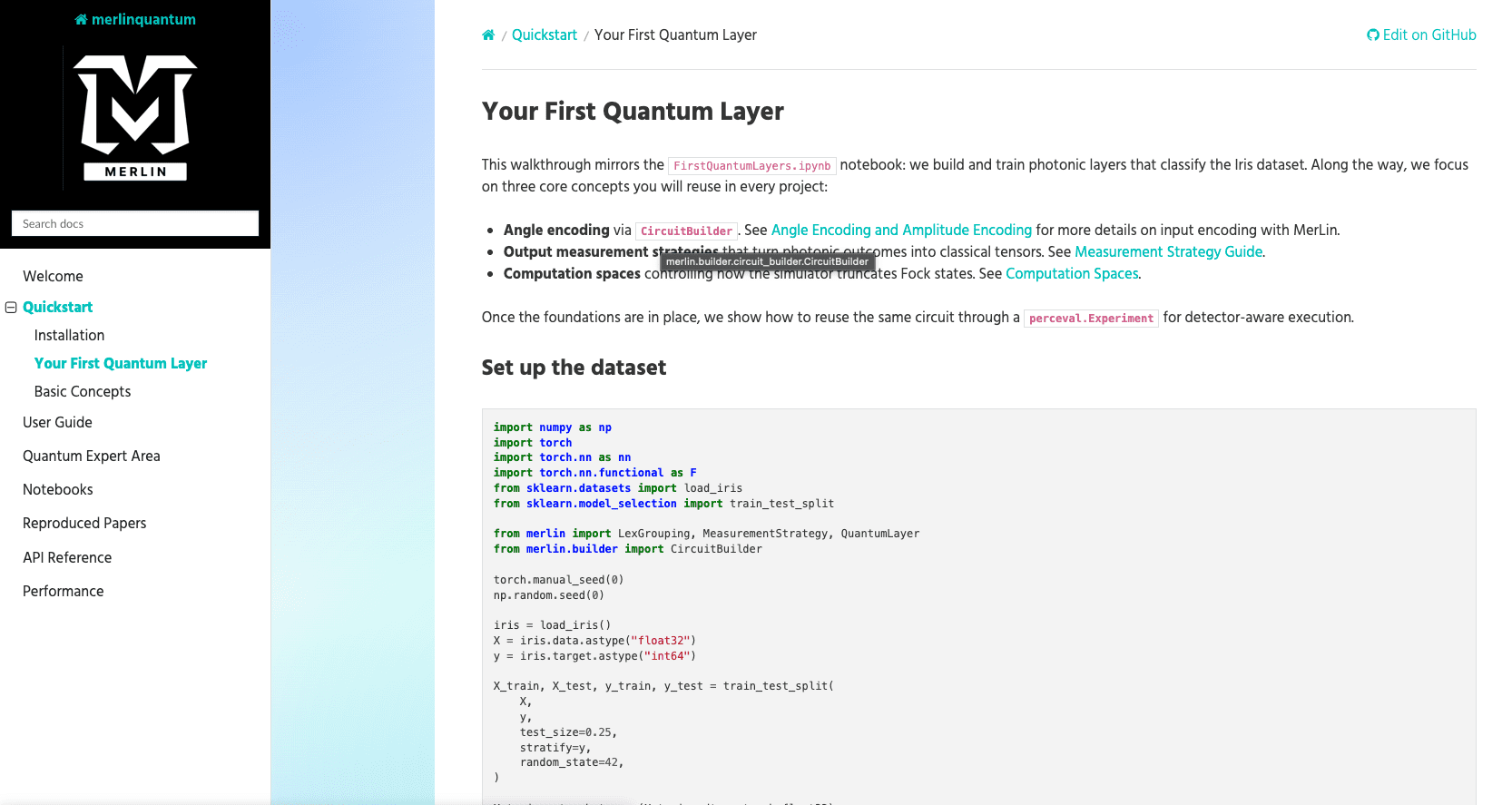
Quandela Quantique Inc. is addressing this need with MerLin, a framework designed to embed photonic quantum models directly within established machine learning ecosystems. This integration allows researchers to “leverage existing tooling for ablation studies, cross-modality comparisons, and hybrid classical–quantum workflows.” MerLin distinguishes itself by combining optimized simulation of linear-optical circuits with standard PyTorch and scikit-learn workflows, enabling end-to-end differentiable training of quantum layers. This means quantum components can be seamlessly incorporated into existing machine learning pipelines, facilitating a more fluid and iterative development process.
To combat this, the team developed a dedicated reproduction framework, systematically replicating eighteen state-of-the-art photonic and hybrid QML works. This initiative addresses a critical need for “rigorous benchmarking in the QML community,” providing a shared experimental baseline and validating MerLin’s functionality.
In this work, we introduced MerLin, a quantum software platform designed for large-scale, simulation-based exploration of hybrid quantum-classical models while remaining explicitly hardware-aware.
Reproducing State-of-the-Art Photonic QML Experiments
Researchers at Quandela Quantique Inc. and collaborating institutions are tackling a critical bottleneck in quantum machine learning: reproducibility. This initiative addresses a significant issue within the field, where fragmented software landscapes hinder independent verification of results. This allows for end-to-end differentiable training of quantum layers, a crucial step toward building practical QML models. This “future-proof co-design tool” aims to link algorithms, benchmarks, and hardware development in a cohesive manner. These reproductions span a broad range of techniques, including kernel methods, reservoir computing, and convolutional architectures.
These aren’t simply isolated reimplementations; they are released as reusable, modular experiments intended to establish a shared experimental baseline. The team emphasizes that the goal extends beyond simply achieving positive results. “Crucially, the objective of this benchmarking effort is not only to identify positive performance gains, but also to understand their origin,” they explain, highlighting the importance of disentangling improvements stemming from data preprocessing or model engineering from those genuinely attributable to quantum mechanisms. The framework and reproduced papers are publicly available, fostering collaboration and accelerating progress in the field.
Benchmarking Challenges and Need for Reproducibility
Researchers are finding that progress in photonic QML “increasingly depends on scalable, benchmark-driven experimentation rather than isolated algorithmic proposals—mirroring the empirical paradigm that underpins modern AI.” This need for systematic assessment is now being addressed with new tools designed to establish a shared experimental baseline. Current quantum software frameworks exhibit a fragmented landscape, each specializing in a particular layer or paradigm. Existing options like Qiskit and Cirq primarily cater to superconducting processors, while others focus on specific platforms like neutral atoms or continuous-variable systems. A systematic survey has found photonic contributions account for approximately 6% of all QML publications.
To tackle these issues, a focus on reproducibility is paramount. The goal isn’t simply to demonstrate performance gains, but to understand their origins, “to disentangle improvements due to data preprocessing, model engineering, or optimization strategies from those arising from genuinely new representational or computational mechanisms.” A new framework aims to provide a unified, hardware-aware platform for implementing, training, and evaluating photonic QML models, alongside a dedicated reproduction framework designed for systematic replication of published works. This includes reproducing reported claims, performance metrics, and experimental analyses within a controlled software environment.
Through its open design and simplified reproduction framework, MerLin encourages the community to systematically benchmark new and existing results, study learning dynamics, and lower the entry barrier for both classical and QML practitioners.
Diverse QML Software Frameworks and Their Limitations
The proliferation of quantum machine learning (QML) software is creating a paradoxical situation: while offering exciting possibilities, the landscape is increasingly fragmented. Many assume a unified ecosystem exists, but in reality, developers face a patchwork of specialized tools, hindering portability and collaborative progress. Continuous-variable approaches are supported by Strawberry Fields and Piquasso, further diversifying the options. This specialization, however, creates “silos where algorithms are not portable without significant conversion effort,” according to the developers of a new framework. Beyond these hardware-specific options, tools like PennyLane, TorchQuantum, and Qiskit-Torch-Module focus on differentiable quantum programming and PyTorch integration.
More recently, DeepQuantum emerged as a unified platform bridging qubit circuits, photonic qumodes, and measurement-based quantum computing, reporting GPU-accelerated gradient computation an order of magnitude faster than PennyLane at scale. Despite this abundance, a cohesive, adaptable system remains elusive. The lack of standardization is particularly acute in photonic QML, a promising area leveraging the unique properties of light. Researchers are increasingly exploring algorithms tailored to specific hardware, but “no existing framework currently combines efficient simulation, integration with ML workflows, noise models and hardware access.” This deficiency hampers rigorous benchmarking, a critical need highlighted by the QML community.
Hardware-Aware Features and Co-design Potential
is addressing with a novel framework. MerLin distinguishes itself through “hardware-aware features,” enabling tests on current quantum hardware while simultaneously facilitating exploration beyond present limitations. MerLin aims to bridge these gaps, offering a unified platform for photonic quantum machine learning.
Source: https://arxiv.org/pdf/2602.11092