

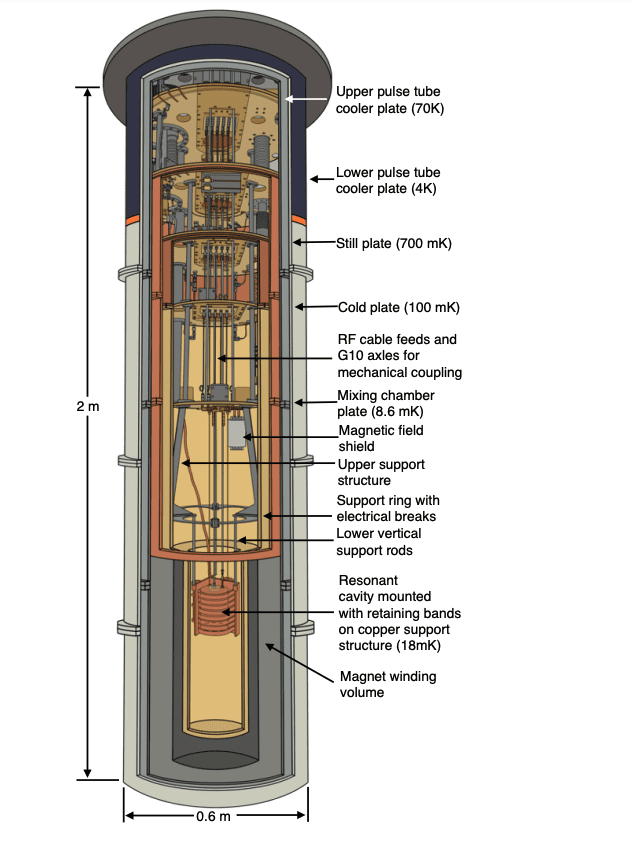
On April 16, 2025, the QSHS collaboration reported on an advanced resonant cavity apparatus designed to detect axion dark matter and other wave-like candidates, marking a significant step in the quest to understand the universe’s unseen components.
The QSHS collaboration developed a resonant cavity apparatus for detecting axion dark matter and other wave-like dark matter candidates. The system features a tunable copper cavity, low-noise amplifiers, and a dilution refrigerator with an 8T solenoidal magnetic field. It also includes fixed-frequency resonators for testing prototype electronics across various axion mass ranges. Performance data for the cavity, refrigerator, and magnet were presented, along with plans for the first science run targeting QCD axions and axion-like particles.
The quest to understand dark matter, a mysterious substance constituting approximately 27% of the universe, has long been a pressing challenge in modern physics. While its existence is inferred from gravitational effects on visible matter, galaxies, and galaxy clusters, direct evidence remains elusive. Recent advancements in quantum sensor technology are now offering a promising new avenue for detecting dark matter candidates known as axion-like particles (ALPs).
At the heart of this breakthrough lies the integration of superconducting circuits with quantum computing techniques. Researchers have developed highly sensitive quantum sensors capable of detecting minuscule fluctuations caused by ALPs interacting with electromagnetic fields. These sensors operate at extremely low temperatures, where quantum effects dominate, allowing for unprecedented precision in measuring subtle changes in energy levels.
The method involves placing the quantum sensor in
The method involves placing the quantum sensor in a strong magnetic field, which polarizes any ALPs that pass through. This polarization creates a detectable shift in the sensor’s energy states. By carefully monitoring these shifts, researchers can infer the presence of ALPs and potentially identify their properties.
Initial experiments have demonstrated the feasibility of this approach, with sensors achieving sensitivity levels sufficient to detect ALPs within a range of plausible masses and interaction strengths. This marks a significant step forward in dark matter detection efforts, as traditional methods often struggle to achieve comparable sensitivity due to background noise and other limitations.
The successful demonstration of this technique has far-reaching implications for dark matter research. If ALPs are indeed a component of dark matter, these sensors could provide critical insights into their properties, such as mass, charge, and interaction strength. This information would not only advance our understanding of the universe’s structure but also pave the way for new technologies inspired by quantum phenomena.
Moreover, the development of highly sensitive quantum sensors has applications beyond dark matter detection. These devices could be used in a variety of fields, including precision metrology, medical imaging, and even next-generation communication systems.
In conclusion, the integration of quantum sensor technology
In conclusion, the integration of quantum sensor technology with dark matter research represents a significant leap forward in our quest to unravel one of the universe’s greatest mysteries. By harnessing the unique properties of superconducting circuits, scientists have created a powerful new tool for detecting axion-like particles and potentially unlocking the secrets of dark matter. As this technology continues to evolve, it holds the promise of not only advancing fundamental physics but also driving innovation across multiple disciplines. The journey to understanding dark matter is far from over, but with quantum sensors leading the way, researchers are one step closer to illuminating the unseen forces that shape our universe.
🗞 QSHS: An Axion Dark Matter Resonant Search Apparatus
🧠 DOI: https://doi.org/10.48550/arXiv.2504.12257


