Get ready for displays that pop: engineers at the Hong Kong University of Science and Technology (HKUST) have achieved a breakthrough in red quantum rod light-emitting diodes (QR-LEDs), paving the way for significantly more vivid and brighter screens. Building on the promise of quantum dot technology, this innovation tackles a key limitation in current LED displays – efficiently getting light out of the device. By optimizing the fundamental properties of these nanoscale materials, the HKUST team has achieved record-high efficiency in red QR-LEDs, bringing us closer to a future of truly immersive and lifelike visuals in everything from smartphones to televisions.
HKUST Engineers Advance Quantum Dot LED Tech
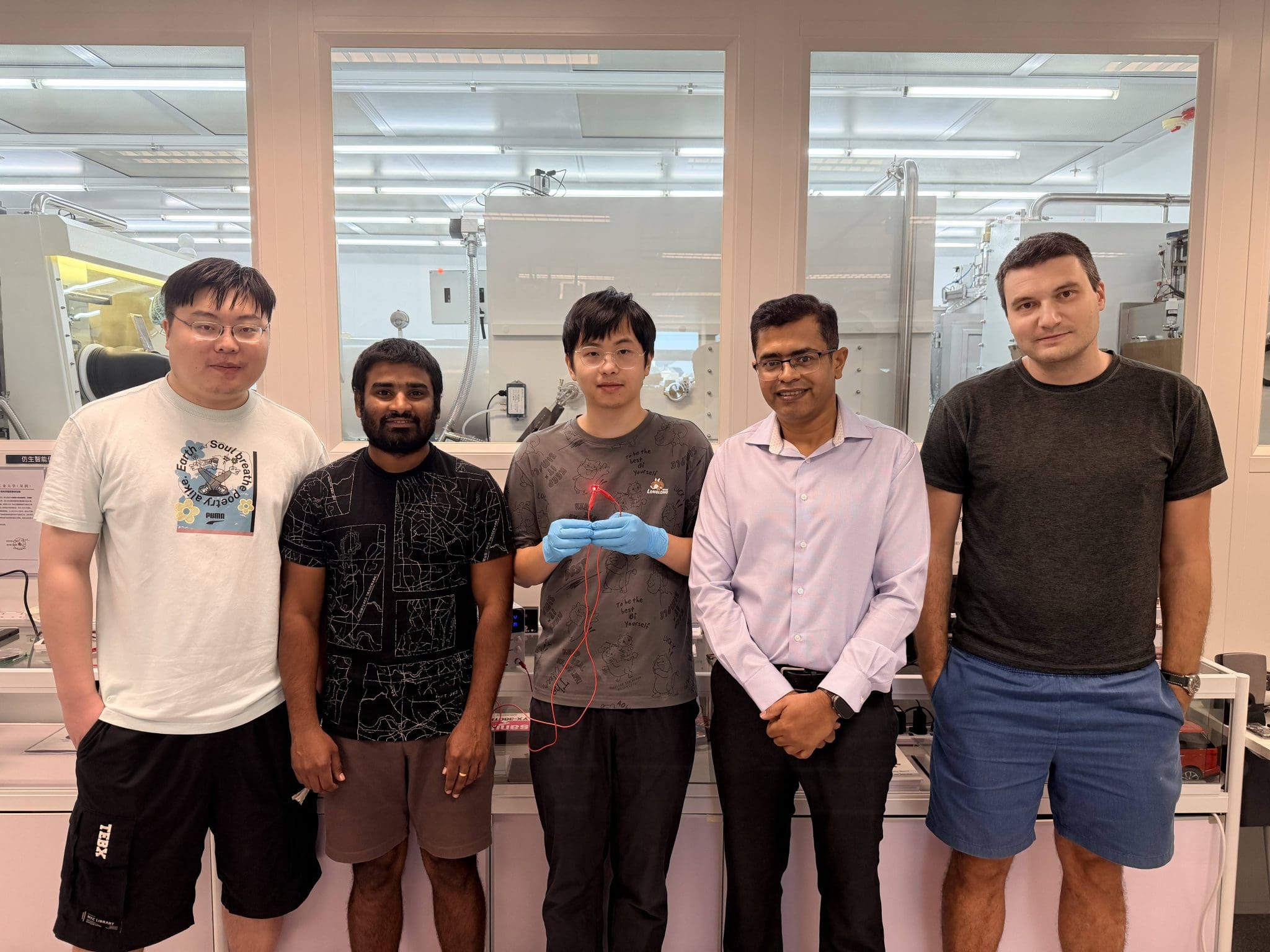
Engineers at The Hong Kong University of Science and Technology (HKUST) are pushing the boundaries of display technology with significant advancements in quantum rod light-emitting diodes (QR-LEDs), achieving record-high efficiency for red QR-LEDs. Building upon the superior color purity and brightness already offered by quantum dot LEDs (QD-LEDs), the HKUST team, led by Professor Abhishek K. Srivastava, focused on overcoming the limitations of light outcoupling efficiency—a key obstacle hindering further performance gains. Their research tackled two primary challenges: low photoluminescence quantum yield (the ratio of emitted to absorbed photons) and substantial leakage current caused by poor thin-film quality. Through refined synthesis engineering, the team achieved an impressive 92% photoluminescence quantum yield for both green and red quantum rods, ensuring optimal light emission. Recognizing that carrier leakage often diminishes light coupling, they developed an equivalent circuit model to illustrate its detrimental effects, leading to strategic modifications of the QR-LED device structure. This innovative approach simultaneously enhanced balanced carrier injections and suppressed leakage current, culminating in optimized red QR-LEDs that achieved a peak external quantum efficiency (EQE) of 31%. This breakthrough promises a future of displays and lighting with significantly enhanced color vividness and brightness for consumers, potentially revolutionizing the visual experience on smartphones and televisions.
Overcoming Key QR-LED Performance Challenges
Recent advancements in display technology are heavily focused on quantum dot and quantum rod light-emitting diodes (QR-LEDs) due to their potential for superior color purity and brightness compared to traditional LEDs. However, realizing this potential requires overcoming key performance challenges, particularly concerning light outcoupling efficiency. While QD-LEDs initially showed promise, researchers at the Hong Kong University of Science and Technology (HKUST) turned to QR-LEDs, leveraging the anisotropic properties of quantum rods to better control light emission direction. The team, led by Prof. Abhishek K. Srivastava, identified two primary hurdles: low photoluminescence quantum yield—the ratio of emitted to absorbed photons—and significant leakage current stemming from poor thin-film quality. To address the former, refined synthesis engineering techniques were employed, achieving an impressive 92% quantum yield for both green and red quantum rods, alongside uniform size and shape. Critically, the team didn’t overlook the impact of leakage current, a common issue in previous studies. They developed an equivalent circuit model demonstrating how leakage diminishes light coupling efficiency, informing a strategic restructuring of the QR-LED device. This innovative approach simultaneously enhanced balanced carrier injections and suppressed leakage, culminating in optimized red QR-LEDs that achieved a peak external quantum efficiency (EQE) of 31%, a record-high achievement poised to revolutionize next-generation displays.
Boosting Efficiency Through Refined Synthesis
A team of engineers at The Hong Kong University of Science and Technology (HKUST) is poised to dramatically improve display technology through advancements in quantum rod light-emitting diodes (QR-LEDs), achieving record-high efficiency levels, particularly in red emissions. Building upon the superior color purity and brightness already offered by quantum dot LEDs (QD-LEDs), the researchers tackled the critical issue of outcoupling efficiency – the limiting factor preventing further performance gains. Their innovation centers on “refined synthesis engineering” of quantum rods – elongated nanocrystals with tunable optical properties – to address two key challenges. Traditionally, QR-LEDs have suffered from low photoluminescence quantum yield – the ratio of emitted to absorbed photons – and substantial leakage current due to imperfect thin-film quality. Professor Abhishek K. Srivastava’s team achieved an impressive 92% photoluminescence quantum yield for both green and red quantum rods, coupled with remarkably uniform size and shape, essential for optimized performance. Critically, they also developed an equivalent circuit model to illustrate how leakage current diminishes light coupling, a factor often overlooked in previous studies. By strategically redesigning the QR-LED device structure, the team simultaneously enhanced balanced carrier injections and suppressed leakage current, culminating in optimized red QR-LEDs boasting a peak external quantum efficiency (EQE) of 31%. This breakthrough promises more vibrant and energy-efficient displays for smartphones, televisions, and future lighting applications.