A team from Duke University, MIT, and Arizona State University has developed Qplacer, a framework designed to address the issue of crosstalk in superconducting quantum computers. Crosstalk, caused by unwanted interactions between components on a quantum chip, compromises computational fidelity. Qplacer mitigates crosstalk by isolating components in spatial and frequency domains and optimizing available space. The framework reduces the required area for a crosstalk-free layout by 26.1% and 22.5% compared to manual design and classical placement engines. This could lead to the development of larger, more efficient quantum computers.
Introduction to Qplacer and Quantum Computing Challenges
Quantum computing, particularly superconducting quantum computers (QCs), has the potential to solve complex problems in fields such as chemistry, biology, algorithms, and machine learning. However, these computers face a significant challenge: crosstalk. This issue arises from unwanted interactions between components on a quantum chip, often triggered when elements with resonating frequencies are either connected or positioned in close proximity. This leads to compromised computational fidelity, with inter-qubit crosstalk being a focal concern. To address these challenges, a team from Duke University, Massachusetts Institute of Technology, and Arizona State University has proposed Qplacer, a frequency-aware electrostatic-based placement framework tailored for superconducting quantum computers.
Qplacer: A Solution to Crosstalk
Qplacer aims to alleviate crosstalk by isolating components in spatial and frequency domains alongside compact substrate design. It commences with a frequency assigner that ensures frequency domain isolation for qubits and resonators. It then incorporates a padding strategy and resonator partitioning for layout flexibility. Central to Qplacer’s approach is the conceptualization of quantum components as charged particles, enabling strategic spatial isolation through a frequency repulsive force concept. This comprehensive approach not only diminishes crosstalk but also maximizes the scalability of the quantum chip.
Qplacer’s Performance
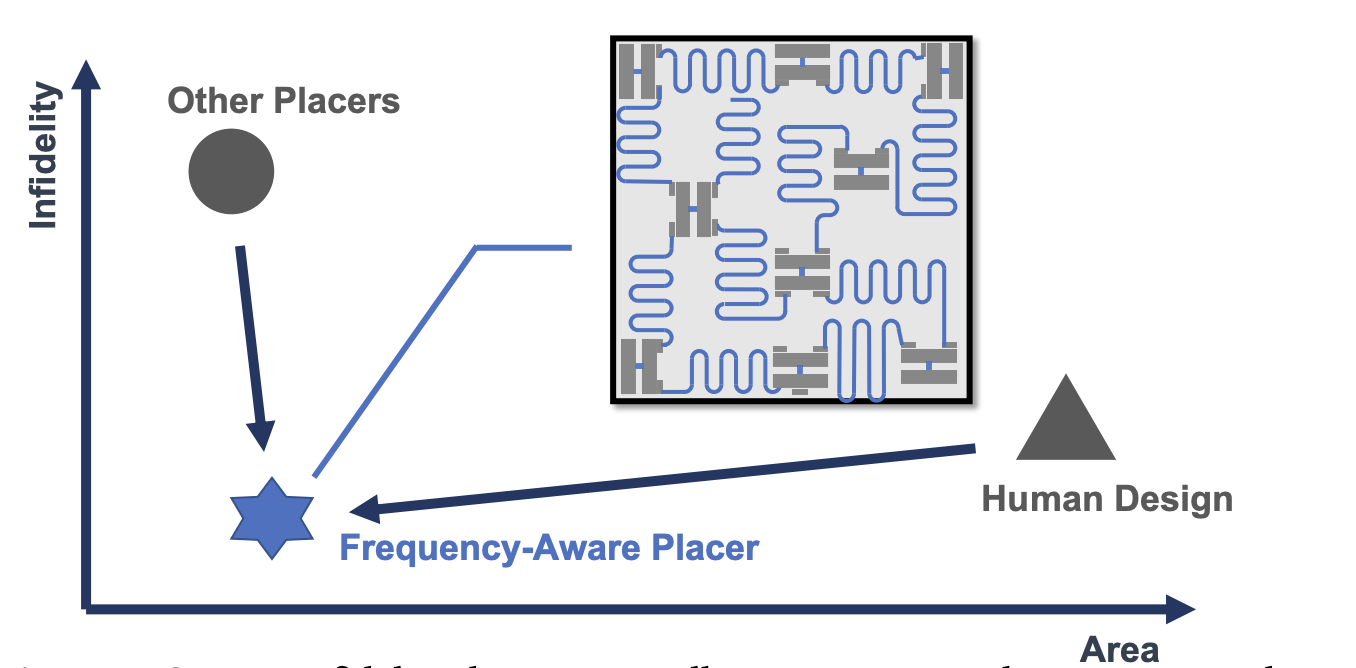
Qplacer carefully crafts the physical component layout in mitigating various crosstalk impacts while maintaining a compact substrate size. On device topology benchmarks, Qplacer can reduce the required area for theoretical crosstalk-free layout by 26.1% and 22.5% on average compared to the results of manual design and classical placement engines, respectively. This optimization of available space results in a compact layout, marking a pivotal advancement in quantum chip design.
Qplacer’s Unique Approach
Qplacer’s electrostatic-based placement approach, inspired by the classical placement framework, distinguishes itself with three major differences. Firstly, it integrates frequency penalties into its cost function to enhance the versatility of models, making it keenly responsive to crosstalk impacts and thereby bolstering the system robustness. Secondly, to address the unique spatial constraints of quantum systems, Qplacer introduces a padding strategy for movable quantum components to set up minimum spacing and partitioning resonators into smaller segments for greater flexibility in layout design. Lastly, it includes a legalizer step which integrates the segmented resonators to ensure their integrity.
Summary
In conclusion, Qplacer represents a significant step forward in the field of quantum computing. By addressing the critical issue of crosstalk and optimizing the use of available space, it enhances the robustness and performance of quantum computers. This innovative approach could pave the way for the development of larger, more efficient quantum computers capable of tackling intricate real-world problems more efficiently.
The article titled “Qplacer: Frequency-Aware Component Placement for Superconducting Quantum Computers” was published on January 30, 2024. The authors of this article are Junyao Zhang, Hanrui Wang, Ding Qiu-lin, Jiaqi Gu, Réouven Assouly, William Oliver, Song Han, Kenneth R. Brown, Hai Lü, and Yiran Chen. The article was sourced from arXiv, a repository maintained by Cornell University. The DOI reference for this article is https://doi.org/10.48550/arxiv.2401.17450.