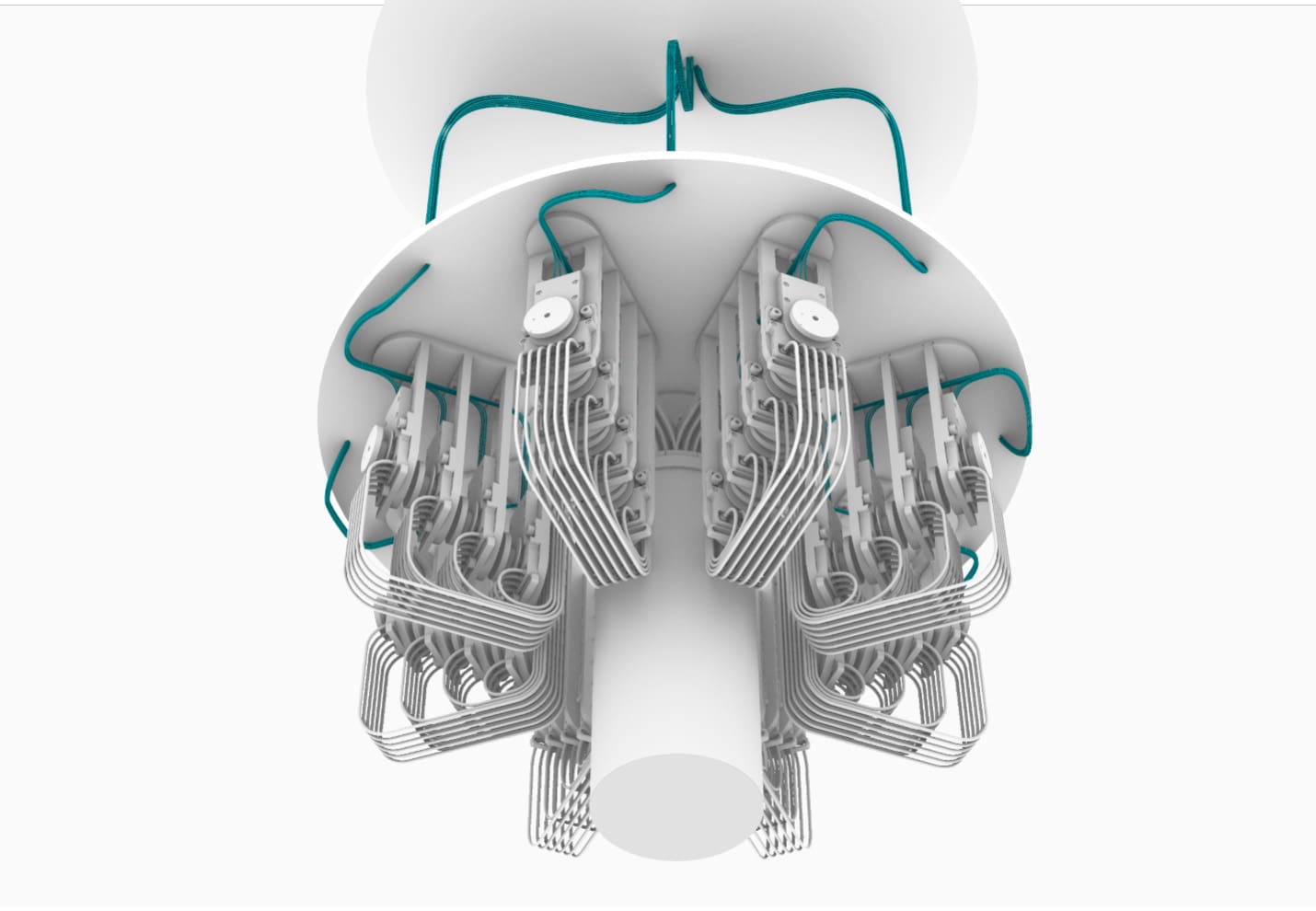
Quantum technology company QphoX has launched the Quantum Transducer, a product designed to enable quantum information transfer through existing optical fiber networks at room temperature and over significant distances. This development addresses a key obstacle to scaling quantum computers, allowing for modular systems with potentially limitless reach and expanded capabilities. By converting quantum states between microwave-based qubits and optical signals, the transducer allows communication between quantum processors, memories, and sensors. “This is the first time the technology to interface microwave and optical systems over a low-noise, high-efficiency quantum link has been commercially available,” said Simon Groeblacher, co-founder and CEO at QphoX; IBM will integrate the Quantum Transducer with its Quantum Networking Unit test devices, seeking to connect superconducting qubits and explore distributed quantum architectures.
Previous attempts at this technology required extremely cold temperatures, but this transducer facilitates high-fidelity quantum state conversion, allowing quantum information to traverse significant distances. This advancement addresses a critical limitation in scaling quantum processors beyond current physical constraints, and the company anticipates it will foster the development of modular quantum computers, offering a pathway to achieve broad quantum advantage through interconnected systems.
IBM Integrates QphoX Technology with Superconducting Qubit Systems
QphoX, based in Delft, Netherlands, unveiled the Quantum Transducer, a device designed to translate quantum information between the microwave frequencies used by many qubits and the optical signals that travel through fiber networks. This is a crucial step for extending quantum processing beyond the limitations of single chips. The advancement allows for quantum information to propagate at room temperature and over considerable distances, potentially overcoming the constraints of maintaining coherence in long-distance quantum communication. The implications extend beyond simply increasing qubit count; the technology promises to connect diverse quantum components, processors, memories, and sensors into a cohesive, scalable system. “At IBM, we have a clear plan to deliver large-scale, fault-tolerant quantum computers by the end of this decade,” said Jerry Chow, CTO of Quantum-Centric Supercomputing at IBM. “As we look to build the future of computing, it is important we work with organizations such as QphoX to explore how novel technologies could help to scale quantum computers even beyond our roadmap and towards distributed networks.”
By connecting different quantum modalities, QphoX aims to create the foundation for distributed quantum computing architectures that could scale beyond today’s physical limits.
Simon Groeblacher, co-founder and CEO at QphoX
Source: https://www.qphox.eu/