

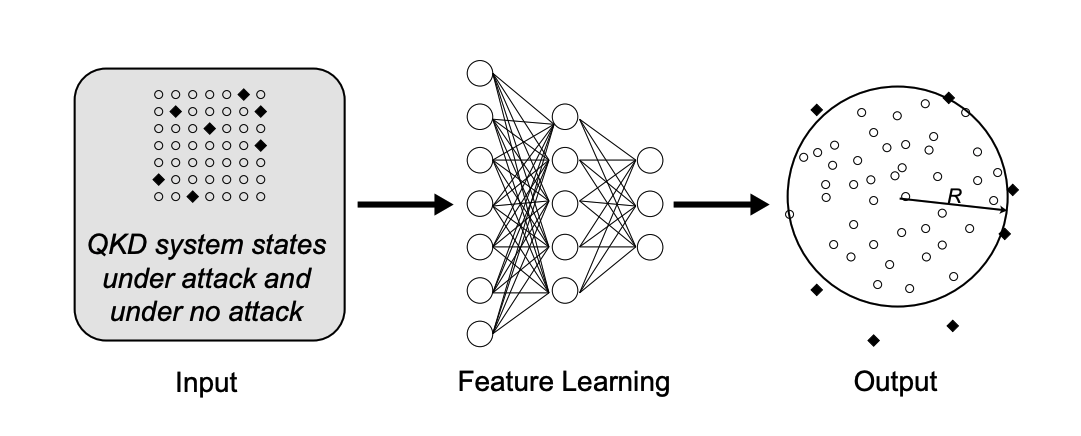
Quantum key distribution (QKD) promises unhackable communication, but practical systems remain vulnerable to side-channel attacks that exploit unintended physical characteristics. Junxuan Liu, from the University of Science and Technology of China, and colleagues demonstrate a new defence against these threats using deep anomaly detection. Their approach learns the normal operating parameters of a QKD system, and then flags any deviations as potential attacks, achieving over 99% accuracy in identifying anomalies. This method offers a significant advantage over existing countermeasures because it requires no changes to existing QKD infrastructure, avoids introducing new vulnerabilities, and importantly, can detect previously unknown attack types, offering a more robust and practical solution for securing quantum communication networks.
Practical Attacks and Security of QKD
Research into quantum key distribution (QKD) consistently reveals vulnerabilities in practical implementations, despite the theoretical security of the underlying quantum principles. This work details a wide range of attacks targeting QKD systems, focusing on how attackers exploit weaknesses in the hardware rather than the quantum protocol itself. These attacks often involve manipulating or monitoring physical characteristics of the system, such as electromagnetic emissions, detector behavior, and timing variations. A significant focus lies on attacks targeting single-photon detectors (SPDs), including manipulating detection timing, overwhelming detectors with light, exploiting detector recovery times, and even damaging detectors with lasers.
Researchers also investigate attacks involving wavelength manipulation, exploiting photorefractive effects, introducing malicious components, and injecting light to disrupt the quantum signal. Countermeasures under development include improved detector designs, decoy state protocols to estimate eavesdropping, measurement-device-independent (MDI) QKD to eliminate detector vulnerabilities, and sophisticated data post-processing techniques. Anomaly detection, leveraging machine learning, is also gaining prominence as a complementary security layer. This research highlights the importance of considering specific QKD protocols like BB84, MDI-QKD, and Twin-Field QKD, as well as technologies such as satellite QKD and integrated QKD systems.
The ongoing development of these technologies is crucial for extending the range and practicality of QKD networks. The field demonstrates a constant arms race between attackers and defenders, requiring continuous innovation in both attack strategies and countermeasures. Ultimately, robust hardware remains crucial for building truly secure QKD systems.
Anomaly Detection Secures Quantum Key Distribution
Researchers have developed a novel security system for quantum key distribution (QKD) networks based on anomaly detection, a technique borrowed from machine learning. Instead of identifying specific attacks, the system learns what constitutes normal, secure operation and flags any deviation from this baseline as potentially malicious. This approach overcomes the limitations of traditional countermeasures, which often require detailed knowledge of attack types or introduce new vulnerabilities. The system utilizes a Deep Support Vector Data Description (Deep SVDD) model, a type of one-class classification algorithm, trained solely on data collected during normal QKD operation, simplifying data preparation.
The system extracts parameters from the QKD system during secure key exchange, building a profile of expected behavior. The Deep SVDD then constructs a boundary around this normal behavior, creating a “safe zone” within the system’s operational parameters. A key strength of this method is its ability to detect previously unknown attacks, as it doesn’t rely on recognizing specific threats. By monitoring QKD system parameters and flagging values outside the established boundaries, the system identifies unusual behavior regardless of its origin. Evaluation using a test set containing both secure and attacked data demonstrates a high degree of accuracy, with an area under the curve exceeding 99%.
Importantly, this approach requires no additional hardware or modifications to existing QKD infrastructure, minimizing implementation costs and avoiding new vulnerabilities. By focusing on the characteristics of normal operation, the researchers have created a flexible and robust security system capable of protecting QKD networks from a wide range of threats, including those not yet identified. Training the model with a diverse and representative dataset further enhances its performance.
Adaptive Anomaly Detection Secures Quantum Key Distribution
Researchers have developed an anomaly detection model to enhance the security of quantum key distribution (QKD) systems. The model learns to characterise normal system behaviour from operational data, enabling it to identify deviations indicative of potential attacks. Testing demonstrates a high level of accuracy, with an area under the curve exceeding 99%, effectively safeguarding QKD systems from security threats. The key advantage of this approach lies in its practicality and adaptability; it can be deployed with minimal cost in existing networks without requiring new hardware or introducing additional vulnerabilities.
Unlike methods reliant on pre-defined attack signatures, this model offers generality and the potential to detect previously unknown attacks. The research highlights the importance of a comprehensive training dataset for optimal performance, noting that the model’s effectiveness scales with the quality and breadth of the data used to define normal system operation. This research provides a promising solution for ensuring the practical security of QKD systems and offers valuable insights for the development of future quantum communication architectures.
🗞 Addressing Side-Channel Threats in Quantum Key Distribution via Deep Anomaly Detection
🧠 ArXiv: https://arxiv.org/abs/2508.12749


