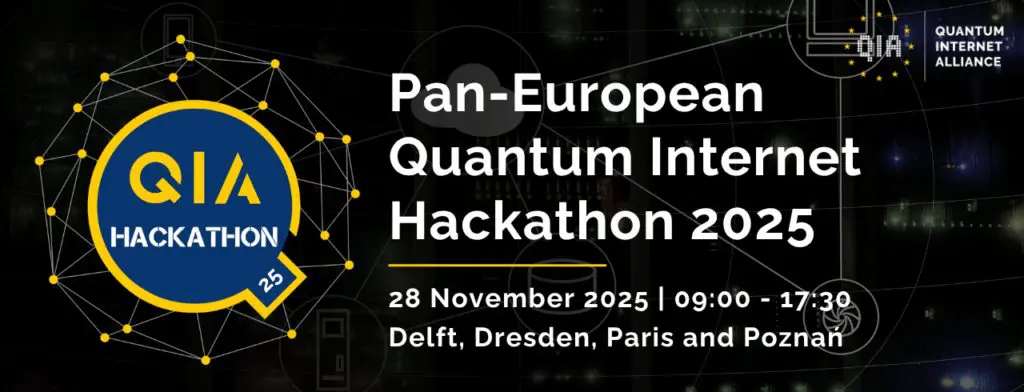
The Quantum Internet Alliance (QIA) has announced a free, continent‑wide hackathon set to take place in 2025, inviting developers, researchers and entrepreneurs to build and test quantum network applications across four European nodes. The event will take place at QIA-managed facilities in Delft, the Netherlands; Dresden, Germany; Paris, France; and Poznań, Poland. It will be launched with a webinar two weeks prior to introduce participants to the SquidASM quantum network simulator that underpins the challenges.
SquidASM: The Simulation Engine Behind the Hack
Central to the hackathon is SquidASM, a sophisticated simulator that models quantum communication and information‑processing protocols. Originally developed as part of the QIA project to inform hardware design, SquidASM enables participants to experiment with quantum key distribution, delegated computation, and even quantum-digital payment schemes in a virtual environment that mirrors real-world constraints. By abstracting the complexities of superconducting qubits, photonic chips, and ion traps, the simulator levels the playing field, enabling teams from academia, industry, and start-ups to prototype end-to-end solutions without access to expensive lab equipment.
The pre‑hack webinar will walk teams through the simulator’s architecture, highlighting its modular design and the APIs that let users script custom protocols. Participants will learn how to translate theoretical ideas, such as entanglement-based key exchange or measurement-device-independent protocols, into executable code that can be run on the same virtual hardware used by QIA’s own research teams. This emphasis on reproducibility and open-source tooling signals a broader shift in quantum research: the transition from isolated experiments to collaborative, software-driven development.
From Quantum Key Distribution to Digital Payments: The Challenge Landscape
The hackathon’s challenge set is deliberately diverse, covering three core areas that illustrate the practical stakes of quantum networking.
- Quantum Key Distribution (QKD) Enhancements: Teams will extend existing QKD implementations, focusing on improving key rates, extending transmission distances, or integrating post-selection techniques to mitigate noise. The goal is to demonstrate a protocol that could be deployed on commercial fibre‑optic links within the next decade.
- Secure Delegated Quantum Computation, Participants will design and simulate a protocol that allows a client to outsource a quantum calculation to a remote server while keeping the data encrypted. This challenge taps into the burgeoning field of quantum cloud services and raises questions about trust, privacy and the economics of quantum‑as‑a‑service.
- Quantum‑Digital Payment Simulation , The most speculative of the three, this task asks teams to create a payment system that leverages quantum entanglement to guarantee transaction integrity. Participants will explore how quantum signatures could replace traditional cryptographic primitives, potentially reducing the risk of fraud in high‑value digital exchanges.
Each challenge is scaffolded with starter code and benchmark datasets, ensuring that even newcomers can contribute meaningfully. The hackathon’s structure encourages rapid iteration: teams will submit progress updates weekly, receive feedback from QIA experts, and refine their solutions before the final showcase.
Nodes, Partners and the Pan‑European Network
The four nodes that will host the hackathon are more than mere venues; they are nodes in a growing quantum internet infrastructure. Delft’s QIA lab, with its state‑of‑the‑art photonic chip facility, will provide hands‑on access to fibre‑based entanglement sources. Dresden’s TU Dresden node, known for its superconducting qubit research, will offer a contrasting hardware flavour, while Paris’s Verisys‑cloud node brings expertise in cloud‑based quantum services. Poznań’s PCSS centre, a national supercomputing hub, will host the largest computing cluster, enabling teams to run heavy simulations that would otherwise be infeasible.
The partnership network behind the event is equally impressive. SURF, the Dutch national research and education network, will provide infrastructure support in Amsterdam, while Veriqloud will host nodes in both Dresden and Paris, ensuring that the hackathon’s reach spans the continent. PCSS’s involvement in Poznań underscores the role of national supercomputing centres in advancing quantum research. Together, these organisations form a distributed ecosystem that mirrors the very quantum networks the participants will be building.
Why This Matters for Europe’s Quantum Future
By bringing together diverse teams to tackle real‑world quantum networking problems, the QIA hackathon serves as a crucible for talent, ideas and cross‑disciplinary collaboration. The event’s focus on simulation and software development reflects a pragmatic recognition that quantum hardware will still be limited in the short term; the true power lies in the protocols that can be deployed over whatever physical links exist.
Moreover, the challenges touch on sectors that stand to be reshaped by quantum technology: secure communications, financial transactions, and cloud computing. If teams succeed in demonstrating practical QKD or quantum‑digital payment schemes, the results could accelerate the rollout of quantum‑enabled services across Europe, giving the region a competitive edge in the emerging quantum economy.
In the broader context of global quantum competition, the QIA hackathon illustrates a European strategy that prioritises open collaboration, shared infrastructure and software‑driven innovation. By nurturing a community of developers who can prototype, test and iterate on quantum protocols, Europe positions itself to not only keep pace with leaders like the United States and China but to shape the standards and architectures that will define the next decade of secure, distributed computing.