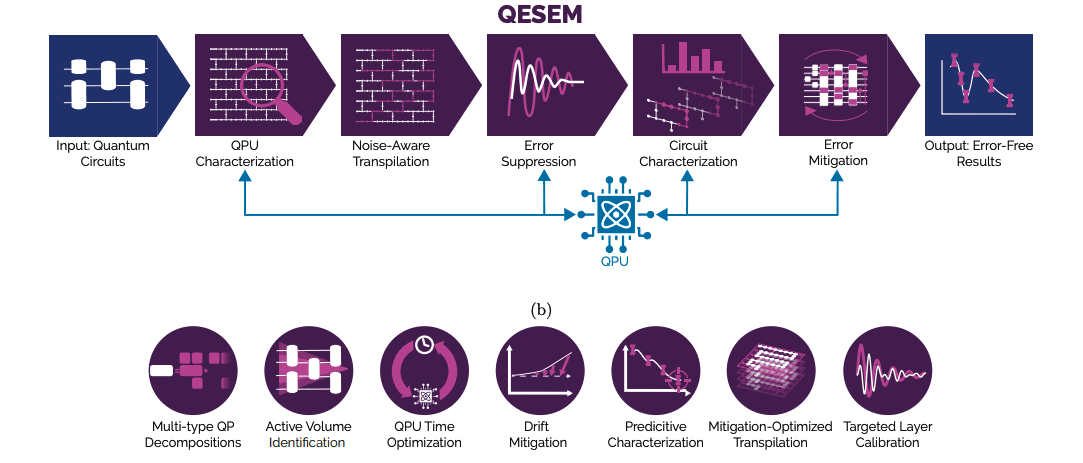
Quantum computers promise to revolutionise computation, but current devices are prone to errors that limit their potential, necessitating robust error mitigation techniques. Dorit Gur, Ilya Gurwich, and Avieli Haber, from 1Qedma Quantum Computing, alongside colleagues at institutions including the Hebrew University and the Weizmann Institute, present a new approach called QESEM, a software-based method for significantly improving the accuracy of quantum computations. The team demonstrates QESEM’s effectiveness in the largest unbiased error mitigation experiment to date, tackling a complex physics problem on IBM and IonQ hardware, and consistently outperforms established methods like zero-noise extrapolation. This advance represents a crucial step towards realising the full capabilities of near-term quantum computers and accelerating the path to quantum advantage across a range of applications, from materials science to fundamental physics.
Error Mitigation for Noisy Quantum Devices
Quantum algorithms hold immense promise, but current noisy intermediate-scale quantum (NISQ) devices are prone to errors that limit the size and depth of circuits that can be reliably executed. These errors stem from imperfections in quantum gates, the loss of quantum information through decoherence, and inaccuracies during measurement, all of which degrade the fidelity of quantum computations. Consequently, developing techniques to suppress or correct these errors is paramount for realising the full potential of quantum computation. Error mitigation offers a promising approach by reducing the impact of errors without the substantial overhead required for full quantum error correction, demanding significant resources in terms of qubits and gate operations. This work focuses on advancing error mitigation strategies to improve the performance of quantum algorithms on NISQ hardware, thereby enabling more complex and meaningful computations.
Quantum Benchmarking and Algorithm Implementation
Recent research has focused on developing improved methods for benchmarking and implementing quantum algorithms. Studies have explored techniques for characterising the performance of large-scale quantum computers using cycle benchmarking, providing insights into their capabilities and limitations. Other investigations have focused on enabling state-of-the-art quantum algorithms on existing hardware, combining error mitigation techniques with platforms like IonQ. Researchers are also pushing the boundaries of quantum simulation, aiming to model complex materials and systems beyond the reach of classical computers. These efforts are supported by advancements in software and algorithms, including those designed to learn and model the noise characteristics of quantum devices, and techniques for mitigating readout errors. Furthermore, studies are exploring the potential of combining quantum computing with high-performance computing to accelerate scientific discovery.
Software Package Mitigates Quantum Computation Errors
Quantum computers promise revolutionary computational power, but are currently limited by errors that arise during calculations. Researchers have introduced QESEM, a new software package designed to significantly improve the accuracy and reliability of quantum computations on existing hardware. This advancement focuses on error mitigation, a technique that reduces the impact of errors without requiring the substantial overhead of full error correction. QESEM achieves this through a sophisticated approach to characterising and suppressing errors, enabling more complex and accurate calculations. The core of QESEM lies in its ability to create a detailed model of the errors present on a specific quantum computer.
By carefully characterising the performance of individual operations, the software can then adjust calculations to minimize the effects of these errors. This process involves a unique decomposition of quantum operations, allowing QESEM to efficiently handle both standard and more complex “fractional” gates, reducing the overall computational cost compared to existing methods. Importantly, QESEM prioritises unbiased error mitigation, meaning it avoids introducing systematic distortions to the results. Testing QESEM on IBM and IonQ quantum computers demonstrated substantial improvements in accuracy compared to widely used error mitigation techniques like zero-noise extrapolation.
The software successfully tackled a complex simulation of the kicked transverse field Ising model, a challenging problem for quantum computers, and also delivered high-accuracy results for molecular calculations relevant to quantum chemistry. In these tests, QESEM reduced the computational depth required for accurate results by up to a factor of two, allowing for larger and more complex circuits to be executed. These advancements are particularly significant because they extend the capabilities of current quantum hardware, bringing practical quantum advantage, where quantum computers outperform classical computers for specific tasks, closer to reality. By improving the accuracy and efficiency of error mitigation, QESEM unlocks the potential for tackling increasingly complex problems, paving the way for breakthroughs in fields like materials science, drug discovery, and fundamental physics. The software is expected to remain crucial even as more robust error correction techniques are developed, as it complements these methods by maximising the utility of limited qubit resources.
QESEM Improves Accuracy in Quantum Calculations
The research introduces QESEM, a new quantum error mitigation workflow designed to improve the accuracy and reliability of calculations on near-term quantum computers. QESEM balances the need for rigorous, verifiable results with practical efficiency, addressing limitations found in both widely used heuristic methods and standard quasi-probabilistic approaches. Demonstrations on both IBM superconducting and IonQ trapped-ion devices, across applications like Hamiltonian simulation and Variational Quantum Eigensolver (VQE) calculations, highlight QESEM’s versatility as a general-purpose tool. The results demonstrate that QESEM consistently achieves higher accuracy than existing zero-noise extrapolation methods, while also offering tunable parameters to manage the trade-off between bias and computational cost. By increasing the volume of circuits that can be reliably simulated and delivering verifiable results, QESEM contributes to a more predictable timeline towards achieving quantum advantage. The authors acknowledge that further acceleration is possible by combining error mitigation with classical high-performance computing techniques, and suggest that the principles behind QESEM can be extended to address logical errors as quantum hardware progresses towards fault tolerance.
👉 More information
🗞 Reliable high-accuracy error mitigation for utility-scale quantum circuits
🧠 ArXiv: https://arxiv.org/abs/2508.10997