Developing complex systems often requires expertise across multiple fields, creating significant hurdles for rapid innovation, and researchers are now leveraging the power of large language models to overcome these challenges. Rong and colleagues at present QCopilot, a new framework that uses multiple interacting language models to design and diagnose experiments, specifically in the field of quantum sensing. This system combines access to external knowledge with active learning and careful assessment of uncertainty, allowing it to automate complex tasks that previously demanded significant human intervention. Demonstrating QCopilot’s capabilities, the team successfully generated ultra-cold atoms, reaching temperatures below one Kelvin, without human assistance, achieving a hundredfold increase in experimental speed, and importantly, the system can independently identify unusual parameters within complex experiments, paving the way for wider adoption of advanced technologies.
AI Automates Cold Atom Experimentation and Analysis
Researchers are employing Artificial Intelligence (AI), particularly Large Language Models (LLMs), to accelerate scientific discovery by automating tasks in cold atom physics and quantum sensing. This approach addresses limitations in traditional methods, which are often time-consuming, labor-intensive, and susceptible to human bias, offering a path to explore experimental parameters more efficiently and comprehensively. The core argument centers on automating experiment design, optimization, data analysis, and even hypothesis generation. Researchers are employing Bayesian Optimization and Reinforcement Learning, powerful techniques for optimizing complex experimental setups.
LLMs play a crucial role by generating experimental protocols, interpreting data, formulating hypotheses, and automating code creation. Multi-agent systems, where multiple AI agents collaborate, further enhance efficiency by allowing parallel exploration of experimental possibilities. This approach increases experimental efficiency, improves optimization by exploring wider parameter ranges, reduces human bias, accelerates discovery by automating repetitive tasks, and offers scalability for larger, more complex experiments. Challenges remain, including the need for large datasets to train AI algorithms, the difficulty of interpreting AI decision-making processes, ensuring AI models generalize to new data, integrating AI with existing infrastructure, and addressing ethical considerations. Nevertheless, the research presents a compelling case for AI’s potential to unlock new insights and advance our understanding of the quantum world.
LLM Agents Orchestrate Atom Cooling Experiments
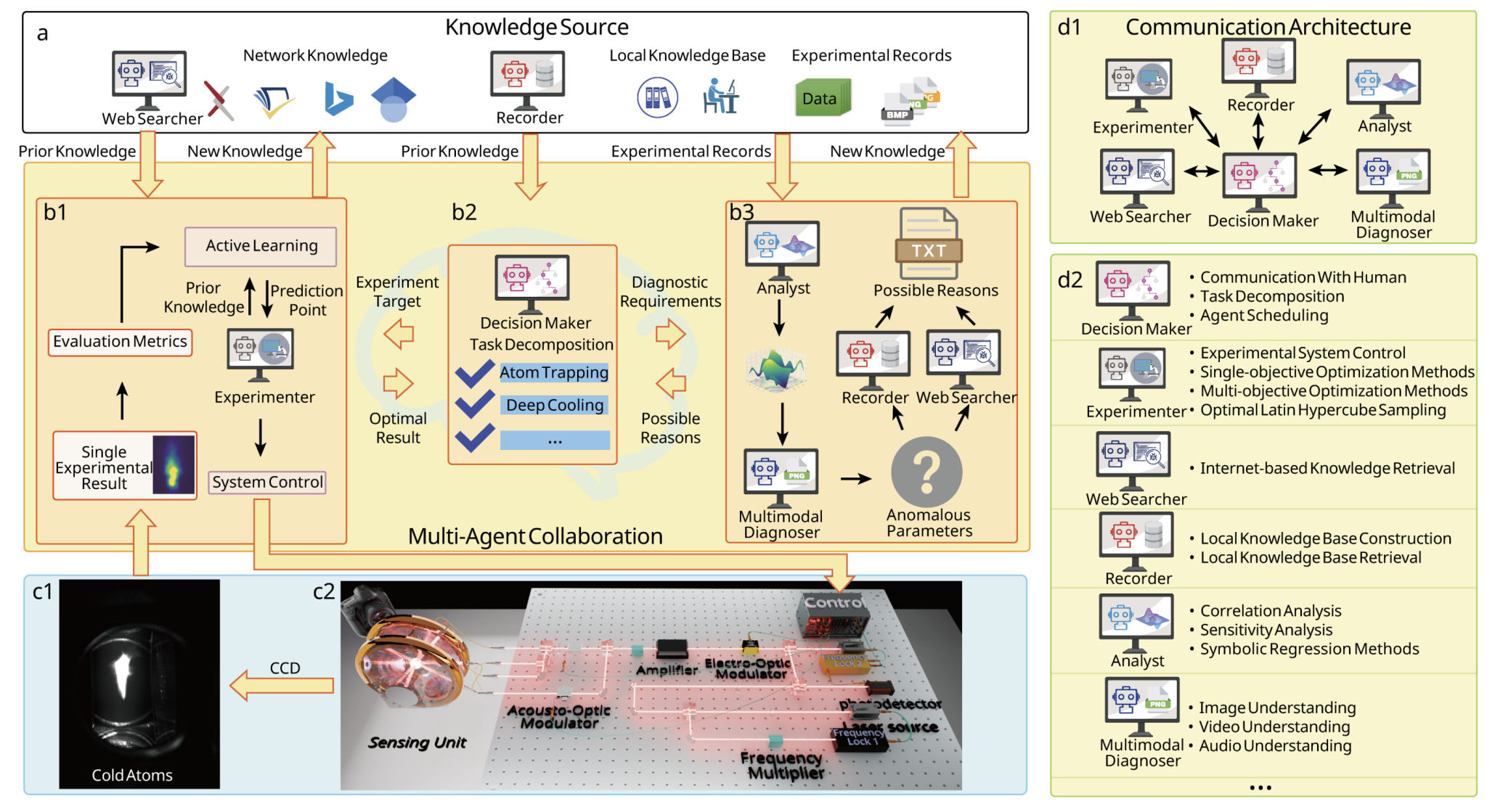
Researchers developed QCopilot, a novel multi-agent framework leveraging large language models to overcome challenges in complex scientific experimentation, specifically within the field of atom cooling. QCopilot addresses these issues by integrating pre-trained language models with external knowledge sources, allowing the system to reason, plan, and understand experimental contexts in a manner similar to human scientists. The core of QCopilot lies in its orchestration of specialized agents, each designed to perform specific tasks within the experimental workflow. A ‘Decision Maker’ agent utilizes both historical data and information gathered from web searches to decompose complex problems and determine the optimal sequence of actions.
This agent then directs other specialized agents, such as the ‘Experimenter’, which autonomously adjusts experimental parameters using active learning techniques to optimize system performance. The system moves beyond simple optimization by incorporating uncertainty quantification, allowing it to assess the reliability of its findings and adapt its strategies accordingly. Crucially, QCopilot also features agents dedicated to diagnosis and anomaly detection. An ‘Analyst’ agent models expected system behavior, while a ‘Multimodal Diagnoser’ analyzes data from various sources, including images, to identify deviations from the norm.
These agents work in concert with the ‘Recorder’ and ‘Web Searcher’ to retrieve potential root causes of problems, enabling targeted troubleshooting and autonomous fault correction. This integrated approach allows QCopilot to not only optimize experiments but also to learn from failures and improve its performance over time, effectively building a self-improving experimental system. The framework’s bidirectional functionality enables both forward optimization of experimental setups and reverse diagnosis of anomalies, representing a significant step towards automating scientific discovery and reducing the reliance on human intervention in complex experiments.
Intelligent Agents Accelerate Scientific Experimentation
Researchers have developed a new framework, QCopilot, that significantly accelerates scientific experimentation by automating complex optimization processes. This system addresses the time-consuming and often subjective nature of tuning experimental parameters. QCopilot leverages the power of large language models, acting as an intelligent assistant that integrates external knowledge, actively learns from results, and quantifies uncertainty to guide experimentation. The system operates through a multi-agent approach, employing specialized components to adaptively select optimization methods and independently diagnose problems.
In a demonstration focused on preparing cold atoms for quantum sensors, QCopilot successfully generated a dense cloud of atoms at temperatures below one microkelvin, a crucial requirement for high-precision sensing, within a matter of hours. This represents a remarkable 100-fold speedup compared to traditional manual experimentation, highlighting the potential for dramatically reducing research timelines. The core of QCopilot’s success lies in its ability to autonomously navigate complex parameter spaces. By combining Bayesian optimization techniques with a knowledge base of prior experimental data, the system efficiently identifies optimal settings for various experimental controls.
In the cold atom experiment, QCopilot not only maximized the number of trapped atoms but also minimized their temperature, achieving a balance that is difficult to attain through manual tuning. The system’s multi-objective optimization capabilities allowed it to identify a range of optimal solutions, offering researchers flexibility in prioritizing different experimental goals. Notably, QCopilot doesn’t simply execute pre-programmed instructions; it actively learns and adapts throughout the experimentation process. By continuously accumulating knowledge from each trial, the system can identify anomalous parameters and refine its optimization strategies. This dynamic modeling capability is particularly valuable in complex experimental setups where numerous factors can influence the outcome, and allows QCopilot to generalize its performance even in the face of environmental variations. The framework’s adaptability and efficiency promise to reduce barriers to large-scale deployment of advanced technologies, such as cold-atom based quantum sensors, in both academic and industrial settings.
QCopilot successfully automates key aspects of quantum experiments, specifically atom cooling. The system integrates external knowledge access, active learning, and uncertainty quantification to optimise experimental parameters and diagnose faults without human intervention. Applying QCopilot to atom cooling experiments resulted in the generation of sub-Kelvin atoms within a few hours, representing a significant speedup compared to manual experimentation. Notably, the framework’s ability to accumulate prior knowledge and dynamically model systems allows it to effectively identify anomalous parameters in complex experimental setups. While currently reliant on online access to large language models, limiting its offline application, the authors acknowledge the potential for future integration with localised inference models, paving the way for deployment on standard hardware. This development could ultimately enable autonomous operation of quantum sensors in field applications and reduce barriers to wider deployment of this technology.
🗞 LLM-based Multi-Agent Copilot for Quantum Sensor
🧠 ArXiv: https://arxiv.org/abs/2508.05421