

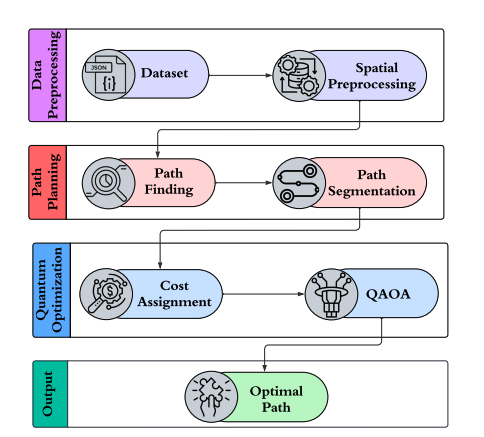
The increasing need for drone navigation in complex environments demands path planning systems that are both efficient and reliable, yet current methods often struggle with the computational demands of real-time obstacle avoidance. Nouhaila Innan, Muhammad Kashif, and Alberto Marchisio, all from New York University Abu Dhabi, alongside colleagues including Yung-Sze Gan from Thales Solutions Asia Pte. Ltd., and Muhammad Shafique, address this challenge with QUAV, a novel framework that integrates quantum computing into UAV path planning. QUAV represents one of the first applications of the Approximate Optimization Algorithm to drone trajectory optimisation, modelling pathfinding as a quantum problem to explore numerous routes simultaneously. This approach achieves a significant advantage in scalability, and extensive testing, including a real-world implementation, demonstrates QUAV’s ability to generate feasible and efficient trajectories, paving the way for future advancements in autonomous drone navigation systems.
The team explores how quantum computing can improve the speed and efficiency of finding optimal paths, particularly in complex environments. QUAV tackles computational demands by framing the problem as a quantum optimization task, allowing it to explore numerous potential routes simultaneously while incorporating realistic constraints and ensuring accurate positioning using a standard coordinate system. This innovative method moves beyond traditional techniques that struggle with the complex calculations needed for safe and scalable drone navigation.
Scientists analyzed QUAV’s computational complexity, demonstrating that the number of operations scales linearly with the size of the search space under specific conditions. This suggests QUAV offers a significant advantage over conventional path planning algorithms, especially in large and intricate environments. To confirm this analysis, the team conducted extensive simulations across diverse scenarios, assessing QUAV’s ability to generate feasible and efficient paths under varying conditions and obstacle densities. Further demonstrating the potential of their approach, researchers implemented QUAV on IBM’s ibm_kyiv quantum processor.
This real-world implementation allowed them to assess the impact of inherent limitations in quantum hardware, such as noise and connectivity, on the optimization process. Despite these constraints, results show QUAV successfully generates viable, efficient trajectories, highlighting the promise of quantum computing for future drone navigation systems. The team’s work represents a pioneering application of QAOA to drone trajectory optimization, paving the way for more intelligent and autonomous aerial vehicles.
QUAV Achieves Scalable Drone Path Planning
Researchers developed QUAV, a novel quantum-assisted framework that revolutionizes UAV path planning by reformulating the process as a quantum optimization task. The team successfully modeled pathfinding as a quantum optimization problem, enabling efficient exploration of multiple potential routes while seamlessly integrating obstacle constraints and geospatial accuracy through UTM coordinate transformation. A theoretical analysis demonstrates that QUAV achieves linear scaling in circuit depth relative to the number of edges, a significant advantage over traditional methods when dealing with increasingly complex scenarios.
Extensive simulations and a real-hardware implementation on IBM’s ibm_kyiv backend validate QUAV’s performance and robustness even under noisy conditions. Despite the limitations of current quantum hardware, results demonstrate that QUAV consistently generates feasible and efficient trajectories, highlighting the potential of quantum approaches to overcome the computational challenges of drone navigation. The framework’s ability to scale linearly with the number of edges suggests a substantial improvement in computational feasibility compared to conventional path planning methods, particularly in large-scale environments. The system models pathfinding as an optimization challenge, allowing it to efficiently explore multiple routes while adhering to constraints such as obstacle avoidance and accurate geospatial positioning. Results from both simulations and implementation on quantum hardware confirm that QUAV successfully generates feasible and efficient trajectories for drones, even in the presence of noise. Compared to established classical methods, QUAV offers a trade-off between speed and path quality, achieving faster runtimes than the A* algorithm and generating higher-quality paths than the RRT method.
The authors acknowledge that current quantum hardware limitations necessitate hardware-aware strategies to ensure reliable execution and that achieving a definitive quantum advantage remains a future goal. Future research directions include improvements in quantum hardware, the implementation of error mitigation techniques, and the exploration of hybrid quantum-classical approaches to further enhance performance and scalability. This work establishes QUAV as a practical initial step towards scalable quantum-assisted path planning for drones, with the potential to complement and eventually surpass classical methods as quantum technology matures.
🗞 QUAV: Quantum-Assisted Path Planning and Optimization for UAV Navigation with Obstacle Avoidance
🧠 ArXiv: https://arxiv.org/abs/2508.21361


