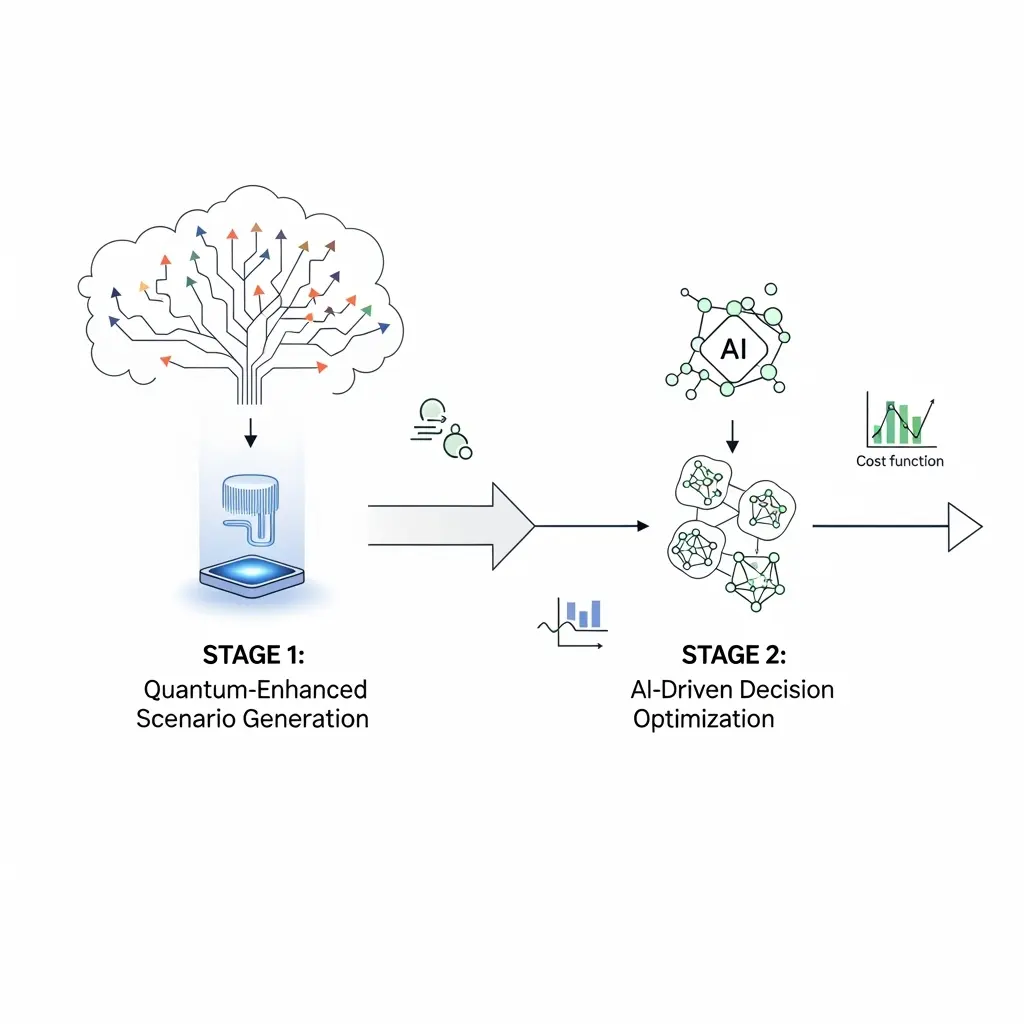
Two-stage stochastic programming, a crucial technique for decision-making under uncertainty, often struggles with the computational demands of considering numerous possible future scenarios, as the complexity increases directly with their number. Taihei Kuroiwa, Daiki Yamazaki, and Keita Takahashi, along with colleagues from the University of Electro-Communications and Grid Inc., present a novel quantum-circuit framework, qGAN-, that tackles this challenge by integrating a pre-trained quantum generative adversarial network with the Quantum Approximate Optimisation Algorithm. This innovative approach encodes the distribution of potential scenarios and optimises initial decisions while minimising future costs, offering a potentially significant speedup for complex problems. The team demonstrates the effectiveness of qGAN- on a realistic energy grid problem, the stochastic unit commitment problem, showing it can achieve competitive results with existing methods and paving the way for more efficient solutions to large-scale stochastic optimisation.
Two-stage stochastic programming frequently discretises uncertainty into scenarios, but enumerating these scenarios increases the computational cost of evaluating expected recourse, at least linearly with the number of scenarios. This research introduces qGAN-QAOA, a unified quantum-circuit workflow designed to address this challenge, integrating a pre-trained quantum generative adversarial network to encode the scenario distribution and the quantum approximate optimisation algorithm, or QAOA, to optimise first-stage decisions by minimising the complete two-stage objective, which incorporates expected recourse cost. With the quantum generative adversarial network parameters fixed following training, the objective is evaluated as the expectation value of a problem Hamiltonian, allowing optimisation to focus solely on the QAOA variational parameters. The concept of non-anticipativity is interpreted as a condition within this framework.
Expectation Value Decomposition and Hadamard Transform
The research details a mathematically rigorous proof demonstrating the decomposition of the Hamiltonian expectation value into first-stage and second-stage contributions, enabling a focused optimisation process. The proof leverages the Walsh-Hadamard transform to represent scenario realizations in a different basis, revealing a sparsity of coefficients crucial for simplifying calculations and reducing computational demands. Orthogonality of the basis states further streamlines the process, while careful manipulation of the binary representation of the scenario index is essential for evaluating key coefficients.
QGAN and QAOA Optimise Stochastic Programming
Scientists developed qGAN-QAOA, a novel quantum-circuit workflow that addresses limitations in traditional two-stage stochastic programming methods, particularly those involving numerous scenarios. The work centers on integrating a pre-trained quantum generative adversarial network (qGAN) to encode the distribution of uncertain scenarios and employing the quantum approximate optimization algorithm (QAOA) to optimize initial decisions while minimizing overall costs. Experiments demonstrate that the objective function can be evaluated by measuring the expectation value of a problem Hamiltonian, streamlining the optimization process to focus solely on QAOA’s variational parameters. The team proved that non-anticipativity is inherently satisfied within their framework, as the marginal distribution of measurement outcomes remains scenario-independent.
Furthermore, by utilizing a uniform discretization of continuous uncertainty and applying the Walsh-Hadamard transform, researchers achieved a sparse Pauli-Z expansion for the random-variable operator, significantly reducing computational demands. Measurements confirm that the number of Pauli-Z terms scales polylogarithmically with the number of scenarios, minimizing the impact of increasing scenario counts on gate count and circuit depth. Applying this method to the stochastic unit commitment problem with photovoltaic uncertainty, the team compared its performance against classical baselines, demonstrating the effectiveness of qGAN-QAOA as a two-stage decision model and establishing conditions under which it offers computational advantages as target accuracy approaches zero.
QGAN-QAOA Solves Two-Stage Stochastic Problems
This research presents qGAN-QAOA, a novel quantum-circuit workflow for two-stage stochastic programming problems, common in fields like energy management and logistics. The team integrates a pre-trained quantum generative adversarial network, or qGAN, to represent uncertain scenarios with a quantum approximate optimization algorithm, or QAOA, to optimise initial decisions while accounting for potential future costs, allowing for the minimisation of the overall two-stage objective function within a single quantum circuit. The results demonstrate that the proposed method can accurately learn the distribution of uncertain variables, concentrate solutions on promising candidates, and achieve expected costs comparable to established stochastic programming techniques. Importantly, the researchers show that, under specific conditions, the quantum circuit’s gate count and depth scale favourably with the number of scenarios, potentially overcoming a key limitation of classical approaches. Future research will focus on improving the efficiency and accuracy of the scenario-generating circuit, exploring circuit designs that better capture complex distributions, and validating the method’s performance on actual quantum computers, with plans to quantify performance degradation due to noise and extend the approach to a wider range of stochastic programming problems.
🗞 Quantum-Circuit Framework for Two-Stage Stochastic Programming via QAOA Integrated with a Quantum Generative Neural Network
🧠 ArXiv: https://arxiv.org/abs/2512.22434