The future of secure communication and revolutionary sensing technologies just received a major boost. The U.S. Department of Energy announced a renewed five-year, $125 million investment in Q-NEXT, a national research center pioneering the development of a quantum-interconnected world. Led by Argonne National Laboratory with key contributions from SLAC National Accelerator Laboratory and Stanford University, Q-NEXT aims to build the foundational elements for a national quantum network – one that promises unhackable communication and sensors with unprecedented precision. This continued funding ensures the U.S. remains at the forefront of the rapidly evolving quantum information science field, potentially reshaping industries from cybersecurity to materials discovery.
Q-NEXT Center Receives Renewed DOE Funding
The U.S. Department of Energy has reaffirmed its commitment to advancing quantum information science and technology with a renewed five-year funding grant for Q-NEXT, a National Quantum Information Science Research Center led by Argonne National Laboratory in partnership with SLAC National Accelerator Laboratory. The $125 million investment, with $25 million allocated for fiscal year 2026, will propel Q-NEXT’s efforts to build a quantum-interconnected world, focusing on three key scientific goals: establishing robust quantum communication networks, exploring practical quantum sensing applications, and discovering novel quantum materials.
A central component of this work is underway at SLAC, where researchers are collaborating with Stanford University to develop a groundbreaking high-bandwidth quantum network. This network aims to overcome a major hurdle in quantum computing by connecting diverse quantum systems – utilizing different qubit types like atomic, superconducting, and solid-state – regardless of their underlying technology. This ambitious project builds upon five years of successful research, and now seeks to demonstrate the potential of distributed quantum entanglement – a phenomenon allowing qubits to remain connected even over vast distances. According to SLAC Director John Sarrao, partnerships like Q-NEXT are crucial for integrating national expertise and facilities, expediting the quantum technology revolution and solidifying U.S. leadership in this transformative field. Incoming Q-NEXT Director Martin Holt emphasized the center’s renewed mission to harness distributed entanglement and demonstrate the possibilities of scalable quantum platforms, ultimately paving the way for revolutionary systems capable of impacting numerous sectors.
Key Goals of the Q-NEXT Initiative
The Q-NEXT initiative, recently renewed by the U.S. Department of Energy with a $125 million investment over five years, is strategically focused on three core scientific goals to accelerate the development of a quantum-interconnected world. Primarily, Q-NEXT aims to establish robust quantum communication networks, leveraging the phenomenon of distributed quantum entanglement – maintaining a connection between qubits even across significant distances – to enable secure and efficient data transmission. Complementing this, the center is dedicated to exploring practical quantum sensing applications, potentially revolutionizing fields like medical imaging and materials science with unprecedented precision. Finally, a crucial aspect of Q-NEXT’s mission involves the advancement of quantum materials, seeking to discover and refine the building blocks necessary for more powerful and stable quantum computers.
A key component of achieving these goals is happening at SLAC National Accelerator Laboratory in partnership with Stanford University, where researchers are pioneering the development of a high-bandwidth quantum network. This network is designed to be universally compatible, connecting quantum systems regardless of the underlying qubit technology – be it atomic, superconducting, or solid-state – a crucial step towards building a truly interconnected quantum infrastructure. Ultimately, Q-NEXT seeks to seamlessly integrate quantum and traditional information systems across optical networks, paving the way for scalable quantum platforms and solidifying the United States’ position as a global leader in quantum innovation.
SLAC and Stanford’s Collaborative Role
A cornerstone of the advancing quantum landscape is the robust collaboration between SLAC National Accelerator Laboratory and Stanford University, particularly within the renewed five-year funding of the Q-NEXT quantum research center. Led by Argonne National Laboratory, Q-NEXT receives $125 million from the Department of Energy to propel quantum information science and technology, and SLAC plays a critical role in realizing this ambitious goal. This partnership isn’t merely logistical; it’s a focused effort to develop a groundbreaking high-bandwidth quantum network. This network aims to overcome a major hurdle in quantum computing—connecting disparate quantum systems, irrespective of their underlying qubit technology, be it atomic, superconducting, or solid-state.
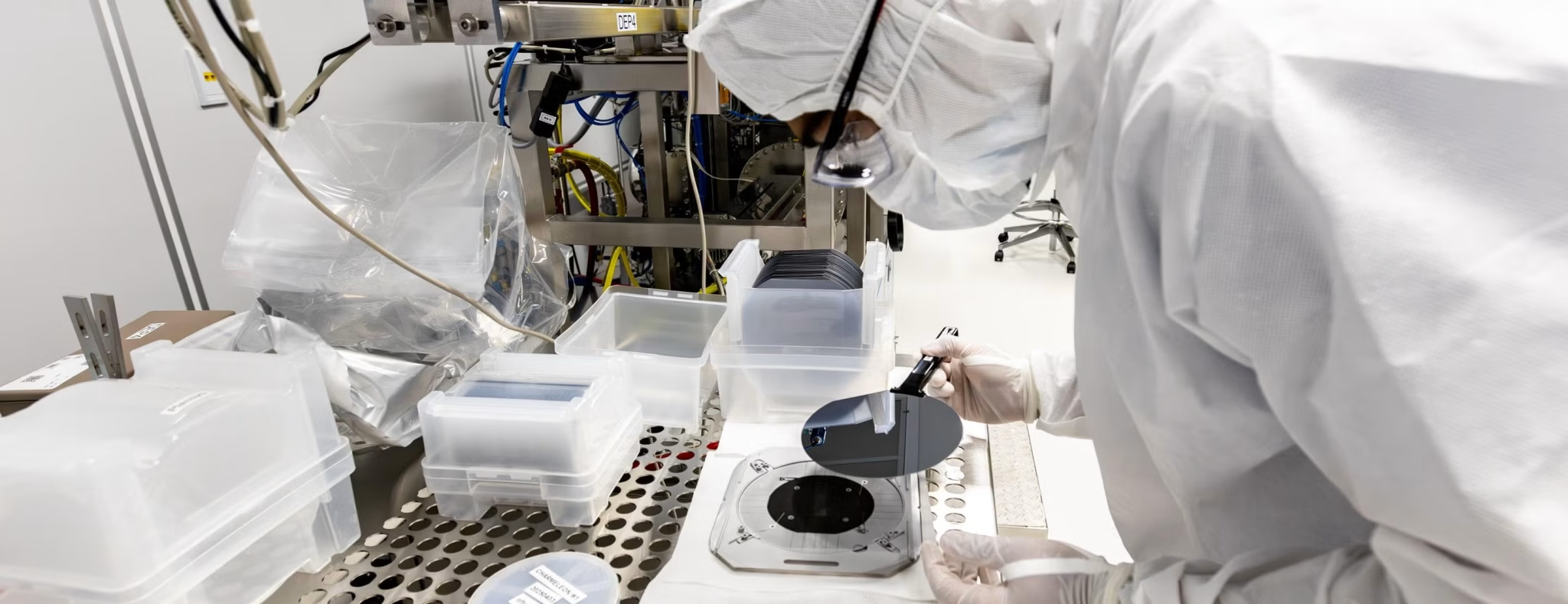
Currently, graduate students like Ameya Kunder are actively contributing to this endeavor, examining prototype frequency-upconverting superconducting quantum devices manufactured at SLAC’s on-site superconducting device foundry – one of two facilities dedicated to advancing quantum capabilities within the Q-NEXT center. This collaborative work isn’t isolated; it’s part of a larger mission to integrate quantum and traditional information systems across optical networks, demonstrating the potential of distributed quantum entanglement—a phenomenon in which qubits remain connected over long distances. As SLAC Director John Sarrao notes, these partnerships “integrate expertise across the country and leverage the world-class facilities of the national labs,” accelerating the quantum revolution and solidifying U.S. leadership in this transformative field. The combined strengths of SLAC’s fabrication capabilities and Stanford’s research expertise are thus central to Q-NEXT’s renewed mission of harnessing distributed entanglement and paving the way for scalable quantum platforms.
Advancing Quantum Information and Entanglement
The pursuit of a quantum-interconnected world is receiving a significant boost with the renewed funding of Q-NEXT, a National Quantum Information Science Research Center led by Argonne National Laboratory in partnership with SLAC National Accelerator Laboratory and Stanford University. This $125 million, five-year investment from the U.S. Department of Energy will propel advancements in quantum information science and technology, specifically focusing on three core goals: developing quantum communication networks, exploring quantum sensing applications, and pioneering new quantum materials. A central tenet of Q-NEXT’s mission is unlocking the potential of distributed quantum entanglement – the bizarre yet powerful phenomenon allowing qubits to remain connected and share information across considerable distances. Currently, researchers at SLAC and Stanford are actively building the foundation for this future, concentrating on creating the first high-bandwidth quantum network capable of linking diverse quantum systems, irrespective of whether they utilize atomic, superconducting, or solid-state qubits.
This endeavor isn’t merely about connecting machines; it’s about seamlessly integrating quantum and traditional information systems via optical networks, paving the way for scalable quantum platforms and revolutionizing fields reliant on secure communication and advanced computation. As SLAC Director John Sarrao notes, these collaborative partnerships are critical to accelerating the quantum technology revolution and solidifying the United States’ position as a global leader in this transformative field. The work builds upon the strong foundation laid over the past five years, with incoming Q-NEXT Director Martin Holt emphasizing the commitment to harnessing distributed entanglement to demonstrate the capabilities of scalable quantum platforms.