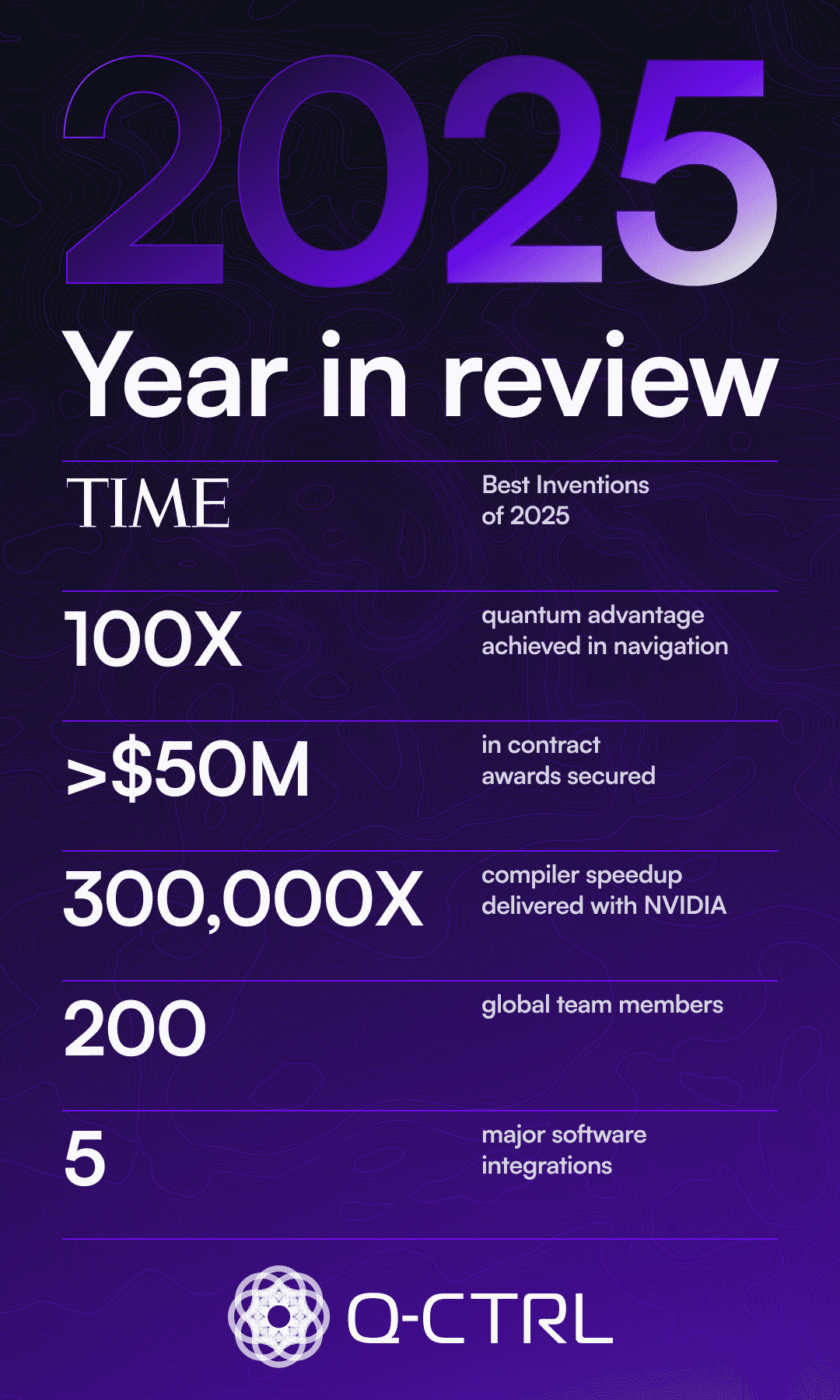
In 2025, Q-CTRL achieved the first demonstration of true commercial quantum advantage, specifically in GPS-denied navigation, during the UNESCO International Year of Quantum Science and Technology. Utilizing quantum sensors, the company outperformed the best conventional alternatives by a factor of 50X, subsequently increasing to over 100X. This achievement, recognized by TIME Magazine as one of the Best Innovations of 2025, signifies a pivotal moment in realizing the practical applications of quantum technology. Q-CTRL’s success underscores the importance of infrastructure software in unlocking the potential of quantum systems, establishing a new benchmark for the sector and driving commercial growth with over $50M in sales and contracts.
Software as Key to Quantum Hardware Performance
Q-CTRL fundamentally believes infrastructure software is key to unlocking useful performance from any quantum technology. This isn’t limited to algorithm research or professional services; they build deployable software to make quantum useful in real-world applications. In 2025, they demonstrated this with commercial wins—over $50M in sales and contracts—and achieved the first true commercial quantum advantage in GPS-denied navigation, outperforming conventional methods by 50X (increasing to >100X).
Their software automates and virtualizes quantum computers, making them more powerful for a broad range of users, from research teams to industry. Q-CTRL’s performance-management software supports partners achieving business objectives in areas like logistics (Airbus, Network Rail), automotive design (Mazda), finance (finQBit), and quantum chemistry (Mitsubishi Chemical, University of Sydney). This is accomplished through enterprise-grade products that elevate quantum computing for everyone.
A major focus is integrating quantum computing into data centers. Q-CTRL’s infrastructure software delivers autonomy and virtualization, addressing limitations to broad deployment. They introduced the Quantum Utility Block reference architecture—developed with QuantWare and Qblox—aiming for push-button quantum computers at 10X reduced cost. The first QUB system will go online at Elevate Quantum in 2026, becoming the first commercially reproducible modular quantum computing platform.
Achieving Commercial Quantum Advantage in Sensing
Q-CTRL achieved the first true commercial quantum advantage in GPS-denied navigation in 2025, outperforming conventional alternatives by 50X, increasing soon after to over 100X. This breakthrough earned recognition as one of TIME Magazine’s Best Innovations of the year. The company attributes this success to its focus on infrastructure software – a key element in unlocking useful performance from quantum technology, specifically in the realm of sensing. This advancement demonstrates a shift from theoretical promise to practical, real-world application for quantum sensors.
Q-CTRL’s software isn’t limited to sensing; it also accelerates quantum advantage in computing by enabling new applications and automating quantum computers for a broader user base. The company ships enterprise-grade products and partners with organizations like Airbus, Mazda, and Mitsubishi Chemical to achieve wins in logistics, automotive design, and quantum chemistry. A key innovation is performance-management software, which supports algorithm execution and helps users realize their quantum ambitions, delivering deployable software applicable across various uses.
A major trend Q-CTRL addresses is integrating quantum computing into data centers. They’ve introduced the Quantum Utility Block (QUB) reference architecture, developed with QuantWare and Qblox, aiming for push-button quantum computer deployment at 10X reduced cost. The first QUB system will go online at Elevate Quantum in 2026, representing a commercially reproducible modular quantum computing platform. This work, along with software integrations with AWS, IBM, and Rigetti, highlights their commitment to practical, scalable quantum solutions.
We win no matter which qubit wins the race to dominance, no matter what sector or application first achieves computational quantum advantage, and no matter whether your preference is for quantum computing or quantum sensing as a primary vertical.
Expanding Quantum Computing Applications with Software
Q-CTRL focuses on software as the key to unlocking practical quantum technology, moving beyond theoretical promise to deliver commercial value. Their infrastructure software automates and virtualizes quantum computers, making them accessible to a broader range of users – from research teams to industry professionals. This approach has resulted in over $50 million in sales and contracts, with applications spanning logistics (Airbus, Network Rail), automotive design (Mazda), finance (finQBit), and quantum chemistry (Mitsubishi Chemical, University of Sydney).
A major trend Q-CTRL addresses is integrating quantum computing into existing data centers. They aim to overcome limitations hindering widespread adoption, emphasizing autonomous operation, broad usability, and scalable deployment without excessive costs. Boulder Opal delivers intelligent autonomy for quantum computer calibration, while the Quantum Utility Block (QUB) reference architecture promises push-button quantum computers at 10X reduced cost, partnering with QuantWare and Qblox.
Q-CTRL’s software delivers unique technology for reducing errors in quantum computers and improving performance. They provide algorithm developers with application-specific insights for error reduction, enabling users to maximize the potential of quantum hardware now. This commitment to practical value is demonstrated through integrations with major cloud platforms like IBM Quantum, AWS (IonQ), and Rigetti, as well as on-premises deployments with RIKEN and Keio Quantum Computing Center.
We’ve focused on how to build a quantum conversant workforce, from machinists and designers through to executives.
Delivering Value Through Cloud and HPC Integration
Q-CTRL focuses on delivering value through cloud and HPC integration by building infrastructure software that enables broader access and usability of quantum computers. This strategy moved beyond early demos with innovations like Boulder Opal, providing intelligent autonomy for quantum computer calibration. A key achievement was the Quantum Utility Block reference architecture, promising 10X reduced cost for deploying quantum computers at scale—the first system will be online at Elevate Quantum in 2026—and interoperable hardware and software components.
The company expanded software integrations across cloud quantum platforms, initially with IBM Quantum and later AWS (IonQ processors) and Rigetti. Notably, Q-CTRL integrated Fire Opal with RIKEN’s IBM Quantum System Two and the Fugaku supercomputer, marking its first on-premises HPC center integration. This demonstrates a push to integrate quantum computing into data centers, focusing on autonomous operation, broad user access, and scalability, moving beyond single installations.
Q-CTRL’s approach centers on software abstraction, crucial for commercially viable quantum computing. They’ve published guides to help data centers integrate quantum computing and offer AI-powered error reduction techniques. At its core is unique technology for reducing errors and increasing performance. This allows algorithm developers to optimize error reduction strategies, providing real value to end users now and paving the way for hybrid classical-quantum computing, as showcased by NVIDIA’s Jensen Huang.
It was also wonderful to see our technology recognized by TIME Magazine, InnovationAus, and the Defence Connect awards.
Integrating Quantum Computing into Data Centers
A key trend in the quantum sector is integrating quantum computing into existing data centers, and Q-CTRL is focused on overcoming deployment limitations beyond initial demonstrations. Their infrastructure software delivers autonomy and virtualization crucial for scalable data center installations. This year saw the release of Boulder Opal, offering intelligent autonomy for quantum computer calibration, and a partnership with TreQ and QuantWare to implement this technology in the Open Architecture Quantum (OAQ) Testbed at the TreQ Manufacturing Facility in Milton Park, Oxfordshire.
Q-CTRL introduced the Quantum Utility Block (QUB) reference architecture, aiming for cost-efficient, large-scale quantum computer deployment within data centers in partnership with QuantWare and Qblox. This approach promises “push-button” quantum computers, reducing costs by 10X and eliminating the need for highly specialized integration teams. The first QUB system is slated to go online at Elevate Quantum in 2026, marking the first commercially reproducible modular quantum computing platform.
To facilitate data center adoption, Q-CTRL published several how-to guides, including resources on integrating quantum computing into HPC facilities, the importance of software abstraction, and learning from GPU adoption. These guides, alongside their core technology for reducing errors in quantum computers, are designed to provide immediate value to end users and drive up performance and efficiency—allowing data centers to move beyond experimental installations.
Autonomous Calibration and the Quantum Utility Block
durationQ-CTRL introduced the Quantum Utility Block (QUB) reference architecture in 2025, aiming to drastically reduce the cost of deploying quantum computers at scale. This approach, developed with QuantWare and Qblox, delivers “push-button” quantum computers into data centers via interoperable components. The QUB is projected to reduce costs by 10X and eliminates the need for highly specialized teams for integration and maintenance, with the first system scheduled to go online at Elevate Quantum in 2026 as a commercially reproducible, modular platform.
A key component of Q-CTRL’s strategy is delivering autonomy for quantum computer calibration and operation. In 2025, Boulder Opal’s intelligent autonomy capabilities were brought to market, moving beyond simple scripted automation to true autonomy. This technology is being implemented in a UK National Quantum Computing Center installation via a partnership with TreQ and QuantWare, demonstrating a focus on systems that can be operated by anyone and scaled without significant cost increases.
Q-CTRL’s infrastructure software is central to enabling hybrid classical-quantum computing. Their solutions address challenges limiting quantum deployment, such as ensuring autonomous operation and broad scalability. This work caught the attention of NVIDIA’s Jensen Huang, who showcased their partnership this year. Q-CTRL published guides to help data centers integrate quantum computing, emphasizing software abstraction as a critical element for commercial viability.
AI-Powered Error Reduction for Quantum Systems
,Q-CTRL focuses on unlocking useful performance from quantum technology through infrastructure software, addressing errors in both quantum computers and sensors. This software is key to enabling applications, automating calibration, and making quantum systems operational. A core component is AI-powered error reduction, designed to deliver immediate value to end users by providing application-specific insights into minimizing errors and maximizing hardware performance. This approach distinguishes Q-CTRL by providing deployable software applicable across various applications.
A significant advancement involves Boulder Opal’s intelligent autonomy capabilities for quantum computer calibration, brought to market this year. This technology, coupled with partnerships like those with TreQ and QuantWare, aims to deliver autonomous operation and scalability for quantum systems within data centers. Q-CTRL also introduced the Quantum Utility Block reference architecture, promising a 10X cost reduction and simplified integration of quantum computers—a first commercial modular platform going online in 2026.
Q-CTRL’s software integrates with a wide range of hardware systems, including IBM Quantum, AWS IonQ processors, and Rigetti Ankaa-3. This broad integration, demonstrated at events like IBM TechXChange, allows users to leverage performance-management error-suppression technology. The company highlights the importance of software abstraction and published how-to guides to facilitate quantum computing integration into existing data center infrastructure, emphasizing solutions for cost-efficiency and ease of maintenance.
Insights for Algorithm Developers on Error Reduction
Q-CTRL focuses on delivering deployable software—not just algorithm development—to help users realize quantum ambitions. Their infrastructure software is key to enabling autonomy and virtualization for quantum computer installations, addressing limitations that hinder broad deployment. Boulder Opal’s intelligent autonomy capabilities, brought to market this year, enable quantum computer calibration, and a partnership with TreQ and QuantWare aims to deliver this technology to a UK National Quantum Computing Center.
A core focus is reducing errors in quantum computers to drive performance and efficiency. Q-CTRL provides application-specific insights to algorithm developers, offering direct advice on choosing the best error reduction strategies for their particular application. This approach extends beyond simple automation, aiming for true autonomy in quantum computer operation, and is demonstrated through integrations with various hardware systems like IBM Quantum, AWS IonQ processors, and Rigetti Ankaa-3.
Q-CTRL’s Quantum Utility Block (QUB) reference architecture, developed with QuantWare and Qblox, offers a cost-efficient solution for integrating quantum computers at scale into data centers. This delivers “push-button” quantum computers with interoperable components at 10X reduced cost, removing the need for PhD-level integration teams. The first QUB system is slated for launch at Elevate Quantum in 2026, representing a commercially reproducible modular quantum computing platform.