Q-CTRL has demonstrated advances in quantum computation by generating entanglement across 75 qubits and implementing high-fidelity long-range CNOT gates on superconducting processors. Published in PRX Quantum, the results showcase a strategy that combines error suppression with error detection – a component of quantum error correction – without requiring full logical encoding. This approach yielded a 75-qubit Greenberger-Horne-Zeilinger (GHZ) state – a record in published literature – with a comparatively low data discard rate, and achieved over 85% fidelity for a 40-site CNOT gate, representing a resource-efficient pathway towards improved performance on near-term quantum computers.
Q-CTRL achieves advancements in quantum computation by integrating error detection directly into the quantum control layer, bypassing the substantial resource demands typically associated with full logical encoding. This positions Q-CTRL’s methodology as a pragmatic intermediate step between the Noisy Intermediate-Scale Quantum (NISQ) and Fault Tolerant Quantum Computing (FTQC) eras, potentially accelerating the realization of quantum advantage. This accelerates the timeline for realizing quantum advantage and bridges the gap between the NISQ and FTQC eras.
Q-CTRL’s team successfully generated GHZ states – a form of multipartite entanglement – for up to 75 qubits through a resource-efficient protocol incorporating sparse error detection via ancillary stabilizer measurements, consuming only nine flag qubits. The retention of a substantial proportion of measurement outcomes – over 80% for the 27-qubit state and over 21% for the 75-qubit state – validates the effectiveness of this approach and highlights its potential for scaling quantum systems. This minimizes qubit overhead, a critical constraint in near-term quantum computing, and showcases a robust error mitigation strategy with efficient resource utilization.
The methodology represents a departure from traditional error correction techniques, focusing on physical-level error mitigation subroutines that directly address noise and decoherence within the quantum system. By leveraging intrinsic symmetries and combining strategic error detection, the company effectively reduces the impact of errors on quantum computations, enhancing their accuracy and reliability. This allows Q-CTRL to demonstrate performance improvements on existing hardware without relying on the development of fully fault-tolerant qubits, which remain a significant technological challenge.
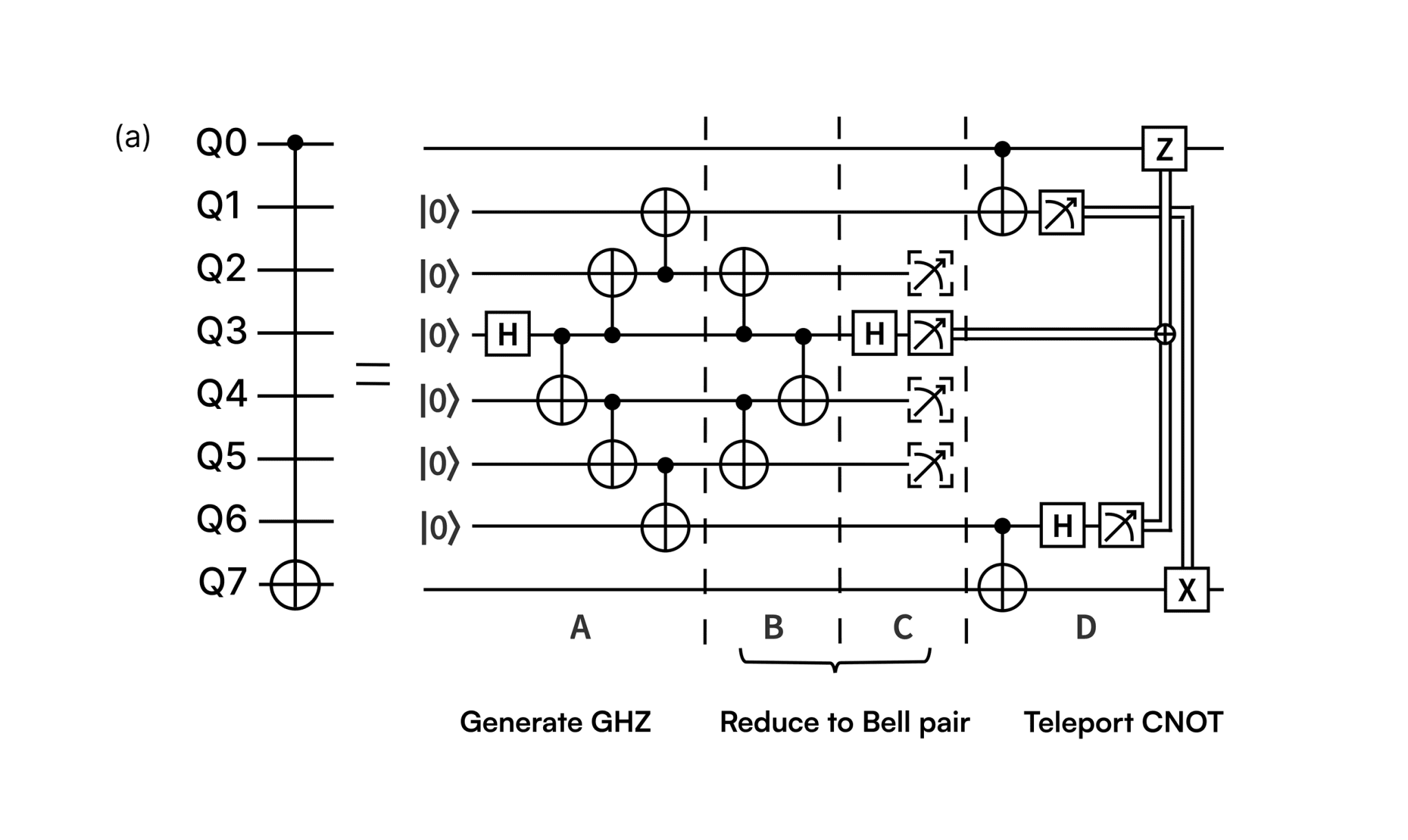
The company demonstrates a novel teleportation protocol for long-range CNOT gates, relying on GHZ state preparation and subsequent disentanglement, which reveals errors during gate application and achieves over 85% fidelity across up to 40 lattice sites—a level exceeding current alternatives. The implications of Q-CTRL’s work extend beyond improvements in fidelity and resource efficiency, offering a new paradigm for quantum error mitigation. Q-CTRL’s methodology offers a pragmatic path toward fault tolerance by demonstrating performance improvements on existing hardware without requiring full-scale quantum error correction.
More information
External Link: Click Here For More