Creating robust and efficient photonic circuits remains a significant hurdle in the development of practical quantum computers, and researchers are continually seeking ways to improve their performance. Gavin S. Hartnett, Dave Kielpinski, and Smarak Maity, all from Q-CTRL, alongside their colleagues, present a new automated framework for designing these circuits, specifically focusing on generating complex quantum states known as graph states. Their approach overcomes limitations of existing methods by employing a novel optimisation technique that efficiently searches for circuits with both high fidelity and a significantly improved probability of success, crucial for scaling up quantum computations. The team demonstrates this framework by discovering optimised circuits for creating graph states with up to five qubits, achieving success probabilities that outperform current state-of-the-art designs by up to an order of magnitude and, notably, realising the first known circuits for preparing certain five-qubit graph states. This advance represents a substantial step towards building larger, more reliable photonic quantum computers.
In the absence of complex manual design or traditional building methods, both post-selected circuits and sequential builds often suffer from rapidly decreasing success rates as complexity increases, motivating the development of automated methods for discovering higher-performing circuits.
Photonic Graph State Compilation and Optimization
This work focuses on developing practical methods for building and operating large-scale photonic quantum computers. Photonic systems are promising because photons are excellent carriers of quantum information and optical components are relatively mature. However, building fault-tolerant photonic quantum computers requires overcoming significant challenges, including scaling up the number of qubits, connecting them effectively, compiling abstract quantum algorithms onto physical hardware, optimising resource usage, and mitigating errors. Key areas of investigation include graph state generation and compilation, where the team explores methods for efficiently generating and manipulating graph states using photonic circuits.
This involves developing algorithms to map abstract quantum circuits onto the physical layout of a photonic chip, minimising the number of photons, gates, and measurement bases needed, and enhancing connectivity using techniques like teleportation. The research also focuses on creating software tools to automate the compilation, optimisation, and simulation of photonic quantum circuits, leveraging libraries like PennyLane, NetworkX, and PyTorch. These tools facilitate the development and testing of photonic quantum algorithms and enable automated differentiation for circuit optimisation and hardware calibration. Furthermore, the team designs and implements quantum algorithms specifically tailored for photonic hardware, exploring variational quantum algorithms and applications in machine learning and quantum simulation. They also address practical hardware challenges by developing calibration techniques, error mitigation strategies, and hardware-aware compilation methods. The work is grounded in theoretical foundations, applying graph theory, category theory, and quantum information theory to analyse and optimise quantum circuits.
High-Fidelity Graph State Circuits via Automated Design
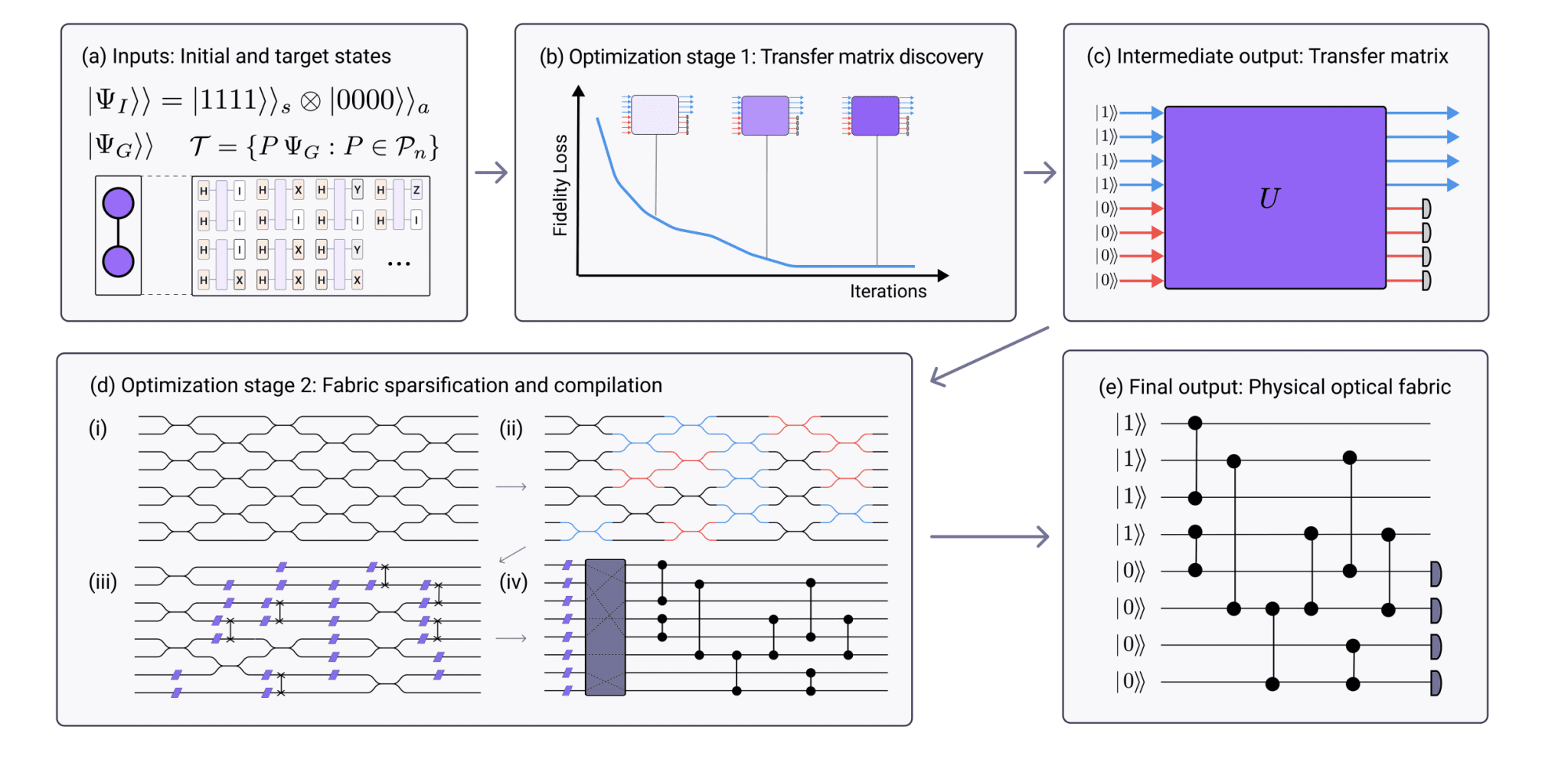
Researchers have developed a novel optimisation framework capable of discovering photonic circuits that prepare graph states with unprecedented fidelity and success probability, addressing a central challenge in linear optical quantum computing. The team’s automated approach systematically searches for circuits that maximise performance, surpassing the limitations of manually designed or traditional assemblies which typically exhibit decreasing yields as complexity increases. This breakthrough delivers circuits for 3-, 4-, and 5-qubit graph states, demonstrating a scalable method for generating essential quantum resources. Experiments reveal that the newly discovered circuits for 4-qubit states achieve success probabilities significantly higher than existing methods, up to 4.
7 times better. Even more significantly, the team achieved success probabilities for 5-qubit states that are up to 7. 5 times higher than previous methods, including the first known state preparation circuits for certain 5-qubit graph states. This process often reveals underlying mathematical structure, resulting in highly simplified circuits. Data confirms that this automated approach is not only scalable but also adaptable to different hardware constraints, making it well-suited for practical deployment in future quantum computing architectures.
Automated Design of Scalable Graph State Circuits
This research presents a new automated framework for designing photonic circuits that generate graph states, essential components in quantum computing. The team developed a two-stage optimisation process, leveraging a simulation technique to efficiently explore circuit designs and a sparsification algorithm to reduce circuit complexity. This approach successfully generates circuits for graph states with up to five qubits, achieving significantly improved success probabilities compared to traditional methods, up to a factor of 4. 7 for four qubits and 7. 5 for five qubits.
The framework reduces optical depth by over 80% and generates circuits operating on up to twenty modes with twelve photons. While current limitations exist due to computational resources, the theoretical prediction of polynomial scaling suggests future improvements are possible. Future work will focus on scaling the framework by leveraging distributed computing and expanding the algorithm to incorporate broader classes of target states, potentially leading to even higher success probabilities.
👉 More information
🗞 Automated discovery of heralded ballistic graph state generators for fusion-based photonic quantum computation
🧠 ArXiv: https://arxiv.org/abs/2508.16505