

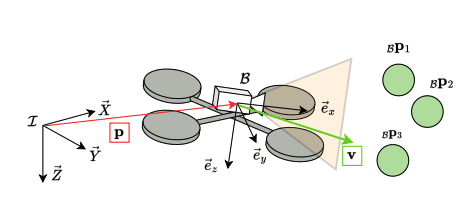
On April 22, 2025, researchers from Anki (now part of Apple) introduced a new navigation system for multirotors in their paper titled Embedded Safe Reactive Navigation for Multirotors Systems using Control Barrier Functions. Their approach employs control barrier functions to ensure safe obstacle avoidance without relying on localization or mapping, integrated into the PX4 autopilot stack. This framework was tested on a small multirotor, demonstrating effectiveness in dynamic environments.
This paper introduces a safety control architecture for autonomous aerial vehicles, designed for integration into open-source autopilots like PX4. Unlike existing methods requiring consistent localization and mapping, it uses composite control barrier functions based solely on onboard range measurements to ensure obstacle avoidance. The framework acts as a safety filter, modifying acceleration references from nominal control loops. Experimental validation with a multirotor demonstrates its effectiveness in dynamic environments, promoting the adoption of reliable safety filters for autonomous aerial systems.
In recent years, drones have evolved into sophisticated tools capable of navigating complex environments with precision. However, ensuring their safety in dynamic and unpredictable settings remains a critical challenge. Researchers have developed an innovative approach combining control barrier functions (CBFs) with predictive safety filters to enhance the reliability and robustness of autonomous drone navigation.
At the heart of this innovation lies the concept of control barrier functions (CBFs), a mathematical framework designed to ensure safety in dynamic systems. CBFs act as virtual boundaries that drones must adhere to, preventing collisions with obstacles or other hazards. Unlike traditional collision-avoidance algorithms, which often rely on reactive measures, CBFs are proactive, continuously adjusting the drone’s trajectory to maintain safe distances from potential threats.
The integration of CBFs with predictive safety filters represents a significant advancement in drone autonomy. Predictive safety filters allow drones to anticipate potential hazards before they become immediate threats, enabling more proactive decision-making. For example, if a drone detects an approaching obstacle, the system can adjust its trajectory to avoid collision while maintaining its intended path as much as possible.
The implications of this research are far-reaching. Drones equipped with CBFs and predictive safety filters could be deployed when human intervention is dangerous or impractical, such as search-and-rescue operations in disaster zones or agricultural monitoring in vast fields. These advancements contribute to safer and more efficient drone operations across various applications.
Despite these advancements, challenges remain. Uncertainty in dynamic environments and computational efficiency are key areas requiring further research. As technology progresses, integrating CBFs with predictive filters is expected to enhance drone capabilities, making them indispensable tools for a wide range of applications.
In conclusion, the development of CBFs and their integration with predictive safety filters marks a significant step forward in drone navigation. By addressing current challenges and continuing to innovate, researchers aim to unlock the full potential of drones, ensuring they operate safely and efficiently in an ever-expanding array of uses.
👉 More information
🗞 Embedded Safe Reactive Navigation for Multirotors Systems using Control Barrier Functions
🧠 DOI: https://doi.org/10.48550/arXiv.2504.15850


